NOAA’s official assessment addresses a deceptively simple question: Where does Earth’s oxygen come from? Scientists estimate that roughly half of the planet’s annual oxygen production occurs in the ocean. Most of that enormous output comes from photosynthetic plankton drifting through sunlit surface waters.
The finding reshapes the familiar picture of forests as Earth’s dominant oxygen factories. Trees remain essential to climate and biodiversity, yet mature forests consume close to the amount of oxygen they produce. Meanwhile, countless marine organisms carry out ocean oxygen production across an area covering more than two-thirds of the planet.
Earth’s largest oxygen factory
“Scientists estimate that roughly half of the oxygen production on Earth comes from the ocean,” NOAA explains. The estimate refers to oxygen produced through photosynthesis over time. It describes a global biological flow rather than the origin of each oxygen molecule entering a person’s lungs.
Most oceanic oxygen production takes place near the surface, where sunlight can penetrate the water. In this bright upper layer, microscopic phytoplankton absorb carbon dioxide and use solar energy to build organic matter. Oxygen is released during the process. Spread across the global ocean, this activity rivals all terrestrial photosynthesis combined.
The ocean’s invisible forest
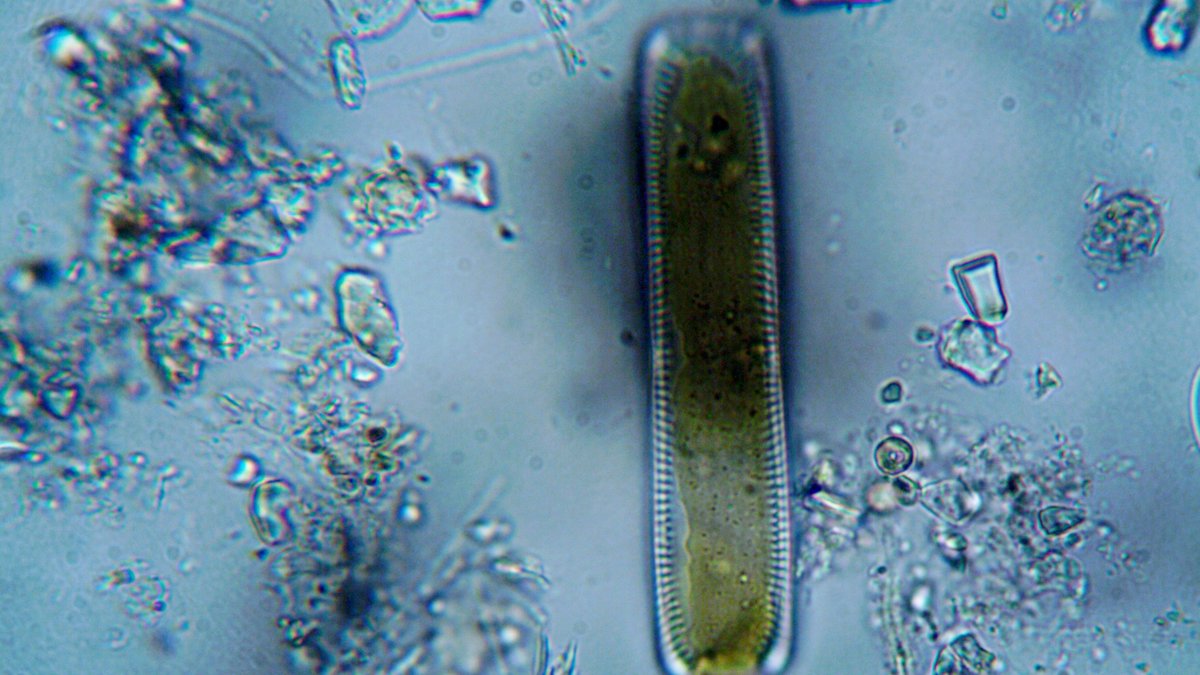
Phytoplankton include microscopic algae and photosynthetic bacteria. They drift with currents because many lack the ability to swim against moving water. Individually, most are invisible to human eyes. Together, they can grow into blooms large enough for satellites to detect from orbit.
Their abundance can be staggering. A teaspoon of productive seawater may contain as many as a million microscopic organisms, with phytoplankton forming a substantial share. These organisms grow quickly when light and nutrients are available. Many are eaten or infected within days, creating a biological turnover far faster than the growth cycle of a forest.
How phytoplankton make oxygen
The underlying chemistry is photosynthesis, the same energy-converting process used by plants on land. Phytoplankton capture sunlight with pigments such as chlorophyll. That energy helps transform carbon dioxide and water into organic compounds that support growth. Oxygen emerges as a by-product.
This process also links oxygen production to Earth’s carbon cycle. Every new phytoplankton cell contains carbon that was previously dissolved in seawater. Some of this carbon moves into zooplankton and fish. Some sinks as waste or dead biological material. Those pathways make phytoplankton central to both the atmosphere and the marine food web.
Prochlorococcus has an outsized role
One organism demonstrates how something microscopic can influence an entire planet. Prochlorococcus is among the smallest known photosynthetic organisms. It thrives across vast stretches of warm ocean and can reach extraordinary concentrations in clear, nutrient-poor waters.
According to NOAA, Prochlorococcus may account for up to 20 percent of oxygen production across the biosphere. Its contribution can exceed that of all tropical rainforests combined. This estimate reflects the organism’s immense global abundance rather than the output of any individual cell.
Why oxygen production changes constantly
Ocean productivity rises and falls with the seasons. Sunlight shifts as Earth moves around the Sun. Winds stir nutrients into surface waters, while currents carry plankton into new environments. Temperature and nutrient availability determine which organisms flourish and how quickly they photosynthesize.
“Calculating the exact percentage of oxygen produced in the ocean is difficult because the amounts are constantly changing,” NOAA states. Measurements from one region or season cannot describe the whole planet. The estimate of roughly half therefore represents the best global picture assembled from satellite observations, field measurements and biological models.
Conditions can also vary over much shorter periods. Photosynthesis increases during daylight and stops in darkness. Respiration continues throughout the day and night. Tides may bring nutrient-rich water into coastal regions, triggering rapid changes in plankton growth and local oxygen levels.
The ocean also consumes oxygen
The ocean’s annual oxygen output tells only one side of its oxygen budget. Marine animals breathe oxygen and phytoplankton use it during cellular respiration. Bacteria also consume oxygen while breaking down dead organisms and other organic material.
NOAA estimates that marine life consumes roughly as much oxygen as ocean photosynthesis produces. The same broad balance exists in mature rainforests. Trees release oxygen as they grow, while plants, animals, fungi and microbes use it during respiration and decay. Ecologists call the total amount created before these losses gross oxygen production.
This balance explains why the disappearance of phytoplankton would first devastate ocean ecosystems and disrupt carbon cycling. The atmosphere contains an immense supply of oxygen accumulated over geological time. Marine food chains would respond far sooner than atmospheric oxygen concentrations.
How ancient carbon burial built the atmosphere
Earth’s breathable air represents a reservoir assembled across hundreds of millions of years. Photosynthesis continually created oxygen, while respiration and decomposition removed much of it. A small share remained when organic carbon escaped decay and became buried in sediments.
This long-term carbon burial separated carbon from the oxygen produced alongside it. Repeated over geological ages, the imbalance allowed oxygen to accumulate in the atmosphere. The oxygen in a single breath may therefore have circulated through Earth’s air, water, rocks and living organisms for an immense span of time.
The modern atmospheric oxygen reservoir is large enough to persist through short-term changes in biological production. This creates a time lag between shifts in photosynthesis and changes in breathable air. Ocean ecosystems and the carbon cycle remain sensitive on far shorter timescales.
Satellites count plankton from space
Scientists cannot sample every ocean basin at every depth and season. Satellites supply the global view by measuring subtle changes in ocean color. Chlorophyll absorbs and reflects particular wavelengths of light, giving productive waters a different color signature from waters containing fewer phytoplankton.
Researchers use those measurements to estimate chlorophyll concentration and biological productivity. Earlier instruments such as SeaWiFS and MODIS created long-running global records. Their maps revealed seasonal blooms, productive coastal zones and broad regions where nutrient scarcity limits growth.
Satellite observations still require careful interpretation. Clouds can block the surface, while suspended sediment and dissolved material can alter water color. Sensors mainly observe the illuminated upper ocean. Researchers combine orbital data with measurements from ships, floats, buoys and laboratory studies to refine their estimates.
PACE reveals different plankton communities
NASA’s PACE mission entered orbit in February 2024 to provide a more detailed view of the ocean’s living surface. Its name stands for Plankton, Aerosol, Cloud, ocean Ecosystem. The mission also studies particles and clouds in the atmosphere, which influence how sunlight reaches Earth and returns to space.
PACE’s hyperspectral instrument measures ocean color across many closely spaced wavelengths. This added detail helps researchers distinguish broad communities of phytoplankton. Earlier sensors were highly effective at estimating chlorophyll, while PACE can reveal more about which groups are present.
That distinction matters because phytoplankton species behave differently. They vary in size, nutrient needs, growth rates and vulnerability to grazing. Their composition affects how carbon moves through marine ecosystems. It also shapes which animals can feed on a bloom and how much organic material may sink into deeper water.
As ocean temperatures and circulation patterns change, PACE can track shifts in these communities from season to season. The mission gives scientists a new way to observe the ocean’s biological response across entire basins rather than relying only on scattered sampling sites.
What Earth’s oxygen means for alien worlds
Oxygen is a leading target in the search for life beyond the Solar System. It reacts readily with rocks and gases, so a large atmospheric supply requires processes that continually maintain it. On Earth, biological activity has played the central role in sustaining that supply.
Earth also demonstrates why oxygen must be interpreted in planetary context. Its atmospheric abundance reflects biological production, chemical reactions, geological processes and the burial of carbon over vast timescales. A telescope observing Earth from afar would see the accumulated result of this long history.
Astronomers therefore treat oxygen as a potential biosignature whose meaning depends on the surrounding atmosphere and the planet itself. Companion gases, surface conditions, stellar radiation and geological activity can all influence the interpretation. The strongest evidence will come from several measurements that support the same explanation.
Closer to home, the ocean’s oxygen story reveals a living planetary system that can be monitored from orbit. The invisible forest changes every day as light, temperature, nutrients and currents reshape it. Through NOAA observations and missions such as PACE, scientists can watch those changes unfold across the global sea.