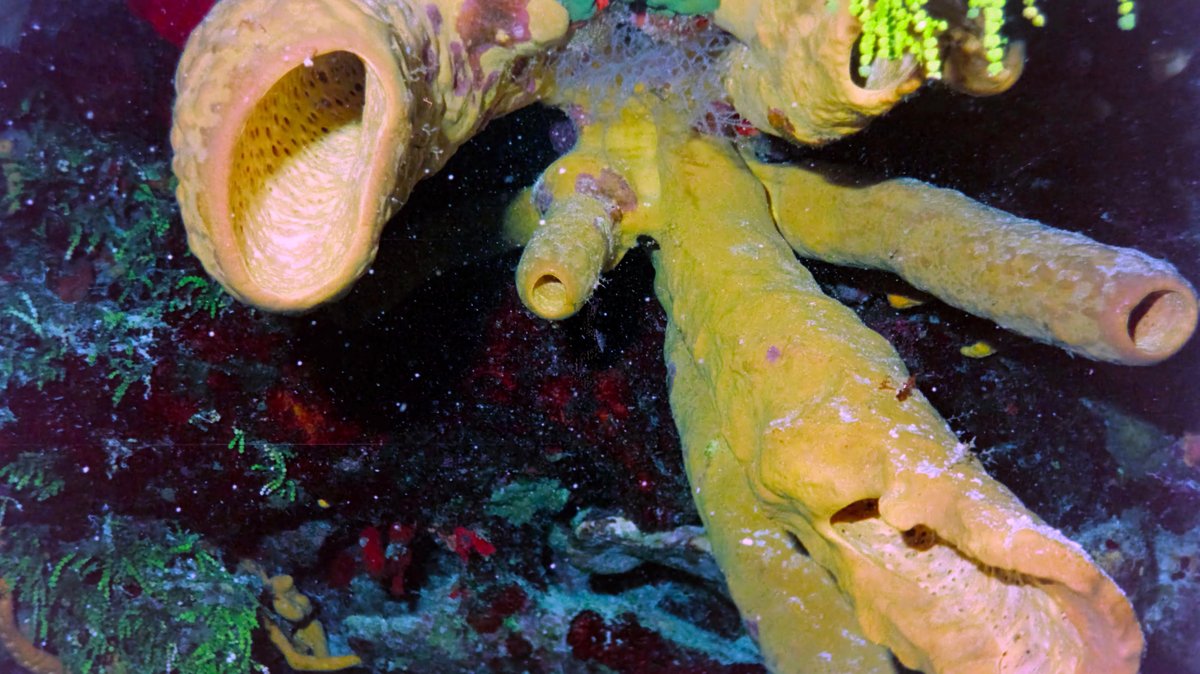
A Marine Biology study found that the Caribbean giant barrel sponge can grow so slowly that some individuals may live for thousands of years. Using repeated photographs and growth measurements, researchers estimated that one enormous specimen photographed off Curaçao may have been about 2,300 years old.
The animal was a giant barrel sponge, known scientifically as Xestospongia muta. It lived fixed to a reef, drawing seawater through its body day after day. If the age estimate is close, the sponge began life centuries before the Roman Empire reached its height.
That makes the Curaçao sponge one of the most striking examples of long life in the animal kingdom. Its story also shows how reef animals can shape their surroundings in quiet ways. A single sponge can filter large volumes of seawater, recycle nutrients and provide structure in a crowded underwater habitat.
A giant animal older than empires
The Curaçao specimen was unusually large. Reports tied to the research describe it as measuring nearly 2.5 meters across at its base. For a sponge, that’s enormous. For a reef animal that stays attached to the same patch of seafloor, it is a record of extraordinary persistence.
Marine biologists often call these animals the redwoods of the reef. The nickname fits their scale and their slow, steady growth. Like ancient trees, giant barrel sponges can stand out as living monuments in an ecosystem that is constantly changing around them.
The comparison has limits, since sponges do grow in a very different way from trees. A tree can be dated by counting rings. A sponge leaves no yearly archive inside its body. Researchers have to estimate age by measuring size, tracking growth and using mathematical models.
Even with that caution, the number is startling. An age of about 2,300 years would place the sponge’s birth in roughly the third century BCE. It could have been filtering Caribbean water while Rome and Carthage were fighting for control of the Mediterranean.
How a sponge survives for millennia
At first glance, a giant barrel sponge looks more like a hollow vase than an animal. Its body has no brain, heart, bones, or familiar organs. Yet its simple design is highly effective. Water enters through tiny pores, moves through a maze of internal channels and exits through the large top opening.
This way of life makes the animal a powerful filter feeder. Microscopic food particles, bacteria and organic matter are pulled from the water as it passes through the sponge’s tissues. The animal gains energy and the surrounding reef water is constantly processed.
The large top opening is called the osculum. It acts like an exhaust port for filtered water. In giant barrel sponges, the osculum can be wide enough to make the whole animal look like a natural chimney rising from the reef.
Sponges also have a body plan that has survived for hundreds of millions of years. Their cells can perform specialized jobs without forming complex organs. That simplicity may help explain why sponges are so resilient across evolutionary time.
Still, long life depends on local conditions. A sponge has to survive storms, sediment, predators, disease, changing water temperature and human impacts. The Curaçao animal’s size suggests that it avoided fatal damage for an astonishing span of time.
The slow math behind its age
The 2008 study used digital photographs of giant barrel sponges in the Florida Keys to measure growth over time. Researchers returned to the same sponges and compared images taken years apart. That allowed them to calculate how fast different individuals changed in size.
The results showed that growth can vary widely. Smaller sponges may expand faster, while older and larger individuals often add size much more slowly. This matters because a very large sponge cannot be aged by applying one simple growth rate from birth to death.
To solve that problem, the researchers used growth models. These models connect measurements such as base circumference and osculum diameter with observed growth patterns. The approach gives an estimate, rather than a direct count of years.
When those methods were applied to very large individuals, some age estimates reached remarkable values. The Curaçao sponge became the standout case. Its immense size led to the widely cited estimate of roughly 2,300 years.
That estimate should be read with care. Growth rates in living reefs can change with depth, food supply, water motion, disease and damage. The main scientific point remains powerful: giant barrel sponges can live far longer than most animals familiar to people.
A reef giant lost to disease
The ancient sponge’s life appears to have ended because of disease. Reports connected to the species describe outbreaks of Sponge Orange Band disease, a condition that damages giant barrel sponges and can spread across affected tissue.
In diseased individuals, orange bands or patches mark areas where tissue is dying. As the damaged zone advances, the sponge loses living tissue. A large animal that survived for centuries can decline rapidly once disease takes hold.
The Curaçao sponge is reported to have died during a period when sponge disease was affecting parts of the Caribbean. Its death highlights a difficult reality for long-lived reef organisms. An animal can survive vast stretches of history and still be vulnerable to sudden environmental stress.
Diseases in reef animals are especially concerning because many reefs already face pressure from warming waters, pollution, sedimentation and physical damage. Sponges can be hardy, but their survival still depends on the health of the wider reef system.
Why sponges matter to coral reefs
Giant barrel sponges are more than impressive oddities. On a coral reef, they help move energy and nutrients through the ecosystem. Their filtering activity processes seawater and can influence the availability of microscopic food and dissolved organic material.
Their bodies also create habitat. A large sponge adds three-dimensional structure to the reef. Small animals can live around it, hide near it, or use it as part of the reef’s complex architecture.
Because they are fixed in place, sponges also act as biological records of local conditions. Their growth reflects the environment around them. Long-term monitoring can reveal how reef communities change across years and decades.
The story of the Curaçao sponge gives that idea a deeper sense of time. A single animal may have lived through thousands of storms, countless reef seasons and dramatic shifts in human history. All the while, it carried out the same basic work: pulling water through its body and extracting what it needed to live.
For scientists, that kind of longevity raises important questions. Researchers still want to understand how giant barrel sponges manage damage, resist stress, recover from injury and interact with changing reef conditions. The answers could help explain why some simple animals endure for so long while the ecosystems around them face growing pressure.