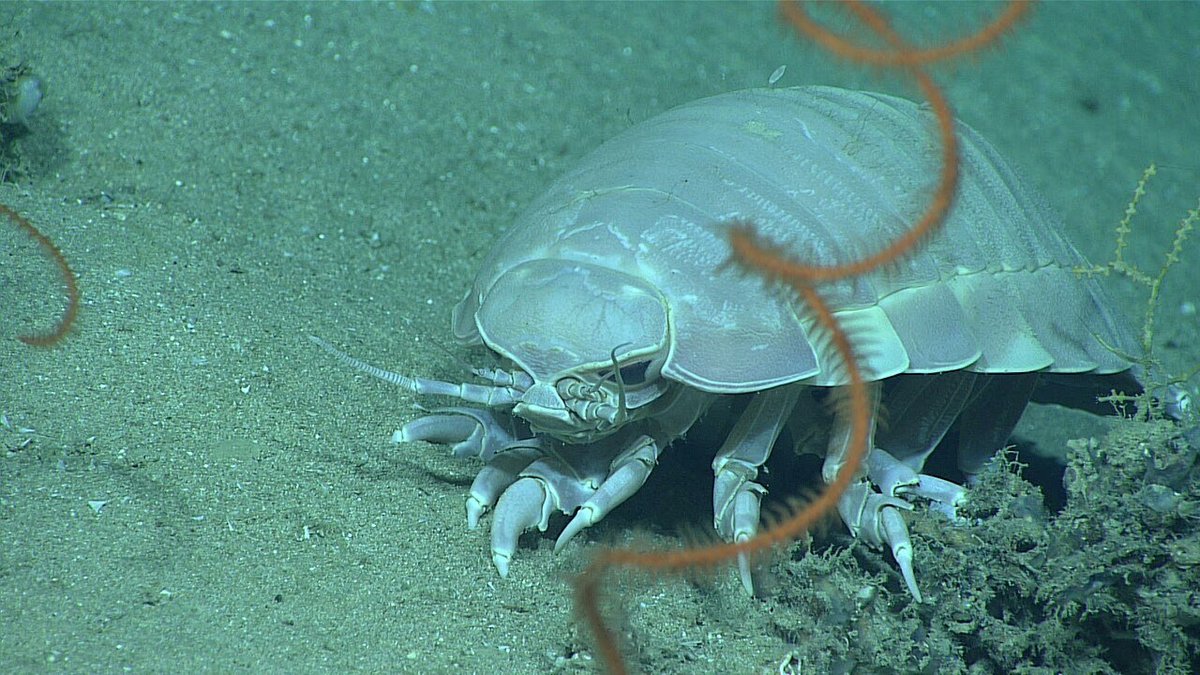
A study in Cell has revealed how a giant deep-sea isopod can survive more than five years without eating. Researchers linked this rare endurance to a two-part survival system, a huge stomach that stores scarce meals and a bacteria-derived gene that helps slow energy use in cold ocean depths.
The research, led by scientists associated with the Chinese Academy of Sciences and collaborators, focused on bathynomids, the oversized relatives of pill bugs that roam the deep seafloor. These animals live where food arrives unpredictably, often as falling scraps from the upper ocean or the remains of dead animals.
For a large animal, that lifestyle creates a biological puzzle. Bigger bodies usually need more energy. Yet Bathynomus species have evolved a way to keep their size while enduring long stretches of scarcity.
The team combined genome sequencing, physiological measurements, anatomical comparisons, behavior studies and microbial analyses. Together, those approaches showed how the animal can gorge when food appears, store reserves inside its body and then lower its energy use for the long wait that follows.
A Giant Built for Rare Meals
Deep-sea bathynomids live in a world shaped by absence. Sunlight fades long before their habitat. Plants cannot grow there. Reliable meals are scarce and survival depends on making the most of brief chances to feed.
The study examined two species from different depths. Bathynomus doederleini was associated with depths of about 300 meters. Bathynomus jamesi was studied from roughly 898 meters. By comparing these animals, the researchers could ask how life changes as food becomes harder to find.
Supergiant deep-sea isopods are especially striking because they are large for their environment. A bigger body can help an animal dominate carcasses and store more food after a feeding event. It also creates a demand for energy that must be controlled during famine.
The researchers found that the animals solve this problem through both body design and gene regulation. Their anatomy helps them capture and retain energy. Their metabolism then stretches that energy over time.
That pairing matters because deep-sea survival is rarely about a single trait. In these isopods, size, feeding behavior, digestion, microbes and genes all appear to work together.
The Stomach That Stores a Feast
One of the clearest findings was anatomical. The animals have a dramatically expanded digestive system. According to the study, the stomach can take up about two-thirds of the body.
This food-retentive stomach acts like a biological storage chamber. When food appears, the isopod can consume a large amount at once. The meal is then processed into a dense, paste-like reserve that remains inside the body.
That reserve gives the animal time. In the deep ocean, another meal may arrive days later, months later, or far beyond that. A stomach built for retention turns one rare feeding opportunity into a long-term supply.
The microbial results added another layer. The researchers reported relatively low levels of digestive bacteria in the stored material. They also found a higher concentration of Chlamydiae-related microorganisms, which were associated in the study with lipid storage.
These findings suggest that the gut contents are managed as an energy bank. The animal takes in a feast when it can, then draws on that stored material through a prolonged period of fasting.
A Bacterial Gene Rewired Energy Use
The genetic results were the study’s most surprising twist. The team identified a gene called ND1 that appears to have come from an external symbiotic bacterium. Over evolutionary time, that gene became integrated into the isopod genome.
This process is known as horizontal gene transfer. It occurs when genetic material moves between organisms in the same generation. In this case, the transferred gene appears to have become part of the animal’s own energy-control machinery.
ND1 drew attention because it was linked to metabolic slowdown. The study found that it helps regulate the mitochondrial metabolic network, the system cells use to manage energy production. Mitochondria are often described as cellular power centers and tuning their activity can change how quickly reserves are spent.
The gene also appears to have gone through post-transfer duplication and unusually high expression. In plain terms, the isopods seem to have amplified the use of this borrowed tool. That may help explain how a gene with microbial origins became important in a large deep-sea animal.
Yuan Jianbo, first author of the study, described the broader importance of the finding by saying, “Our work not only deciphers the mystery of ultra-long starvation tolerance in deep-sea isopods, but also provides an important paradigm for understanding how life balances growth and survival in extreme environments.”
Cold Water Makes the Trick Work
The deep sea is cold and that detail is central to the discovery. Low temperatures naturally slow many biological reactions. For bathynomids, the cold appears to help the ND1-linked system conserve energy more effectively.
The study connected ND1 activity with a reduction in energy production under conditions that resemble deep-sea environments. This form of cold-induced metabolic suppression means the animal can maintain basic survival while spending less fuel.
That matters after feeding. Once the stomach is filled, the animal benefits from spending its stored reserves slowly. A lower basal metabolic rate helps stretch that reserve across months or even years.
The result is a body plan suited to feast-and-famine living. The animal can remain large enough to exploit rare food falls. It can also shift into a low-use state when the ocean offers little.
This balance is delicate. If metabolism falls too far, essential processes fail. If it stays too high, the animal burns through its reserves. The study suggests ND1 helps fine-tune that middle ground.
Zebrafish Tests Revealed a 37% Survival Boost
To test the role of ND1 more directly, the researchers used functional experiments in other systems. These included transgenic zebrafish, nematodes and human 293T cells.
The experiments showed that context matters. At normal temperatures, introducing the gene was linked with lower tolerance to nutrient deficiency. Under low-temperature conditions that simulate deep-sea metabolic suppression, the result changed.
In zebrafish, ND1 increased starvation tolerance by 37% under low-metabolism conditions. That result gave the researchers experimental support for the idea that the gene helps conserve energy when cold conditions already push metabolism downward.
The cell and animal tests also connected ND1 with reduced mitochondrial activity. By lowering energy-production signals, the gene appears to help slow the drawdown of stored reserves.
These experiments do have limits. Zebrafish, nematodes and cultured human cells are testing systems. They help reveal what the gene can do, while the deep-sea isopod remains the animal where this survival system evolved.
What This Says About Life in the Deep Ocean
The finding gives scientists a clearer view of how large animals can persist in habitats with severe food scarcity. The bathynomid strategy combines storage, restraint and genetic adaptation.
For deep-sea biology, that combination is important. Many animals in the abyss live with long intervals between meals. The Bathynomus system shows one route by which evolution can support a large body in a low-energy world.
The study also expands the role of microbial genes in animal evolution. A gene that began in a bacterium appears to have become useful for a deep-sea crustacean. That kind of transfer can open new evolutionary possibilities when the gene fits a difficult environment.
The researchers framed the discovery as a way to understand energy trade-offs in extreme environments. Large size can be useful. Survival during famine requires restraint. Bathynomids appear to manage both through a stomach built for rare meals and a gene system tuned to cold scarcity.
Much remains to explore. Future work could clarify how widespread this strategy is among deep-sea animals and how microbial genes become stable parts of animal genomes. For now, the giant isopod offers a vivid example of life stretching one meal across an astonishing span of time.