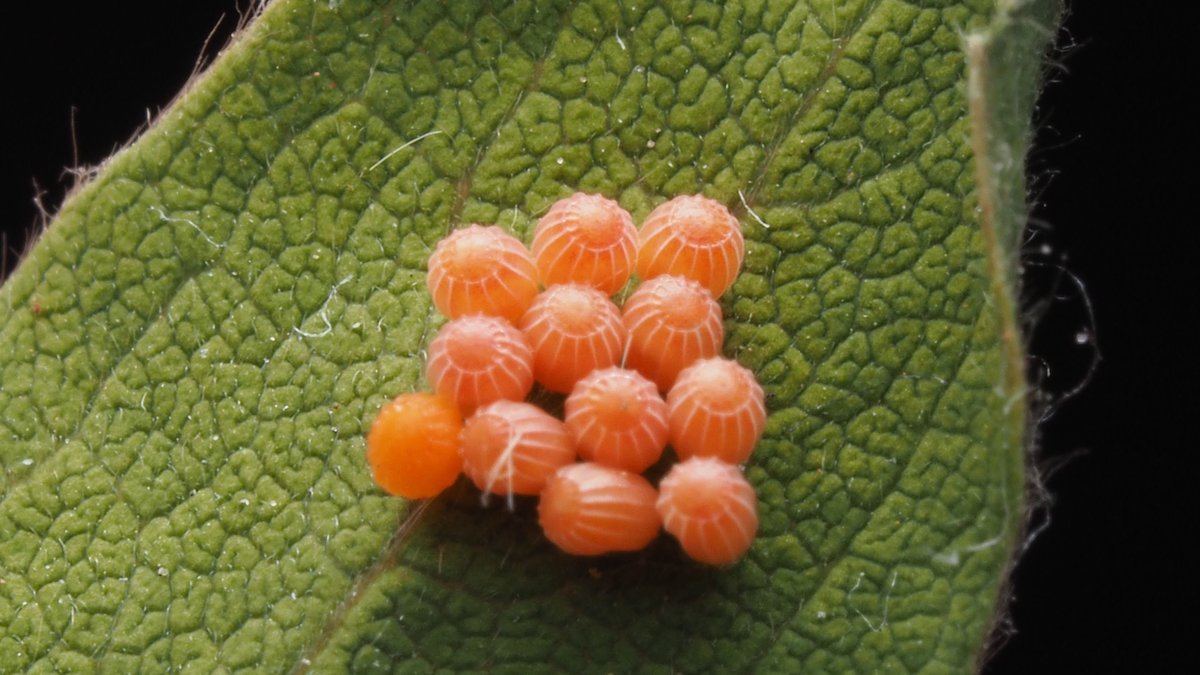
A study in the Zoological Journal has revealed that citizen-science observations helped more than double the known evidence for parental care in harvestmen, a diverse group of arachnids known for unusually devoted egg guarding. Led by Glauco Machado of the University of São Paulo, the research used iNaturalist records alongside nearly three decades of field and laboratory data to reconstruct how care by mothers and fathers evolved in the superfamily Gonyleptoidea.
The result is a rare evolutionary map of parenting behavior in animals where fathers often take center stage. The team found that guarding eggs has appeared, vanished and reappeared several times in the history of these arachnids. That pattern suggests parental care in harvestmen is unusually flexible, shaped by different pressures across lineages and environments.
Harvestmen are often mistaken for spiders, although they belong to a different arachnid order called Opiliones. More than 6,900 species are recognized worldwide. Their small share of arthropod diversity hides a striking fact, they account for more than half of the independent origins of paternal care known among arthropods.
iNaturalist Doubled the Evidence
The study combined published records, field observations, laboratory data and a systematic search of iNaturalist, a platform where people upload georeferenced photos and observations of organisms. That mixture allowed the researchers to widen the record of parental behavior far beyond what traditional studies had captured.
Before this work, scientific literature from 1936 to 2025 documented parental guarding behavior in 80 harvestmen species. The new study added 85 records of parental behavior, including 78 records of maternal or paternal care and seven records of no care. Sixty-two of the new records came from iNaturalist alone.
This matters because parental behavior can be hard to catch in the wild. A researcher has to find the right animal, at the right time, in the right place. A public photo database changes the scale of the search. Thousands of observers can document moments that would be easy for a small research team to miss.
Machado and colleagues used these observations to assemble a broader picture of behavior across harvestmen. They then mapped those records onto a newly assembled evolutionary tree of 165 species across nine families. That allowed the team to ask how many times care appeared, how often it disappeared and whether male and female care followed the same evolutionary routes.
The study shows how ordinary wildlife observations can become data for large-scale evolutionary questions. A phone photo of an arachnid guarding eggs can help researchers track one of the strangest patterns in animal parenting.
Why Harvestmen Make Rare Fathers
Male-only care is uncommon across much of the animal kingdom. In many species, females provide most of the care because they invest heavily in eggs or young. Harvestmen offer a different view of family life, since males in some species guard eggs alone.
That makes paternal care in harvestmen especially valuable for evolutionary biology. It gives researchers a natural system for asking why a male would spend time protecting offspring instead of searching for additional mates. Guarding eggs can be risky and costly. A caring male may lose feeding time, expose himself to predators, or miss other reproductive chances.
At the same time, egg guarding can make a male more attractive. In species where females prefer males already caring for eggs, a guarded clutch may serve as a visible signal. A male with eggs can look like a proven partner. More females may then add their eggs to his clutch.
This idea is known as enhanced fecundity. In simple terms, care may become part of courtship. A male guards eggs, females respond to that behavior and the male gains more reproductive success. Over evolutionary time, this feedback can favor males that continue guarding.
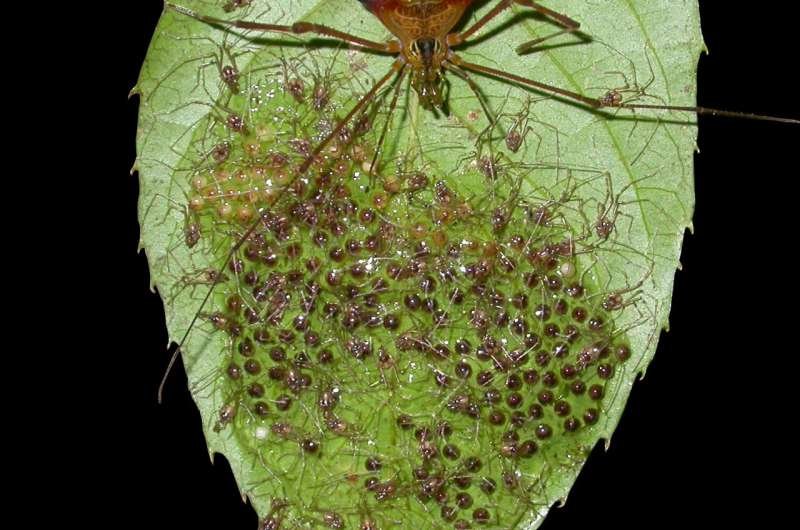
Harvestmen are well suited for this question because paternal care evolved independently many times within the group. That repeated pattern lets scientists compare lineages. If the same behavior appears in different branches of the family tree, researchers can look for shared conditions that might have pushed evolution in the same direction.
Two Routes to Paternal Care
The study focused on Gonyleptoidea, the clade that contains the most documented examples of care in harvestmen. By placing behavioral records on a supertree, the team reconstructed likely changes across evolutionary history.
The clearest difference involved the origins of male and female care. The researchers found that maternal care arose from ancestors with no care. That pattern resembles what has been seen in insects, where female guarding or attendance often appears directly from a no-care ancestor.
Male care followed a more varied path. According to the study, paternal care evolved from ancestors with no care and also from ancestors with maternal care. That second route is especially intriguing because it suggests a shift in which the caring role moved from females to males in some lineages.
These routes point to different selective pressures. When male care evolves directly from no care, egg protection may have become favorable under ecological conditions that rewarded guarding. When male care evolves from maternal care, sexual selection may have played a larger role. In those cases, female preference for caring males could help explain why males took over egg attendance.
The study describes these changes as evolutionary transitions. Each transition marks a shift in the behavior likely shown by ancestors and descendants. By comparing many species at once, the researchers could move from isolated natural-history notes to a broader evolutionary reconstruction.
When Egg Guarding Disappears
Parental care in harvestmen also appears to disappear repeatedly. The study found frequent transitions from care back to no care in both sexes. That pattern is important because it shows that guarding eggs can be lost when other strategies reduce the need for constant attendance.
Egg guarding brings benefits, especially when predators, parasites, fungi, or environmental stress threaten exposed eggs. A parent can clean eggs, defend them, or deter small attackers. Those benefits may be strong in some habitats and weaker in others.
Some harvestmen may protect eggs in other ways. The study points to egg laying in hidden sites and the use of debris coverings as possible alternatives. A well-hidden clutch may need less active guarding. A covered clutch may avoid attention from enemies. These strategies can reduce the value of prolonged parental attendance.
That trade-off helps explain why parental guarding behavior can be evolutionarily labile. If care is costly, lineages may lose it when safer nesting options become available. If exposed eggs face heavy danger, care may become favored again. Over time, this push and pull can produce repeated gains and losses.
For general readers, the key point is that parenting behavior evolves like other traits. It responds to costs, benefits, mating opportunities and ecological risks. In harvestmen, those pressures have created a surprisingly rich record of mothers, fathers and unattended clutches across related species.
Why Taxonomists Still Matter
Citizen science greatly expanded the record, although the study also highlights the need for expert verification. A photograph can reveal an animal near eggs, but specialists are needed to identify the species and interpret the behavior correctly.
Taxonomists play a central role in that process. They provide names, refine classifications and separate species that may look similar to non-specialists. Without that expertise, a large collection of images can become difficult to use for evolutionary analysis.
The challenge is especially sharp for harvestmen. Many species are small, cryptic, or poorly known. Some groups require close attention to body shape, locality and reproductive structures. A record that looks simple at first glance can involve a difficult identification.
Behavioral interpretation also requires care. An individual standing near eggs may be guarding offspring. In another case, it may be involved in mating, feeding, or sheltering. Researchers need enough visual and biological context to distinguish parental care from superficially similar behaviors.
This is where large public platforms and specialist knowledge work best together. Citizen observers increase reach. Experts increase reliability. The study’s strength comes from bringing those roles into the same research pipeline.
A Faster Way To Study Evolution
The pace of discovery was one of the most striking parts of the project. Records that would have required extensive travel, museum visits, or years of fieldwork could be found through a targeted search of iNaturalist. According to the research summary, many of the useful records were gathered in only days.
That speed has special value for scientists with limited access to major collections or costly field expeditions. Citizen science can lower barriers, especially for researchers in the Global South. A global database can bring distant observations into reach without requiring a global travel budget.
The approach also expands the kinds of questions researchers can ask. Natural-history records often begin as scattered notes. Once enough records accumulate, they can support macroevolutionary analyses. That means scientists can study broad patterns across many species, rather than describing one behavior at a time.
The study in the Zoological Journal of the Linnean Society offers a clear example. The team used public observations to fill major gaps in the presence and absence of care. Then they used those data to infer how maternal and paternal guarding changed across a major arachnid group.
There are limits. Observers are more likely to photograph striking behaviors than ordinary absence. A parent guarding eggs is easier to recognize and more likely to be uploaded than a hidden clutch with no adult nearby. The researchers account for that challenge by treating new records as valuable additions rather than a complete census of every species.
Even with those limits, the study shows how fast biodiversity knowledge can grow when professional science and public observation overlap. For harvestmen, a group already famous among biologists for devoted fathers, that overlap revealed an even more dynamic story. Male and female care have shifted repeatedly through time and the next clue may already be sitting in someone’s wildlife photo archive.