A study in PLOS One found that the plant-eating dinosaur Nigersaurus taqueti had one of the most extreme dental systems ever identified in a dinosaur. Its mouth held roughly 500 teeth and the study estimated that each tooth could be replaced about every two weeks.
That finding turned a strange Cretaceous herbivore into a vivid example of how evolution can shape an animal around a single daily challenge. For Nigersaurus, the challenge was eating low plants near the ground while grit and tough vegetation constantly wore its teeth away.
The animal lived about 105 million years ago in what is now the Republic of Niger. It belonged to the long-necked dinosaur group known as sauropod dinosaurs, yet its skull and feeding system were unusually specialized. Its broad muzzle faced downward and its teeth formed compact batteries at the front of the jaws.
A strange sauropod from Niger
The story of Cretaceous Niger began with fossils collected from the Sahara during French expeditions led by paleontologist Philippe Taquet between 1965 and 1972. Those expeditions recovered many remains from the Gadofaoua region. Among them were bones from a sauropod that would later become famous for its delicate skull and crowded mouth.
Years later, paleontologist Paul Sereno and colleagues returned to the same fossil region. Their work produced additional material and helped clarify the animal’s identity. In 1999, the dinosaur was formally described as Nigersaurus taqueti, a name that honors Niger and Taquet’s early fieldwork.
Nigersaurus was modest by sauropod standards. Estimates place it at about 30 feet long and roughly two tons in weight. Even so, its body plan was surprising. Its neck was relatively short for a sauropod and its skull bones were so thin that some required especially careful handling during preparation.
The fossils showed an animal built with lightness in mind. Air-filled spaces extended into several bones, a feature also seen in modern birds. These spaces helped reduce weight while preserving support in a large-bodied animal.
A mouth packed with replacement teeth
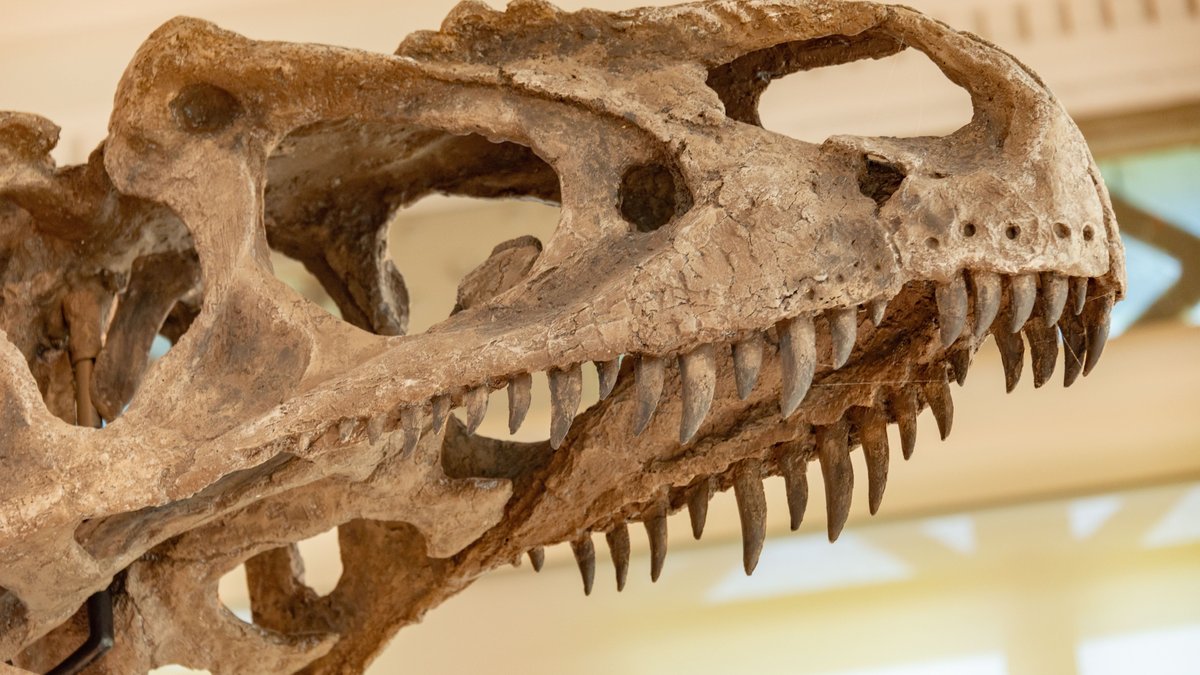
The most famous feature of Nigersaurus sits at the front of its face. Its jaws carried tightly organized tooth batteries, with many teeth lined up in a wide, squared-off muzzle. The arrangement gave the dinosaur a cutting edge suited for cropping plants close to the ground.
At any moment, only some teeth were exposed and working. Behind them, more teeth were already forming. The fossils show that replacement teeth were stacked in columns, ready to move forward as older teeth wore down.
This system made Nigersaurus a nonstop tooth factory. For each functional tooth, several replacements could be waiting deeper in the jaw. That queue mattered because the animal’s feeding style created heavy wear.
The broad muzzle also shaped how scientists interpret its behavior. Rather than taking high vegetation from trees, Nigersaurus appears to have fed low to the ground. Its face was built for sweeping or cropping plants across a broad surface.
How scientists timed tooth growth
The 2013 PLOS One study examined how tooth replacement evolved in sauropods. Researchers compared tooth formation and replacement patterns across several sauropodomorph dinosaurs. Their work used measurements from teeth and growth records preserved inside fossil dental tissue.
Teeth can preserve daily growth marks, somewhat like tiny time stamps. By counting those microscopic lines and comparing the size of developing replacement teeth, scientists can estimate how long each tooth took to form. From there, they can calculate how quickly a new tooth moved into place.
For Nigersaurus, the result was extraordinary. The paper states, “Nigersaurus is estimated to have replaced each tooth as often as once every 14 days.” That rate was faster than the estimates reported for other sauropods in the study.
The same study placed Nigersaurus within a broader evolutionary pattern. Sauropods did vary widely in tooth shape, tooth size and replacement speed. Some had larger, longer-lasting teeth. Others evolved faster turnover and smaller teeth.
This matters because teeth record feeding pressures in a durable way. Bones can show posture and size, but teeth capture repeated contact with food. In Nigersaurus, the dental evidence points to an animal whose mouth was constantly renewing itself.
Why grazing wore the teeth down
Low-growing plants can be rough on teeth. Horsetails and other ancient vegetation often contain silica, which gives plant tissues an abrasive quality. Plants near the ground can also collect sand and dust, especially in dry environments.
For a grazing dinosaur, that mix would act like natural sandpaper. Each bite could grind down the cutting surfaces. Rapid tooth replacement gave Nigersaurus a steady supply of sharp new edges.
The wear pattern fits the shape of the mouth. Nigersaurus had a wide muzzle with teeth clustered at the front. That design suggests a feeding style based on cropping vegetation in repeated bites.
Its jaws seem specialized for slicing plant material rather than crushing it. The teeth slid past one another in a shearing motion. That kind of action can be efficient, but it also places steady stress on the teeth.
The dinosaur’s dental system offers a clear evolutionary tradeoff. Nigersaurus grew many small teeth quickly. That approach helped the animal keep eating as older teeth were worn away by abrasive food and grit.
CT scans revealed its delicate skull
The skull of Nigersaurus has been especially important because complete skeletons remain unavailable. Scientists reconstructed the animal from fossils belonging to multiple individuals. That made digital methods valuable for arranging fragile pieces without forcing them into place by hand.
Researchers used CT scans to look inside skull bones and vertebrae. The scans revealed internal spaces, bone thickness and hidden details that ordinary surface study could miss. This helped scientists rebuild the skull and test how the head may have been held in life.
Those scans supported the view of Nigersaurus as a ground-oriented feeder. Its muzzle appears to have pointed downward in a natural head position. That posture fits its broad dental battery and its apparent habit of feeding on low vegetation.
The same imaging work highlighted how delicate the skull was. Some skull bones were extremely thin, even for a dinosaur with air-filled skeletal features. Paleontologist Jeff Wilson Mantilla has described the skull bones as strange enough that identifying them was challenging.
Together, the fossils and imaging show an animal with an unusual combination of traits. Nigersaurus had a large body, a lightweight frame, a delicate head and a mouth that renewed itself with remarkable speed. Its 500-tooth system gives paleontologists a rare view of how feeding, wear and replacement can reshape an entire skull.