A study in Science has opened a rare window into one of evolution’s deepest mysteries: how complex animals began to take over Earth’s oceans before the famous Cambrian explosion. The fossils, found in southwest China, include evidence for animals linked to deuterostomes, the great branch of life that includes humans and our closest invertebrate relatives.
The discovery comes from the Jiangchuan biota in eastern Yunnan, a fossil assemblage dated to the final stretch of the Ediacaran period. These rocks preserve a community that lived roughly 554 million to 539 million years ago, just before the Cambrian world burst into view in the fossil record.
For decades, paleontologists have debated whether complex animal groups appeared abruptly during the Cambrian period or began diversifying earlier. The new fossils suggest that several recognizable animal lineages were already present during the late Ediacaran. In the words of the Science abstract, “Animal diversification across the Ediacaran-Cambrian transition was a crucial event in Earth history.”
A fossil window before the Cambrian explosion
The Cambrian explosion has long stood as one of the great turning points in the history of life. Around 538 million years ago, the fossil record begins to show a striking variety of animals with bodies that look more familiar to modern eyes. Arthropods, echinoderms, worms and other groups appear with new shapes, new behaviors and more complex ways of living.
That burst of diversity created a scientific puzzle. If so many animal body plans were present in the Cambrian, their ancestors had to come from somewhere. Yet the rocks just before the Cambrian often preserve organisms that seem strange, soft and hard to classify.
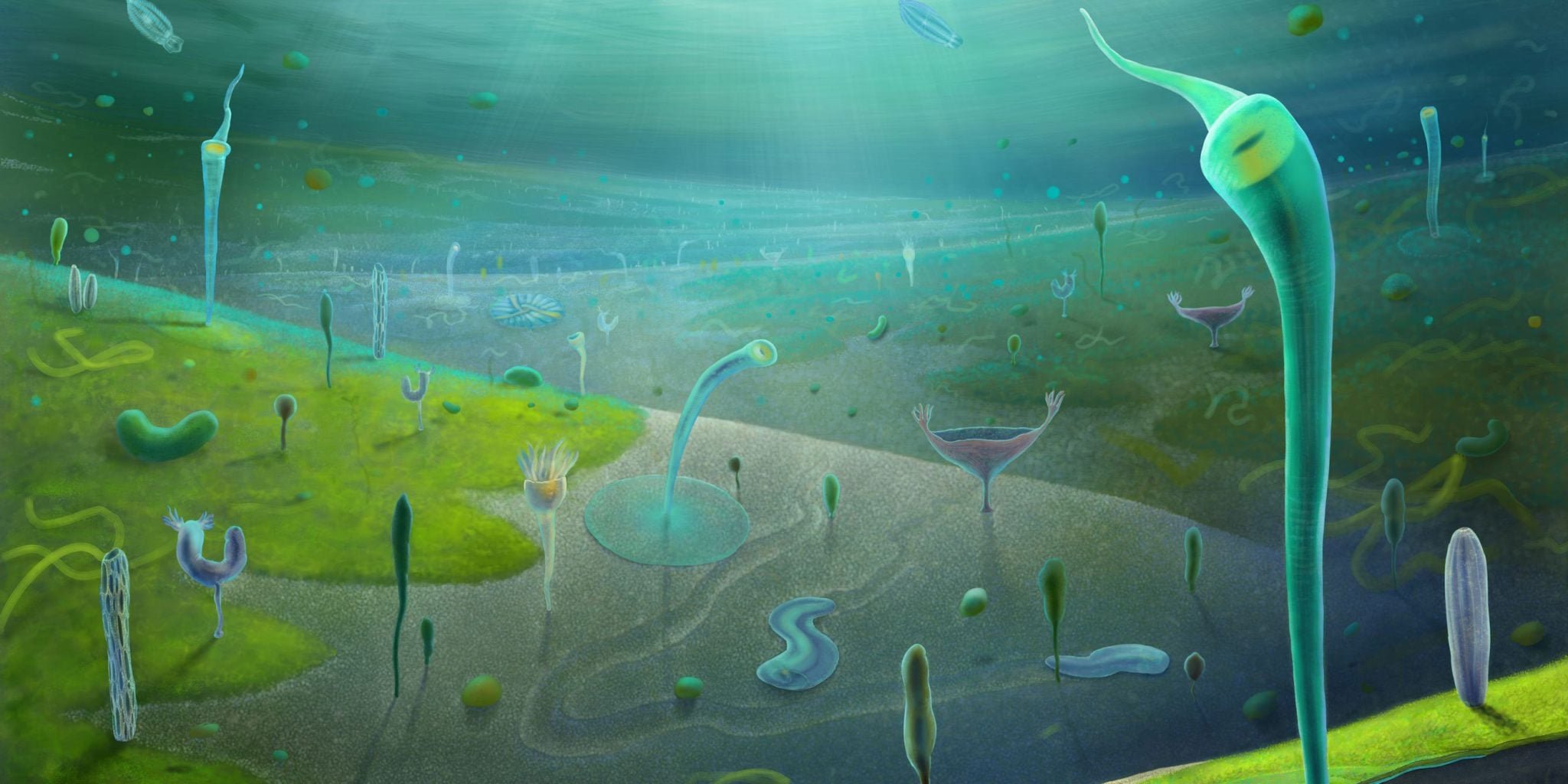
The Jiangchuan fossils help fill that gap. They preserve a community from the late Ediacaran that contains both odd ancient forms and animals with clearer links to later Cambrian groups. That mix makes the site unusually valuable. It captures a transition rather than a single frozen moment in evolutionary history.
Researchers studying these fossils argue that the roots of complex animal life reach deeper into time than the Cambrian explosion alone suggests. The Cambrian still marks a dramatic expansion in the fossil record. The new find adds an earlier chapter, with animal groups already experimenting with body plans and ecological roles.
The strange world of the Ediacaran
The Ediacaran period lasted from about 635 million to 538 million years ago. It was the final period before the Cambrian and its fossil record looks unlike the animal worlds that followed. Many Ediacaran organisms had soft bodies shaped like quilted fronds, discs, tubes, or flattened sacs.
Some lived on or near microbial mats that covered parts of the seafloor. These mats formed broad living surfaces in shallow marine environments. Animals that grazed, burrowed and churned sediment later transformed that kind of ecosystem.
Classifying Ediacaran organisms has always been difficult. Some fossils have been interpreted as simple animals, while others have been compared with fungi, lichens, algae, or extinct life forms with no living descendants. Recent studies of growth and reproduction have strengthened the case that at least some Ediacaran organisms were animals, although many belonged to branches that left no modern representatives.
The Jiangchuan biota adds clarity because it preserves recognizable complexity in the same broad interval. The site includes organisms that resemble Ediacaran forms, along with fossils closer to Cambrian-style animals. That combination gives paleontologists a way to study how one world blended into the next.
A hidden animal community in Yunnan
The fossils were discovered in eastern Yunnan, China, in rocks already known for preserving delicate ancient life. The work began during field studies focused largely on fossil algae. As researchers split open the rock layers, they began finding animals that hinted at a richer ecosystem than expected.
Gaorong Li, then a PhD student at the Yunnan Key Laboratory for Palaeobiology, was part of the team exploring these Ediacaran deposits. The study also involved researchers including Wei Fan, Peiyun Cong and colleagues from the University of Oxford. Together, they assembled a picture of a fossil community from the last millions of years before the Cambrian.
The Jiangchuan fossils are important because they preserve body fossils rather than only traces of behavior. Late Ediacaran rocks have yielded trails and burrows that suggest animals were moving through sediment. Those traces show activity, yet they reveal little about the bodies that made them.
Body fossils tell a different kind of story. They can preserve outlines, attachment structures, tentacles, stalks and other anatomical clues. In the Jiangchuan biota, those details point to a diverse community that included animals with complex forms and varied ways of feeding or living on the seafloor.
The “bugle worm” and other complex bodies
One of the most striking finds was a strange wormlike animal that researchers nicknamed the bugle worm. It appears to have lived attached to the seafloor by an anchoring disc. Its body included a proboscis that could turn inside out, likely helping it collect food.
Earlier fossils had preserved only the disc-shaped structure, which had been described under the name Cycliomedusa. The new specimens revealed the full organism. That broader view changed the scientific picture, because the disc was part of a more complex animal rather than an isolated mysterious form.
Other fossils from the Jiangchuan biota also point to a more varied late Ediacaran ecosystem. The assemblage includes organisms that resemble forms previously known from the Cambrian. These include a primitive animal similar to Mackenzia, along with worms and possible swimming predators known as ctenophores.
The presence of these animals matters because Cambrian fossils are often easier to place into living or extinct animal groups. Finding comparable forms in the late Ediacaran suggests that the assembly of animal ecosystems was already underway. The fossil record becomes less like a sudden appearance and more like a sequence of earlier experiments preserved in scattered windows.
Ancient relatives of starfish and acorn worms
The most eye-catching part of the discovery involves fossils interpreted as the oldest evidence for deuterostomes. This is the major animal branch that includes vertebrates, along with echinoderms such as starfish and sea urchins. It also includes hemichordates, a group represented today by acorn worms.
Humans belong to the deuterostome branch through the vertebrate line. That makes living starfish and acorn worms some of our closest invertebrate relatives. The Jiangchuan fossils extend the story of that branch back into the Ediacaran world.
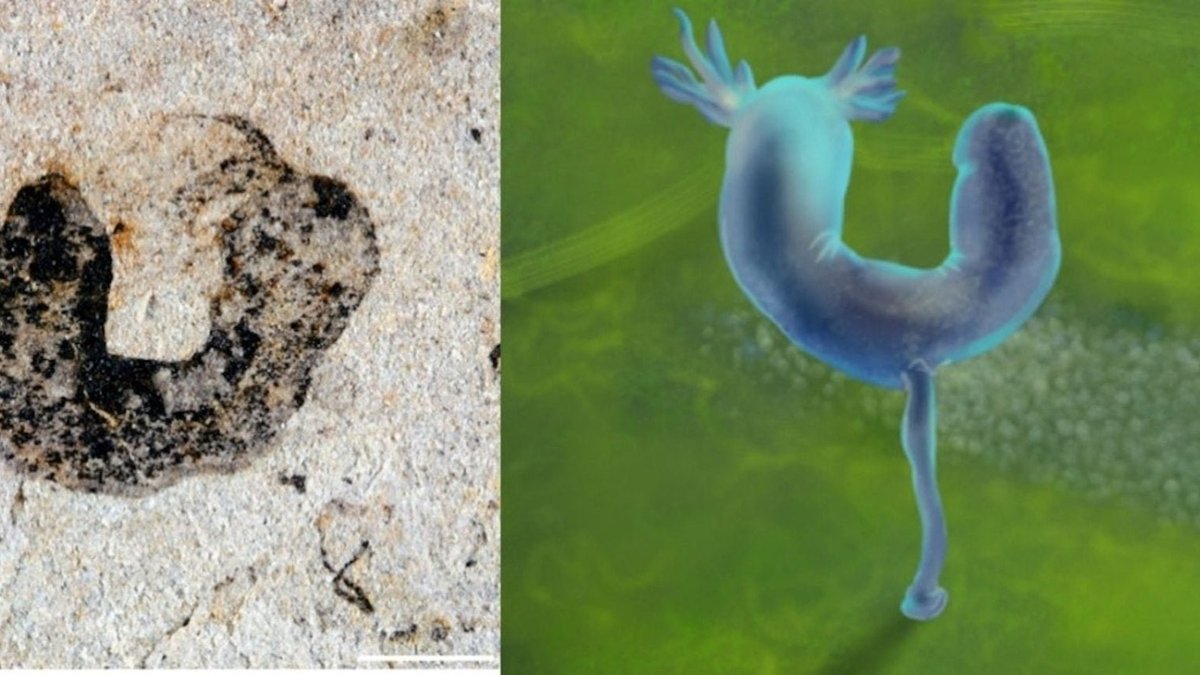
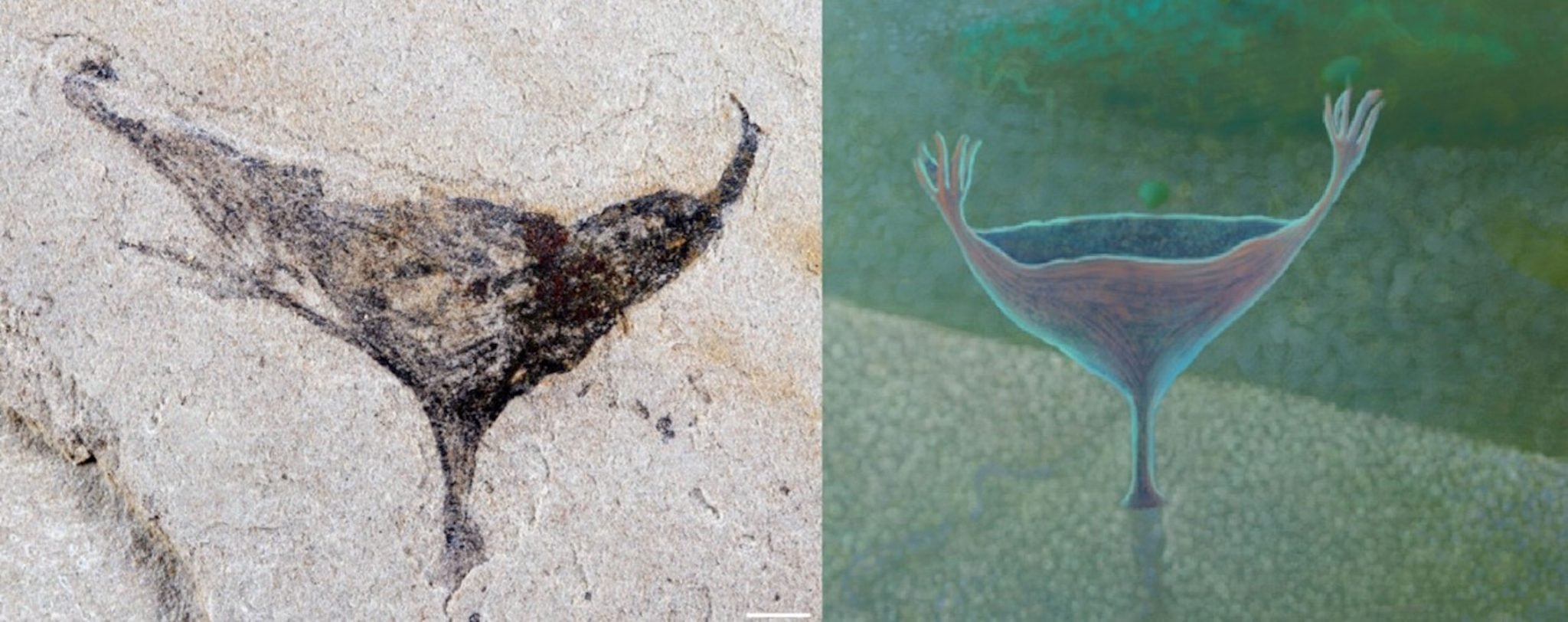
Several specimens have a stalk and tentacles. The researchers report that they closely resemble cambroernids, an extinct Cambrian group linked to living echinoderms and acorn worms. Those features are central to the claim that the fossils capture early relatives of the lineage that eventually led to animals like us.
This does not mean the fossils look human in any ordinary sense. Their importance lies in evolutionary branching. They appear near the base of a deep family tree, in a time when the ancestors of modern animal groups were still taking shape in ancient seas.
That connection gives the Jiangchuan biota unusual public resonance. A fossil only a few millimeters across can sit close to one of the oldest visible roots of the lineage that later produced vertebrates. It links the soft-bodied world of the Ediacaran to the richer animal ecosystems of the Cambrian.
Why the discovery rewrites the animal timeline
The Jiangchuan biota suggests that complex animals shared Ediacaran seafloors with stranger ancient organisms for millions of years. That overlap is important. It shows that the transition into the Cambrian involved communities where old and emerging forms lived side by side.
The study also sharpens how scientists think about Bilateria, the vast group of animals with left-right symmetry. Bilaterians include animals with brains, muscles, guts and active movement. Trails and burrows from the late Ediacaran already hinted that such animals were present, while the Jiangchuan body fossils add more direct anatomical evidence for complex animal life.
Fossils from this interval remain rare and difficult to interpret. Soft bodies decay quickly and preservation depends on unusual conditions. That means each new fossil assemblage can change the timeline. The Jiangchuan site is powerful because it preserves many organisms from a narrow and crucial slice of Earth history.
The discovery also gives researchers new targets for comparison. Paleontologists can now examine how Jiangchuan animals relate to Cambrian forms, how they lived among microbial mats and how their body plans fit into early animal evolution. Better fossils may help identify which lineages survived into the Cambrian and which belonged to vanished branches.
For now, the message is clear: the dawn of complex animal life had a deeper prehistory than the Cambrian explosion alone reveals. In rocks from southwest China, some of the oldest known relatives of humans’ closest invertebrate kin were already living in the seas before the familiar animal world came into focus.