A study in Science has put a surprising new contender near the top of the Cretaceous ocean food chain. Researchers studying fossilized jaws from Japan and Canada report that Nanaimoteuthis haggarti, an ancient octopus relative, may have reached about 19 meters in length.
The estimate places the animal in the same size range as some of the most imposing marine predators of its time. Its body vanished almost completely from the fossil record, as soft-bodied animals usually do. Its jaws, however, survived long enough to tell a much larger story.
“Our findings suggest that the earliest octopuses were gigantic predators that occupied the top of the marine food chain in the Cretaceous,” said Professor Yasuhiro Iba, a paleontologist at Hokkaido University.
Ancient jaws point to a giant octopus relative
The study centers on 27 fossil jaw samples recovered from Cretaceous rocks in Japan and on Vancouver Island in Canada. The remains date to roughly 100 million to 72 million years ago, when dinosaurs lived on land and large reptiles, sharks and other predators filled the seas.
For paleontologists, the jaws offered a rare opening into the history of ancient octopuses. Most octopus bodies decay quickly after death. Their muscles, skin, arms and internal organs usually disappear before burial can turn them into fossils.
Even so, the preserved lower jaws showed enough shared structure to connect the fossils to the genus Nanaimoteuthis. One species, Nanaimoteuthis haggarti, stood out for the size of its jaw. The largest specimen became the basis for the striking 19-meter estimate.
That number should be read as an upper estimate, since researchers had to infer total body length from hard parts. Still, the jaws themselves point to a huge animal. They suggest a Cretaceous cephalopod with a body plan closer to finned octopuses than to modern squids with long feeding tentacles.
A predator built from rare fossil fragments
Only a small part of the animal survived, yet that small part matters. In living cephalopods, the beak and jaw help capture and process prey. Their size and shape carry clues about body size, feeding behavior and evolutionary relationships.
The research team compared the fossils with jaws from modern cephalopods. That work helped them identify patterns in shape and proportion. It also helped separate the fossils from unrelated marine animals that lived in the same ancient waters.
The remains came from widely separated sites, which adds another layer to the finding. Fossils from Japan and Canada suggest that these animals, or their close relatives, may have occupied a broader region of the northern Pacific than a single local discovery would imply.
The study also describes another species, Nanaimoteuthis jeletzkyi. Together, the fossils point to a group of large Cretaceous octopod relatives that had already diversified by the Late Cretaceous.
Why soft-bodied giants are so hard to find
Octopuses are among the most difficult animals to trace through deep time. A clam can leave a shell. A shark can leave teeth. An octopus usually leaves almost nothing.
That preservation problem has shaped the history of cephalopod research. Ancient squids, cuttlefish and octopuses often appear in the fossil record through isolated hard parts. For octopuses, the jaws can become some of the most important surviving evidence.
This makes giant species especially hard to confirm. A huge soft-bodied animal might dominate its environment and still leave behind only a few small fragments. If those fragments are rare, damaged, or misidentified, the animal can remain scientifically hidden for decades.
The Nanaimoteuthis fossils show why careful reanalysis matters. A fossil jaw can look modest next to a dinosaur skull or a mosasaur skeleton. Under close study, it can reveal an animal large enough to change how scientists picture an ancient ecosystem.
How scientists estimated a 19-meter animal
The 19-meter figure came from comparison rather than a complete skeleton. Researchers used the relationship between jaw size and body size in living cephalopods, especially forms with body plans relevant to the fossils.
They also used scanning methods and computer models to study the preserved jaws. These tools allowed the team to examine shape, wear and proportions in detail. From there, they could compare the fossils with modern relatives and estimate the likely size range.
The largest Nanaimoteuthis haggarti specimen was estimated at roughly 7 to 19 meters in total length. That wide range reflects the difficulty of scaling a soft-bodied animal from one hard structure. The upper end, about 62 feet, would make it one of the largest known invertebrates.
Modern giant squids can reach impressive lengths, often cited at around 12 to 14 meters depending on measurement and specimen. Nanaimoteuthis haggarti may have exceeded that scale. The estimate remains tied to the assumptions used in the comparison.
That caution strengthens the finding rather than weakening it. Even the lower part of the estimated range indicates a very large animal. The jaw evidence supports a Cretaceous octopod relative that was far beyond ordinary size for its group.
A different hunter in Cretaceous oceans
The animal’s anatomy suggests a predator that hunted with arms and a strong beak. Unlike many squids, this octopus relative appears to have lacked long feeding tentacles. That would have shaped how it approached prey.
Instead of a distant strike with extended tentacles, Nanaimoteuthis haggarti likely depended on close contact. Its arms could have helped hold prey in place while the beak and jaws did the hard work of cutting or crushing.
The fossil jaws also show wear. Patterns on the preserved surfaces suggest repeated use against tough prey. In a Cretaceous sea filled with fish, crustaceans, ammonites, marine reptiles and sharks, a giant cephalopod would have had many possible targets.
Some features may also hint at lateralization, where one side of the body is used more strongly or more often than the other. In living octopuses, side preference can be linked with complex behavior. The fossil evidence cannot reveal the animal’s mind, yet it opens a path for asking how behavior evolved in ancient cephalopods.
That mix of size, arms, jaws and possible behavioral clues makes the animal especially intriguing. It suggests a predator that relied on strength, close-range control and a flexible body plan.
What Nanaimoteuthis changes about ancient food webs
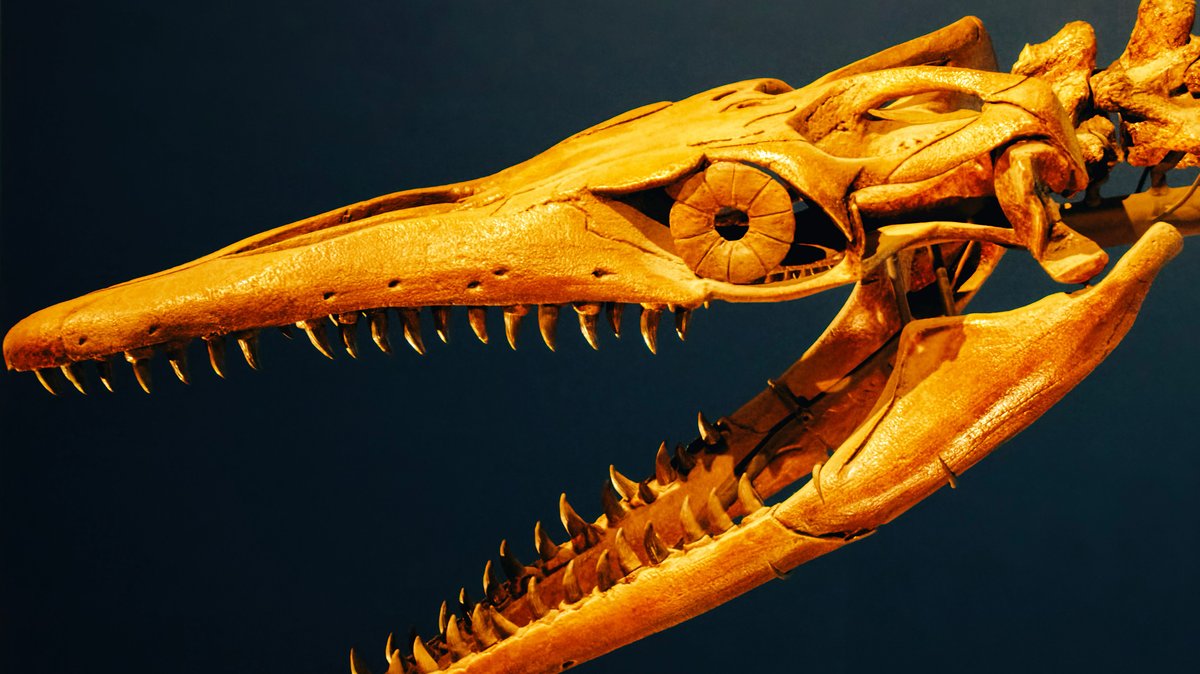
Cretaceous seas are often pictured through their biggest vertebrates. Mosasaurs, plesiosaurs and sharks dominate many reconstructions because their hard bones and teeth fossilize well. Nanaimoteuthis adds a large invertebrate predator to that picture.
“This study provides the first direct evidence that invertebrates could evolve into giant, intelligent apex predators,” Iba said. The claim rests on rare fossils, but the broader implication is clear. Ancient marine food webs included more giant soft-bodied predators than the fossil record easily reveals.
The comparison is striking. Some mosasaurs reached about 17 meters. Large Cretaceous sharks reached roughly 10 meters. At the upper size estimate, Nanaimoteuthis haggarti would have belonged among the most formidable animals in its environment.
The discovery also pushes against a preservation bias. Animals with bones and teeth leave more obvious records, while soft-bodied giants can vanish from view. A few fossil jaws from opposite sides of the Pacific now suggest that major predators may have been hiding in that gap.
Future finds could refine the size estimate and clarify how these animals lived. More jaws, better-preserved specimens, or rare soft-tissue fossils would help test the reconstruction. For now, Nanaimoteuthis gives paleontologists a powerful reminder that ancient oceans held giants whose bodies left only the thinnest trace.