A 2016 Oceanography study documented sharks and other marine life inside the active crater of the Kavachi submarine volcano in the Solomon Islands. Cameras lowered into the crater during a rare quiet period recorded silky sharks, scalloped hammerheads, bony fish and microbial communities living amid volcanic emissions.
The discovery presented researchers with an ecological puzzle. Kavachi’s crater contains heated and acidic water. Volcanic gases and suspended particles also produce a turbulent environment with poor visibility. Eruptions can begin with little warning and violently rearrange the summit.
Yet the images revealed a complex biological community at several levels of the food web. The study abstract reported that “Populations of gelatinous animals, small fish and sharks were observed inside the active crater, raising new questions about the ecology of active submarine volcanoes and the extreme environments in which large marine animals can exist.” Those observations suggest that large predators can use some active volcanic environments when local currents and crater shape keep conditions within survivable limits.
Inside Kavachi’s active crater
Kavachi lies about 24 kilometers south of Vangunu Island in the western Solomon Islands. The submarine volcano rises roughly 1,200 meters from the surrounding seafloor. Its summit reaches to within about 20 meters of the ocean surface, placing volcanic activity in direct contact with waves and strong surface currents.
People living in the surrounding islands have long known Kavachi as Rejo te Kavachi, often translated as Kavachi’s Oven. The name captures the volcano’s heat and persistent activity. Recorded eruptions have repeatedly thrown steam, ash, rock fragments and discolored water above the surface.
Some eruptions have built temporary islands from volcanic debris. Waves then eroded those fragile structures until the summit disappeared beneath the sea again. This cycle makes Kavachi a changing habitat whose depth and shape can shift after major events.
Inside the crater, volcanic emissions alter the surrounding seawater. Carbon dioxide and sulfur compounds affect its chemistry, while heated fluids raise local temperatures. Fine particles cloud the water and carry chemical energy that microbes can exploit. Together, these processes create a volatile setting with the potential to support bursts of biological productivity.
The 2015 expedition
In January 2015, a research team led by Brennan T. Phillips reached Kavachi during an unusual lull in eruptive activity. The timing allowed the scientists to approach the summit and place instruments directly over the crater. Previous work had often been limited to observations from the surface or measurements around the volcano’s edges.
The expedition combined seafloor mapping, water sampling, chemical measurements and biological imaging. Researchers mapped Kavachi’s main summit and identified another peak to the southwest. Evidence of diffuse venting showed that volcanic fluids were escaping across more than one part of the structure.
To see which animals entered the crater, the team deployed baited cameras from a boat. These autonomous units descended into dark water where suspended particles sharply reduced visibility. The cameras recorded conditions at depths of roughly 50 to 80 meters and returned with footage of an unexpectedly active ecosystem.
Microbial samples added another layer to the picture. The crater supported communities associated with sulfur-rich environments. Orange and white mats were visible on volcanic surfaces, showing how microbes could establish the base of a food web powered partly by chemical energy.
Sharks in the volcanic plume
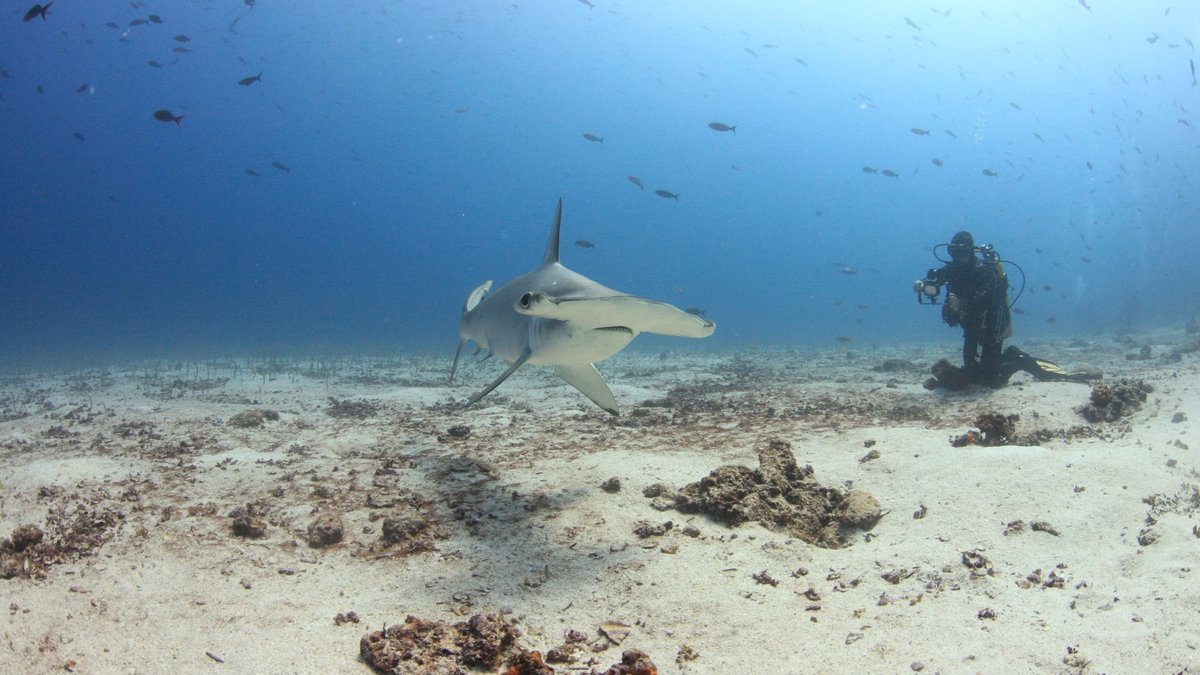
The camera footage captured two large predatory species. Silky sharks, scientifically known as Carcharhinus falciformis, moved through the crater along with scalloped hammerhead sharks, or Sphyrna lewini. Bluefin trevally, snapper and other fish also appeared in the recordings.
These animals were swimming inside an active volcanic structure rather than gathering only along its outer slopes. The distinction matters because the crater is where heated water, gases and particles become most concentrated. Conditions can also change quickly as new pulses of volcanic material rise from below.
The available footage offers a brief view of shark behavior during a quiet phase. It does not establish that the animals remain in the crater through eruptions. They may enter when conditions become favorable and leave as the plume intensifies.
Sharks possess sensitive electroreceptors that help them detect the weak electrical signals produced by prey. Changes in seawater chemistry can influence how these sensory systems operate. Kavachi therefore offers researchers a natural setting for studying how large marine animals navigate an environment shaped by heat, acidity, darkness and chemical disturbance.
How the crater supports a food web
Volcanic fluids carry chemicals that certain microorganisms can use as an energy source. These organisms create organic material through chemosynthesis, a process that can support ecosystems beyond the reach of sunlight. At Kavachi, microbial communities linked to sulfur cycling indicate that this chemical pathway contributes to local productivity.
A chemosynthetic food web can attract small animals that graze on microbes or consume organic particles. Fish may then gather to feed on those organisms. Larger predators gain access to a concentrated supply of prey within a relatively small area.
The sharks could be taking advantage of this temporary abundance. A crater filled with fish may offer worthwhile feeding opportunities during quieter intervals. The biological rewards could offset the physical stress of entering warm and chemically altered water for limited periods.
Researchers still lack direct evidence showing what the sharks ate inside Kavachi. No stomach-content analysis or tissue sampling was conducted during the expedition. The prey-concentration explanation remains a plausible interpretation based on the observed food web and patterns seen around other hydrothermal systems.
Behavior may provide another part of the answer. Mobile animals can move between pockets of water with very different conditions. Sharks capable of detecting subtle environmental changes may retreat when volcanic discharge intensifies and return after currents dilute the plume.
Why Kavachi differs from deeper volcanoes
Other submarine volcanoes have produced very different biological scenes. Studies at deeper volcanic craters have found areas where toxic or oxygen-poor water becomes trapped. Animals entering these zones can become overwhelmed, producing accumulations of carcasses rather than active communities of large predators.
Kavachi’s crater geometry may help prevent that outcome during quiet periods. Its shallow summit and relatively low crater walls allow volcanic emissions to escape. Strong currents near the ocean surface can then mix heated and acidic fluids with surrounding seawater.
This circulation may create a patchwork of conditions. Some parts of the crater can remain chemically intense, while nearby water becomes diluted enough for fish and sharks to enter. The habitat may shift over minutes or hours as currents and volcanic discharge change.
Deeper craters with higher walls can retain dense volcanic fluids more effectively. Gases and dissolved chemicals may accumulate near the bottom. That difference helps explain why superficially similar volcanoes can support sharply different biological communities.
Crater shape is one explanation among several. Water depth, eruption chemistry, oxygen concentration, current speed and the structure of surrounding food webs can also influence survival. Comparisons among volcanoes will require measurements collected with similar instruments across multiple phases of activity.
Disposable robots enter the sharkcano
Working above Kavachi carries an obvious risk. An eruption can damage instruments or endanger a research vessel before a team has time to recover its equipment. Phillips and his colleagues addressed that problem by treating the loss of some devices as a likely part of the mission.
The team built small autonomous instruments from inexpensive components. Some housings incorporated used PVC sewer pipe obtained near the expedition site. The approach allowed researchers to send cameras and sensors into a dangerous crater without risking equipment that was too costly to lose.
This design philosophy expands the range of places scientists can investigate. A large research vehicle often requires careful recovery and substantial support. Small disposable systems can enter unstable vents, contaminated waters, or turbulent plumes where conventional equipment would face unacceptable risk.
Low-cost robots also make repeated deployments more practical. Multiple instruments can sample different parts of a crater at the same time. Future versions could measure temperature, acidity, oxygen, sound and animal movement across an entire eruptive cycle.
Kavachi demonstrates the value of building instruments around the environment rather than expecting the environment to accommodate delicate technology. Rugged and replaceable tools can collect valuable observations in places where physical access remains brief and unpredictable.
Questions that remain
The 2015 expedition captured a single window in Kavachi’s behavior. Researchers sampled the crater during a period of relative calm, so the observations cannot reveal how its ecosystem changes before or after a major eruption. Fish and sharks could leave during violent phases and recolonize the summit later.
The length of each visit also remains unknown. Individual sharks may spend minutes inside the crater or return repeatedly over longer periods. Long-term tagging could show whether the animals follow predictable routes and whether their movements respond to shifts in temperature or water chemistry.
Scientists also have little evidence for special physiological adaptations among the Kavachi sharks. No genetic analysis or tissue study has established that these animals differ from members of the same species elsewhere. Their presence could result primarily from flexible behavior and rapid movement between harsh and milder water.
Future expeditions could combine acoustic tags with stationary receivers positioned around the summit. Chemical sensors could record conditions as tagged animals enter and leave. Such measurements would connect shark behavior directly with changes in the volcanic plume.
For now, Kavachi offers a vivid example of life using a dangerous habitat whenever a brief opportunity appears. Its sharks reveal how mobility, food availability, ocean circulation and volcanic geology can intersect. That combination has turned one of the Pacific’s most active submarine volcanoes into an exceptional natural laboratory for extreme marine ecology.