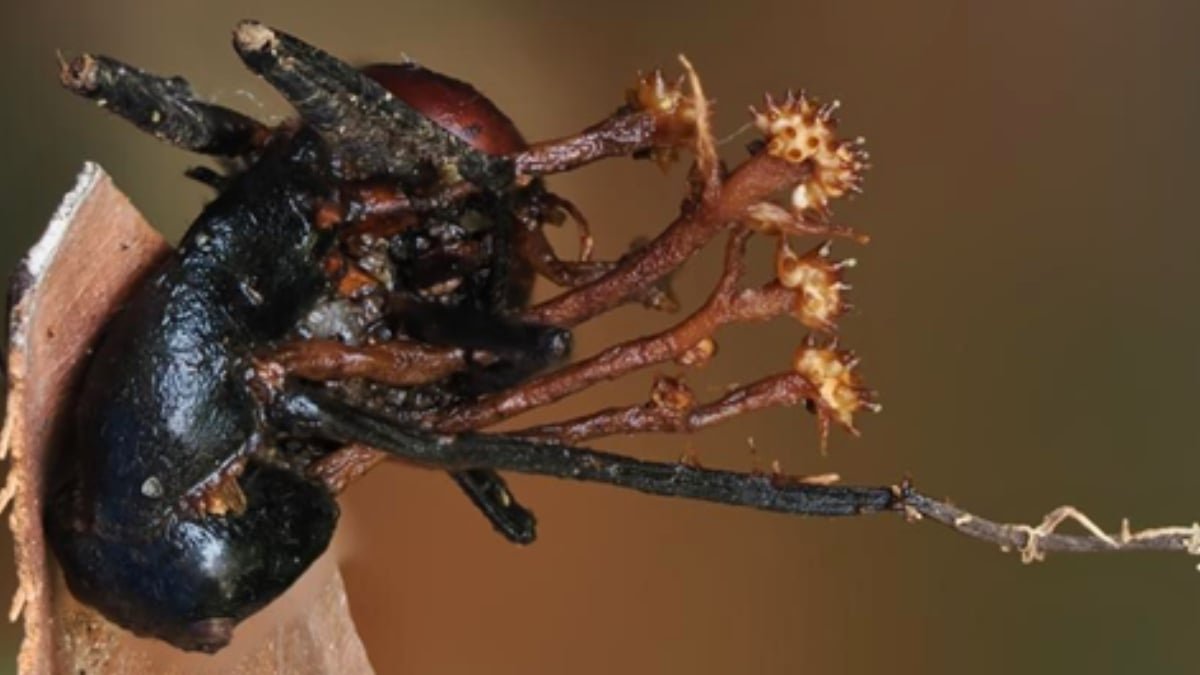
Researchers at Universiti Malaysia Sabah have announced the discovery of a new horn-shaped fungus from Borneo’s Danum Valley, a striking species named Pleurocordyceps cornusynnemata. The fungus was found during fieldwork by the university’s Institute for Tropical Biology and Conservation and confirmed after publication in the taxonomy journal Phytotaxa.
The discovery adds a strange new layer to one of nature’s most unsettling relationships. The new fungus grows in association with insects already invaded by Ophiocordyceps, the group widely known as “zombie fungus” because some species manipulate insect behavior before killing their hosts. In this case, the newly described organism feeds on the fungal invader itself, placing it inside an even more intricate chain of parasitism.
Its most eye-catching feature is built into its name. The species was named for its horn-like structures, which set it apart from other known members of its genus. In a rainforest famous for hidden life, the specimen shows how much biological complexity still waits inside dead wood, leaf litter and the bodies of tiny animals.
A horn-shaped fungus found in Danum Valley
The new species was collected in the Danum Valley Conservation Area, a remote forest landscape in southern Sabah. The site is already known for rich tropical biodiversity, yet small fungi growing on insects can easily escape notice. They often emerge as fragile stalks, threads, or clubs from bodies only a few millimeters long.
According to Universiti Malaysia Sabah, the research team was led by Associate Professor Dr Jaya Seelan Sathiya Seelan from the Institute for Tropical Biology and Conservation. The work also involved postgraduate researchers Muhammad Shahbaz and Firdza Zulkarnain Mohadden. Citizen scientist Elyse Yang co-discovered the new species during fieldwork in the Infapro area of Danum Valley.
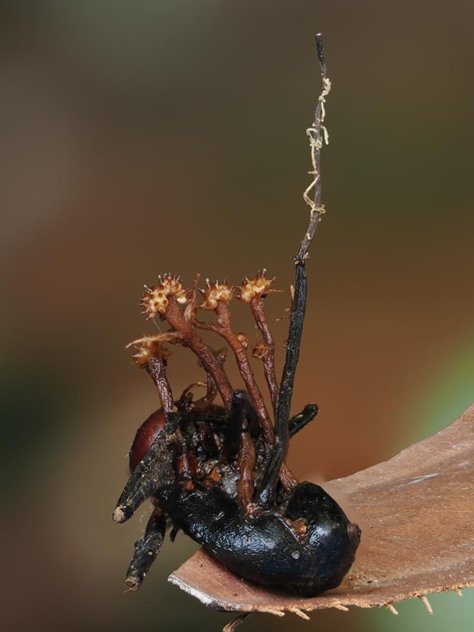
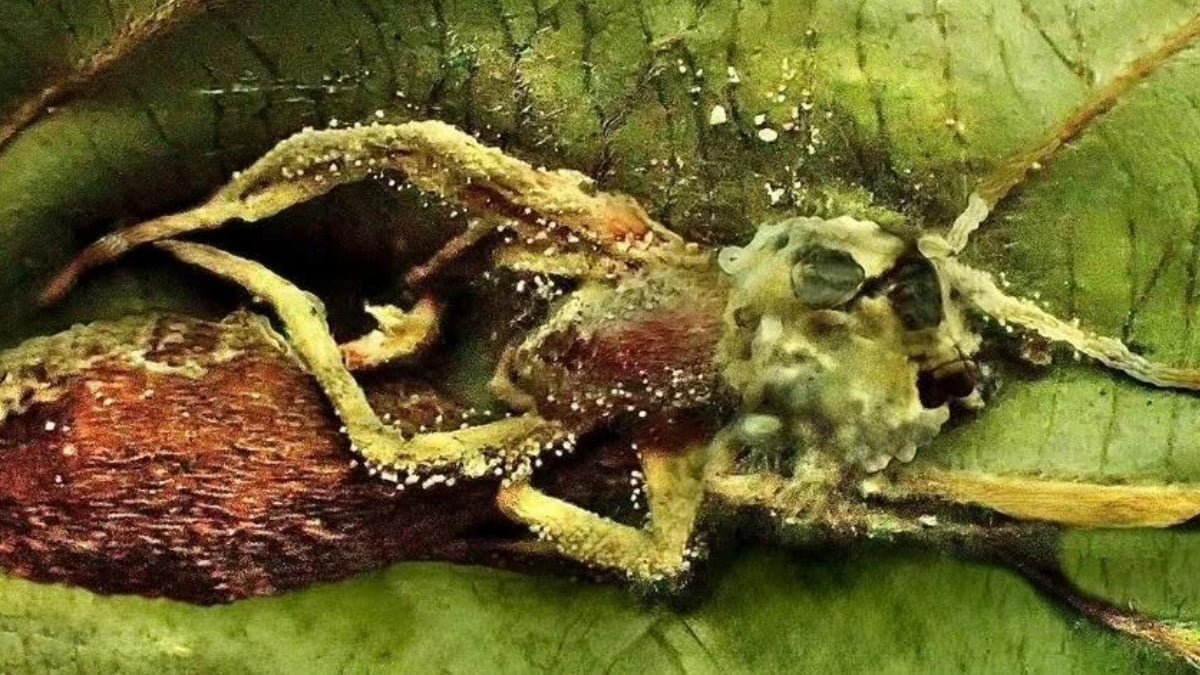
The fungus was found growing on a dead ant. That detail matters because ant-infecting fungi have become famous for their elaborate life cycles. Some Ophiocordyceps species can alter an insect’s behavior and position the dying animal in a place where the fungus can release spores effectively.
Here, the story gains another level. The newly named horn-shaped fungus was described as a hyperparasite, meaning it targets another parasite. Instead of making the ant its main nutritional target, it exploits the fungal tissue already developing within the insect host.
How the hyperparasite attacks zombie fungus
A hyperparasite is a parasite that lives at the expense of another parasite. In plain terms, the new fungus appears to feed on the organism that had already infected the insect. That makes the dead ant a biological meeting place where host, parasite and hyperparasite overlap.
Ophiocordyceps fungi are known for invading insects and producing fruiting bodies from their remains. These visible structures release spores into the environment. The process can look macabre, especially when the fungal stalks rise from an ant, beetle, or cicada like alien growths.
Pleurocordyceps adds a second fungal layer to that scene. The new species has been described as feeding on the Ophiocordyceps tissue inside the host. That relationship turns the original pathogen into food and habitat for another fungus.
This kind of interaction helps explain why rainforest ecosystems can feel almost endlessly nested. A single dead ant may support a parasite, then a hyperparasite, then bacteria and other microbes that recycle what remains. Each organism occupies a narrow role in a system built from many such roles.
For scientists, these relationships are more than curiosities. They can reveal how fungi compete, specialize and evolve. They also help taxonomists map the hidden diversity of organisms that rarely appear in public discussions of wildlife.
Why its horn-like shape matters
The most distinctive feature of the new species is its shape. Jaya Seelan said, “The species is notable for its horn‑like structure.” That horn-like form distinguished the specimen from 26 other species in the same genus that had previously been recorded in China, Thailand and Japan.
For taxonomists, shape is one of several clues used to recognize a species. The external form of a fungus can show how it produces spores, how it emerges from its host and how it differs from related organisms. In many fungi, small differences in stalks, branches, colors and spore-bearing structures carry scientific weight.
The species name cornusynnemata reflects that appearance. Scientific names often preserve a key trait, a location, or a person connected with the discovery. In this case, the name points back to the horn-like structures that made the specimen stand out.
Still, modern fungal identification usually depends on more than appearance. Researchers compare visible anatomy with microscopic features and genetic relationships when those data are available. That layered approach helps avoid confusion among species that look similar to the naked eye.
The result is a formal place for the organism in the scientific record. Once described and published, the species can be compared with future finds from Borneo and other Asian rainforests. The preserved specimen at the BORNEENSIS collection center at UMS also gives researchers a reference point for later study.
What the dead ant revealed
The dead ant at the center of the discovery illustrates why field biology often depends on patience and close attention. A tiny insect on a forest floor can carry evidence of several species at once. In this case, the visible fungus led researchers toward a new organism with an unusual lifestyle.
Ant-infecting fungi have earned public attention because some alter host behavior before death. The infected insect may climb vegetation or attach itself to a surface in a way that benefits the fungus. After the insect dies, fungal structures grow from the body and release spores.
The new hyperparasite complicates that familiar scene. It points to a second fungus exploiting the first one after infection has already taken hold. The ant’s body becomes a resource shaped by both the original pathogen and the organism that feeds on it.
That chain also shows why the word “zombie” only captures part of the biology. The dramatic behavior of the infected insect draws attention, while the microbial competition inside the host is harder to see. The new species brings that hidden fungal conflict into view.
Specimens like this are valuable because they preserve a real ecological event. A lab description can name the species, yet the field context shows where it lives and how it appears in nature. For a newly discovered hyperparasite, the host setting is part of the story.
Another parasite emerged from the same fieldwork
The Danum Valley work produced more than one notable fungal record. The UMS team also recorded two other Pleurocordyceps fungi, Pleurocordyceps aurantiaca and Pleurocordyceps nipponica, for Malaysia. Their appearance in the same study broadens the known range of the genus within the region.
Jaya Seelan said, “In addition to this new world species, our team also recorded two other fungi.” The comment underlines a common feature of biodiversity surveys. A field trip aimed at documenting one group of organisms can reveal several important records at once.
These findings matter because species distributions are scientific data. When a fungus is recorded in a new country, researchers gain a better sense of where it lives, which hosts it uses and how widespread it may be. That information can help guide future surveys.
The study also involved collaborators from Universiti Tun Hussein Onn Malaysia, including Dr Yap Jing Wei and PhD student Jeremiah Sia Yiao Rong. The collaboration shows how taxonomy often relies on teams that bring together field knowledge, specimen work and specialist expertise.
Field discoveries like these are especially important in tropical forests. Many fungi grow briefly and disappear quickly. Their fruiting bodies may emerge only under specific humidity, temperature and host conditions. A species can exist in an ecosystem for centuries before a scientist encounters it at the right moment.
A new spider-killing fungus from Borneo
The same wider fieldwork also yielded a new species of spider-killing fungus. It was identified as Leptobacillium geminatum, a fungus associated with spiders. According to the discovery account, it spreads spores through the arachnid before killing it.
Spider-killing fungi belong to a larger world of fungal parasites that specialize in arthropods. These organisms can infect insects, spiders and other small invertebrates. Their life cycles often depend on precise timing, because the fungus must grow, produce spores and reach new hosts in a crowded forest environment.
The spider-killing discovery helps place the horn-shaped hyperparasite in a broader pattern. Danum Valley holds many small predator, prey, parasite and decomposer relationships that are still being documented. Fungi are major players in that web, even when they remain nearly invisible.
For general readers, these organisms can sound like horror fiction. For biologists, they are evidence of specialization. A fungus that attacks a spider, an ant, or another fungus has evolved a narrow strategy for survival. Each strategy reflects countless interactions with hosts and competitors.
That specialization also makes these fungi challenging to study. Researchers often need to find the correct host, preserve the specimen carefully and compare it with known species. In tropical field conditions, that work can be demanding and time-sensitive.
Sabah’s rainforest still holds hidden species
Sabah’s rainforests remain a major frontier for species discovery. Large animals often dominate public attention, yet many of the most numerous and diverse organisms are small. Fungi, insects and microscopic life form a vast biological infrastructure beneath the forest’s visible canopy.
The UMS announcement described the discovery as part of the university’s broader effort to elevate Sabah’s natural heritage. The work was supported by a UMSGREAT research grant, with collaboration from the Sabah Forestry Department and Yayasan Sabah under the 12th Malaysia Plan project.
The specimen is now preserved at the BORNEENSIS collection center at the Institute for Tropical Biology and Conservation. Such collections serve as biological archives. They allow scientists to verify identifications, revisit old specimens with new tools and compare new finds with documented material.
Taxonomy can move slowly, but it gives biodiversity a durable language. A species needs a name before it can be tracked, compared, protected, or studied in detail. The discovery of Pleurocordyceps cornusynnemata shows how much remains unnamed even in well-known conservation landscapes.
In one dead ant from Borneo, researchers found a miniature ecosystem with a remarkable twist. A parasite had become prey for another parasite and the result was a horn-shaped fungus new to science. The finding turns a tiny forest-floor specimen into a reminder that the living world still contains elaborate relationships waiting to be seen.