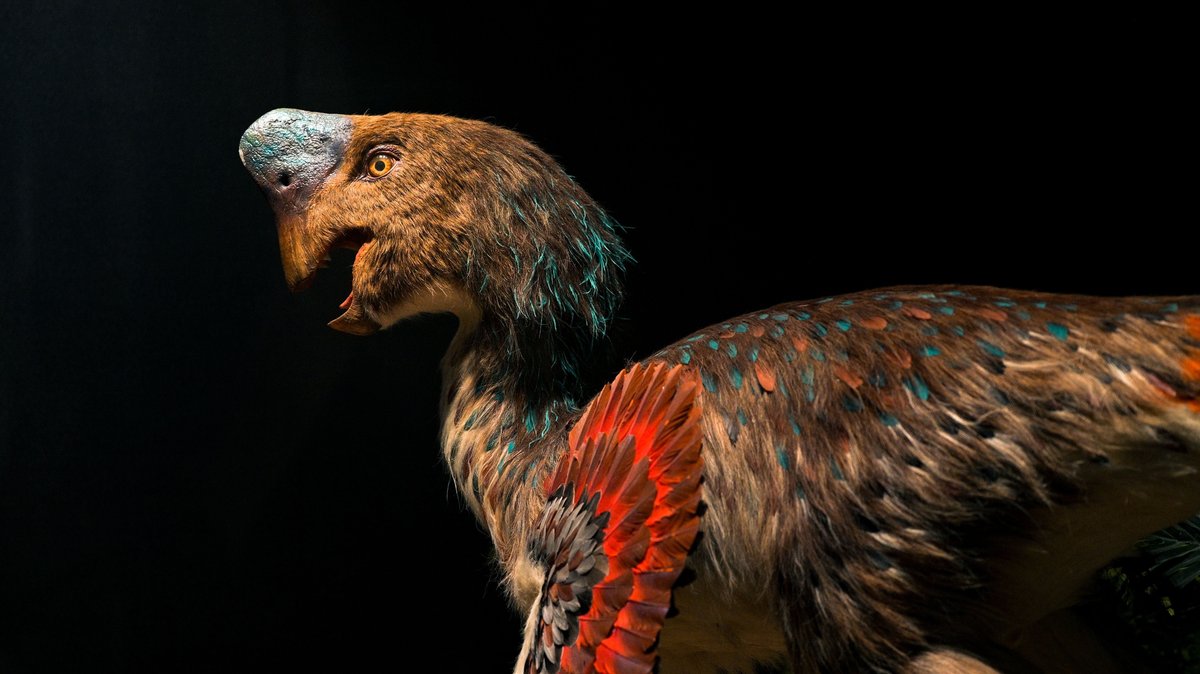
A study in Communications Biology found that rare fossils of the feathered dinosaur Anchiornis preserve a surprising clue in their wings. The animals had developed feathers and wing-like limbs, yet their feather replacement pattern suggests they were probably unable to fly.
The research was led by Dr. Yosef Kiat of Tel Aviv University, working with collaborators in China and the United States. Their analysis focused on nine exceptionally preserved fossils from eastern China. These specimens captured details that usually vanish long before fossilization, including feather structure and traces of original color.
That preservation gave the team a rare way to study life history in an extinct dinosaur. By following tiny shifts in dark markings along the wings, the researchers identified feathers that were still growing when the animals died. Those growth patterns pointed to an irregular molt, a pattern associated today with birds that do without flight.
Rare Feathers From Jurassic China
Fossil feathers are among the most fragile traces of ancient life. Bones can survive for millions of years because they are mineral-rich from the start. Feathers are soft tissues, which means they usually decay before they can be buried and preserved in enough detail to reveal their structure.
The fossils examined in the study come from eastern China, a region known for extraordinary preservation of feathered dinosaurs. In the case of Anchiornis, the fossil record captured both the skeleton and the surrounding feather impressions. That combination allowed the researchers to examine the animal’s wings as biological tools rather than simple outlines around bones.
Anchiornis lived around 160 million years ago during the Jurassic Period. It belonged to Pennaraptora, a group of feathered theropod dinosaurs closely tied to the evolutionary story of birds. Members of this group often had complex plumage and several lineages carried wing-like structures on their forelimbs.
For decades, animals such as Anchiornis have raised a difficult question. Feathers can help with insulation, display, balance, brooding and aerodynamic movement. A winged body plan alone gives only part of the answer. To judge flight ability, researchers need evidence from many parts of the animal, including bones, feathers and how those feathers were maintained during life.
Color Patterns Preserved in Stone
The fossils offered the team a particularly unusual advantage. The feathers retained evidence of their color pattern, including mostly pale wing feathers with a dark spot near the tip. Those repeating marks created a natural map across the wings.
In living birds, each feather grows in a specific position. A mature wing tends to have an orderly arrangement, with neighboring feathers forming smooth rows and edges. In the Anchiornis fossils, the preserved spots allowed the researchers to track individual feathers and compare their positions with unusual precision.
Most of the dark spots formed a continuous line along the wing. Some spots fell out of alignment. The team interpreted those mismatched marks as evidence of feathers that were still growing. A developing feather would have been shorter than its neighbors, so its dark marking would appear shifted from the main row.
That detail matters because fossil color is rarely preserved clearly enough to reconstruct this kind of sequence. Here, feather coloration became a functional clue. Dr. Kiat described the find as unusually valuable, saying, “This is a rare and especially exciting finding.”
The study shows how small surface details can carry information about movement, behavior and life cycle. A fossil wing can reveal far more than the outline of a limb when its soft tissues survive in fine detail.
The Molting Clue Hidden in the Wings
“Feather molting seems like a small technical detail,” Dr. Kiat said. For birds, that small detail has major consequences. Feathers wear down, break, fade and lose performance over time. Molting replaces them with new growth and keeps the wing useful.
A growing feather is supplied by blood vessels for a short period. The reported study details notes that feathers grow for roughly two to three weeks before reaching their final size. Once mature, they become nonliving structures. That means a wing always carries a record of recent replacement when molting is underway.
Among flying birds, molting tends to be carefully managed. Many species replace flight feathers gradually and symmetrically. This helps keep the wings balanced while the animal continues to move through the air. A bird that loses too many important feathers at once may pay a steep cost in maneuverability or lift.
The Anchiornis fossils showed a different pattern. Several developing feathers appeared at scattered positions rather than in a neat sequence. The preserved black spots made those replacement feathers visible because their marks sat away from the expected line.
This gave the researchers a rare snapshot of molting pattern in a non-avian feathered dinosaur. The paper reports that Anchiornis preserves the first evidence of an irregular molt in a non-avian pennaraptoran. That detail became central to the team’s interpretation of how these animals used their wings.
Why Irregular Feather Growth Points to Flightlessness
Modern birds provide the comparison that makes the fossil evidence meaningful. In species that rely on flight, feather replacement is constrained by the need to keep the wing functional. The wing cannot simply lose performance at random across the flight surface without consequences.
Flightless birds can follow looser molting schedules. Since their daily survival does not depend on fine control of aerodynamic surfaces, feather replacement can occur in a less organized way. This pattern gives paleontologists a living reference point when they study extinct animals with preserved feathers.
The Anchiornis specimens showed an irregular replacement pattern similar to what is seen in flightless birds. The evidence came from the developing feathers visible through their shifted color marks. It also came from the broader wing structure described in the study.
“Based on my familiarity with modern birds, I identified a molting pattern indicating that these dinosaurs were probably flightless,” Dr. Kiat said. The wording is careful and the conclusion rests on comparison. Fossils cannot show a living animal taking off, landing, or running. They can preserve traits that make some behaviors more likely than others.
The result places flightlessness at the center of the Anchiornis story. The animal had feathers and wings and the study suggests those structures were shaped by an evolutionary history more complex than a straightforward march toward powered flight.
A More Complex Origin Story for Flight
The origin of flight has long been one of the most vivid questions in dinosaur research. Feathered fossils have transformed that debate by showing that feathers appeared before modern birds. They also showed that wing-like structures evolved across several related dinosaur groups.
Early research often focused on skeletons. Bone shape can show whether an animal had strong forelimbs, particular shoulder motion, or limb proportions suited to aerodynamic behavior. The new Anchiornis study emphasizes soft tissues, especially the feathers that formed the wing surface itself.
This matters because flight depends on a complete system. Wings require bones, muscles, feathers, coordination and maintenance. Molting belongs to that system because flight feathers must be replaced without destroying the wing’s usefulness. A molting strategy can therefore reveal how strongly an animal’s life depended on flight.
The findings suggest that wing evolution among dinosaurs and birds had many branches. Some feathered dinosaurs may have used their wings for display, balance, gliding, brooding, or other behaviors. Others may have evolved limited aerial abilities. Some lineages may have reduced or lost flight-related function over time.
Anchiornis now joins a broader set of feathered dinosaurs that complicate any simple picture of the transition from ground-dwelling theropods to birds. Its fossils point to a body covered in elaborate plumage, with wings that preserved ancient details of growth and replacement.
What Anchiornis Reveals About Feathered Dinosaurs
Anchiornis helps show why feathers should be read as biological structures with many possible roles. In living animals, feathers can insulate the body, create visual signals, protect skin and shape movement. Their presence in a fossil points to a rich set of functions that scientists must evaluate case by case.
The study’s strength lies in the unusual preservation of nine specimens. A single fossil can be remarkable, yet multiple specimens allow researchers to compare patterns across individuals. In this case, the repeated evidence of feather growth helped the team interpret molting as a real biological signal.
The work also highlights the importance of museum collections. Fossils collected and preserved in institutions can gain new scientific value as researchers develop fresh questions and sharper methods. Details that once seemed decorative may later become central evidence about behavior or physiology.
For modern birds, molting is part of the yearly rhythm of survival. For Anchiornis, the same process became frozen in stone. The shifted black spots along its wings allowed scientists to glimpse feather replacement in an animal that lived long before birds filled today’s skies.
The broader message is one of evolutionary variety. Feathered dinosaurs experimented with many forms and functions across deep time. Anchiornis shows that even a winged, feathered dinosaur could belong to a grounded branch of that story, with its ancient feathers preserving the clue.