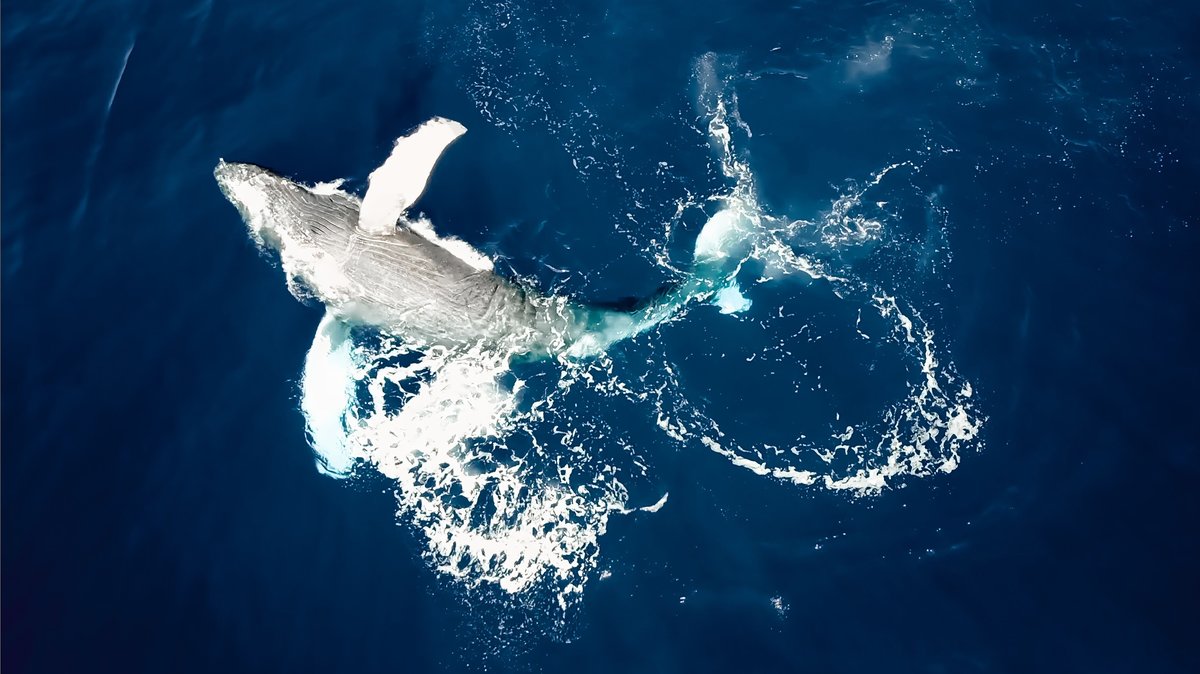
A study in Royal Society Open Science has found that two humpback whales made extraordinary journeys between breeding grounds in eastern Australia and Brazil. The whales were recognized from the unique markings on their tails, revealing rare long-distance exchanges across the Southern Hemisphere.
The finding matters because humpback whale populations are usually tracked as separate breeding groups. These two animals connected regions that sit roughly 14,500 kilometers apart. Their journeys push the known limits of humpback movement and raise new questions about how whales navigate, mingle and respond to changing oceans.
Tail photos revealed the record crossings
The discovery began with a familiar feature in whale research, the underside of a tail. Each humpback whale has a distinctive pattern of light and dark markings, along with unique edges and scars. To scientists, that fluke can work like a fingerprint.
Researchers analyzed 19,283 curated whale images collected between 1984 and 2025. The photographs came from research groups and citizen scientists in eastern Australia and Brazil. Recognition software then helped compare flukes across decades of sightings.
That search turned up two individuals photographed in both regions. The study’s abstract states, “We identified two individuals photographed in both areas.” The short line carries a big implication, since the same whales had appeared at breeding areas separated by ocean-basin scale distances.
The minimum great-circle distances between the sighting locations were about 14,200 kilometers for one whale and 15,100 kilometers for the other. Those numbers mark the separation between documented sightings. The actual routes may have been longer.
Two whales traveled in opposite directions
One of the most striking parts of the study is the direction of travel. The two whales moved between the same broad regions in opposite directions. Together, they provide the first evidence of two-way exchange between these distant breeding populations.
One whale was seen in Australia and later documented in Brazil. The other was photographed in Brazil and later found in Australia. That pattern makes the case stronger than a single unusual sighting.
Humpback whales already have a reputation for epic migration. They often feed in high-latitude waters during warmer months and move toward tropical breeding areas in winter. Even by that standard, a Brazil-Australia connection is exceptional.
The longer of the two documented separations reached 15,100 kilometers. That distance is more than 9,300 miles. It places the movement among the longest confirmed journeys ever documented for an individual humpback whale.
Why the journeys surprised scientists
Humpback whales often follow migration routes learned early in life. Mothers can shape where calves travel, where they feed and where they return to breed. That creates recognizable population patterns over time.
These crossings show that some individuals can move far beyond expected links between breeding areas. The study describes such movement between humpback breeding stocks as extremely rare. For scientists who study population boundaries, the two whales are valuable outliers.
Stephanie Stack of Pacific Whale Foundation, a study co-author, captured the surprise in a quote shared with the Associated Press. “Finding not one but two individuals that have crossed between Australia and Brazil challenges what we thought we knew,” Stack said.
The movements also matter for conservation. Occasional exchange between distant populations can affect genetic diversity. It may also help explain how behaviors such as whale songs spread across ocean regions.
Southern Hemisphere humpbacks have recovered in many areas after the end of large-scale commercial whaling. As populations grow, more whales may explore wider ranges. The study suggests this recovery could help create rare opportunities for exchange between ocean basins.
Photo matching turned decades of sightings into a map
The method behind the discovery was photo-identification. Researchers compare fluke images across sightings, then look for a match. A clean image can reveal the same whale years later and thousands of kilometers away.
This approach has become more powerful as databases have grown. Citizen scientists, whale-watching operators, research teams and conservation groups now contribute images from many coastlines. The result is a wider visual record of animals that spend most of their lives underwater.
The study used curated images from breeding stock E1 in eastern Australia and breeding stock A in Brazil. In whale biology, breeding stocks are groups that tend to reproduce in particular regions. Finding the same animal in two distant breeding areas suggests movement across a boundary that scientists rarely observe directly.
Software helped screen the large image set. Human expertise still matters, because fluke matches require careful checking. Scars can change, image angles can mislead and old photographs can vary in quality.
Platforms such as Happywhale have helped transform scattered whale photos into research tools. When many observers contribute, a single tail photograph can become part of a long-term movement record.
The route remains a mystery
The photos show where the whales were seen at the beginning and end of their documented journeys. They don’t reveal the exact paths between those points. A whale could travel by a relatively direct route, or it could follow feeding grounds and currents across a much longer path.
Researchers also don’t know why these particular animals crossed between breeding regions. Stack suggested one possibility in the Associated Press report. The whales may have met animals from another population on shared feeding grounds and followed them instead of returning to their usual breeding area.
The Southern Ocean may provide an important stage for that kind of exchange. Humpbacks from different breeding populations can overlap in feeding regions. Those overlaps could create chances for individuals to switch routes during later migrations.
The study also supports the Southern Ocean Exchange hypothesis. That idea proposes that population recovery and environmental variability can create opportunities for rare movement between ocean basins. The two whales give researchers concrete examples to test against future sightings.
Northern Hemisphere humpbacks face a different geographic setup. Continents and enclosed seas can limit open-ocean routes. In the Southern Hemisphere, whales have more room to move around Antarctica and across broad ocean corridors.
What long-distance whales could reveal about warming oceans
Climate change is adding urgency to this kind of research. Humpback whales depend on prey such as krill and small fish. If warming waters shift where prey is abundant, whales may adjust where they feed and how they move.
Long-distance photo records can help scientists see those shifts as they unfold. A single strange match may look like an exception. Many matches over time can reveal a changing pattern.
The Brazil-Australia whales show how much can be learned from old images when they are combined with modern tools. Photos taken decades ago can become new evidence when matched with recent sightings. That gives researchers a way to reconstruct movement across a time span that satellite tags rarely cover.
For conservation teams, the lesson is practical. Whale populations that appear separate may have occasional links across huge distances. Protecting migratory species can require a wider view than one coastline or one breeding ground.
The record-breaking pair also reminds researchers that whale behavior can remain surprising even in a well-studied species. Humpbacks are famous for songs, migrations and acrobatics. Their tails have now revealed another story, one that stretches from Australia to Brazil and across the hidden highways of the Southern Ocean.