A study in Frontiers in Marine Science has tracked one of the world’s most unusual whale populations in new detail, revealing that Arabian Sea humpback whales usually remain close to Oman while one female completed the first directly recorded crossing to India.
The research followed 14 whales fitted with satellite tags off Oman between 2014 and 2017. Most stayed within a compact coastal range centered on the Gulf of Masirah and Hallaniyat Bay. One whale, a female known as Luban, traveled across the Arabian Sea to India and then returned.
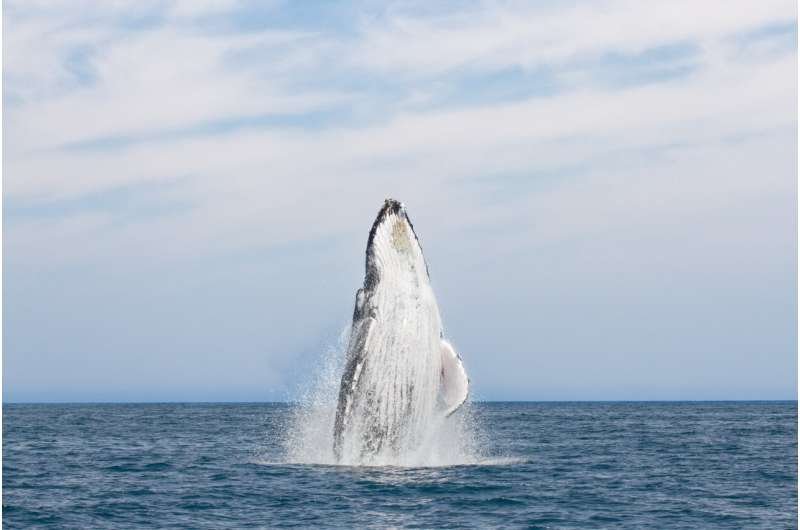
That single journey matters because the population is tiny. Scientists estimate just over 80 Arabian Sea humpback whales off Oman’s coast. The whales are classified as endangered and they face pressure from fishing, shipping, coastal development and a changing ocean.
A Rare Whale Population off Oman
Arabian Sea humpback whales occupy a rare place in whale biology. They are understood to be the only humpback whale population that spends its life within the Arabian Sea instead of making long seasonal movements between high-latitude feeding grounds and low-latitude breeding areas.
For most humpbacks, migration is part of the rhythm of life. They feed heavily in cooler waters and travel to warmer breeding grounds during another part of the year. The Arabian Sea population appears to have followed a different path for thousands of years. Previous research suggests it diverged from Southern Hemisphere humpback whale populations around 70,000 years ago.
That history makes the Omani coast unusually important. Researchers have studied these whales through boat surveys and photo-identification catalogs since 2000. Those methods allowed scientists to recognize individual animals by features such as dorsal fins and tail flukes. Satellite tracking added a moving map to that picture.
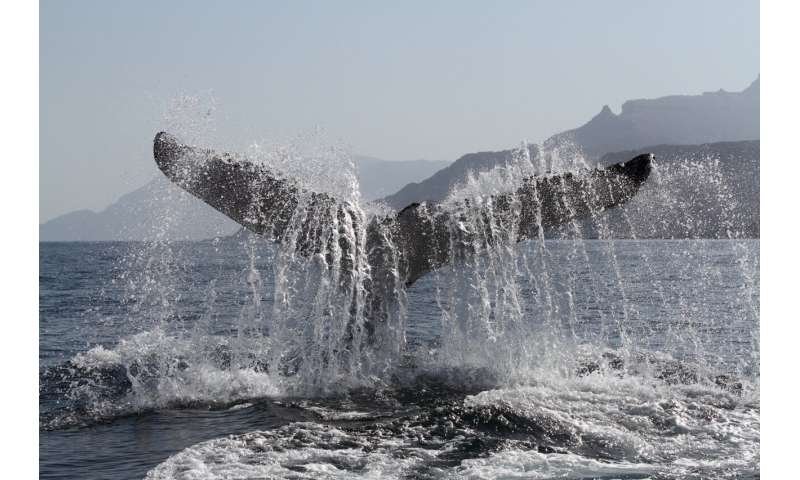
First author Dr. Andrew Willson, a marine scientist and founding director of Future Seas Global SPC, said the work showed how strongly these whales stayed tied to Oman. “We show ASHWs predominantly stayed within a very restricted home range along the coast of Oman.”
The population’s small size makes every sighting valuable. When scientists can connect a whale’s photograph with its movement track, they gain a clearer view of where that animal feeds, rests, travels and may reproduce.
Satellite Tags Reveal a Small Home Range
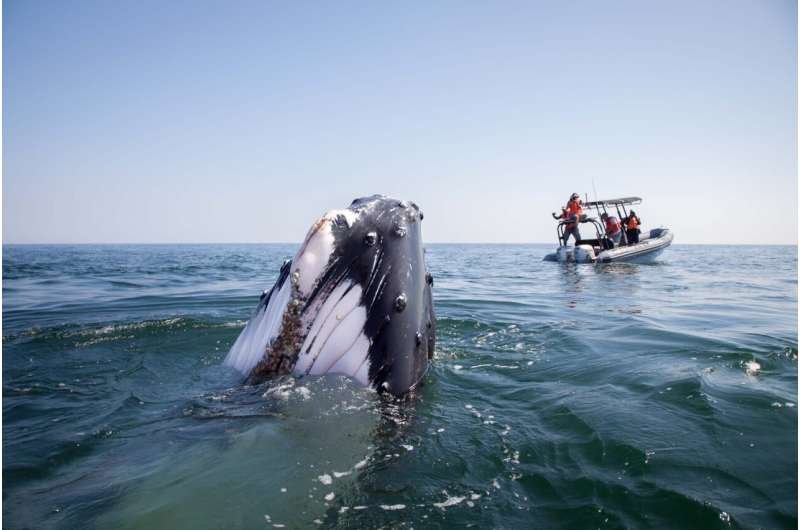
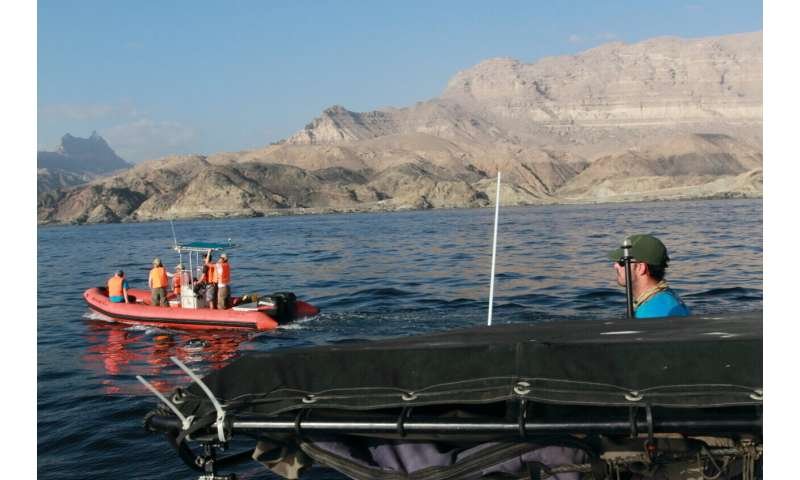
The study used satellite telemetry to follow whale movements and dives. Tags were deployed in two important areas, Gulf of Masirah and Hallaniyat Bay. On average, each tag transmitted for 53 days. Together, the tags sent more than 1,800 location points.
Those locations showed a strong coastal pattern. Five whales tagged in the Gulf of Masirah stayed in that area while their tags were active. Two others traveled south to Hallaniyat Bay. All six whales tagged in Hallaniyat Bay moved among the Gulf of Masirah, Hallaniyat Bay and waters off northern Yemen.
The Gulf of Masirah stood out. It accounted for 57 percent of all transmitted locations. Hallaniyat Bay accounted for 18 percent. The whales’ home range and core range both pointed to strong site fidelity between areas less than 400 kilometers apart.
For researchers, the tags offered a daily window into animals that are difficult to observe at sea. “Tagging these whales allowed us to peel back the lid of the sea and check in online to see where they were each day,” Willson said.
The tags also recorded depth-use data for 484 days in total. That extra layer helped scientists infer whether whales were moving through an area or spending time in ways associated with feeding and breeding. The study used movement models to distinguish area-restricted search behavior from transiting movement.
Luban’s 7,000-Kilometer Journey
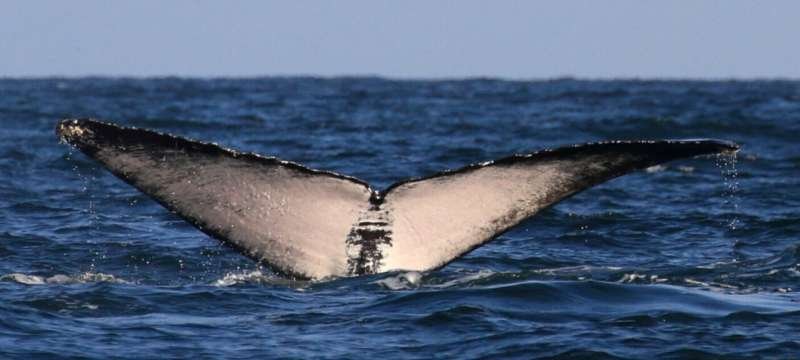
One result broke the local pattern. A female whale named Luban traveled east across the Arabian Sea and was detected off Goa on India’s west coast. Her name comes from the Arabic word for frankincense, inspired by a frankincense-shaped pattern on her tail fluke.
Luban completed a return journey of about 7,000 kilometers. The study describes this as the first direct evidence of an Arabian Sea humpback whale crossing the Arabian Sea. Earlier research had connected humpback whale song between the Omani and Indian coasts, but a tracked animal had never supplied this kind of movement record.
Her trip raises new questions about habitat use across the northern Indian Ocean. The area where she remained off southern India for up to a month is known for high productivity. Researchers suggest food and reproduction may have been linked drivers of the journey.
The team later resighted Luban in the Gulf of Masirah. For a population this small, that return carried real significance. “It’s always a relief when we make resightings of these amazing whales given the limited size of the population,” Willson said.
Luban’s route also expands the conservation map. If even occasional crossings connect Oman with productive waters near India, international coordination becomes more important. Protecting a whale that can travel across national waters requires information sharing and management beyond a single coastline.
Why These Whales Track Coastal Food
The western Arabian Sea is shaped by monsoon-driven upwelling. Seasonal winds help bring nutrient-rich water toward the surface. That process can fuel plankton blooms, support fish and create productive feeding areas along the continental shelf.
The study links whale movements to this productive setting. Many locations occurred over the continental shelf, where inshore prey can gather. Willson said the whales may be tracking prey such as sardines near the coast. Deeper dives beyond the shelf could involve searches for food such as krill.
This helps explain how a humpback population can remain in one broad ocean region year-round. If feeding opportunities remain available through enough of the year, long seasonal migration becomes less central to survival. The Arabian Sea gives researchers a living example of humpback flexibility.
The whales’ behavior may reflect both foraging and breeding in overlapping places. In many humpback populations, those activities are separated across large distances. Here, the study found area-restricted search behavior over shelf areas, a pattern associated with feeding and breeding behavior.
Suaad Al Harthi, executive director of the Environment Society of Oman, described the region’s importance in unusually direct terms. “The Arabian Sea provides unique conditions allowing a once-migratory species to completely change its ecology.”
Fishing, Shipping and a Fragile Future
A population of roughly 80 animals has little room for added losses. The study emphasizes that Arabian Sea humpback whales face growing human pressures throughout their known range. Fishing activity, vessel traffic and coastal development can all overlap with whale habitat.
The tracking data are useful because they identify where risk is likely to concentrate. If whales repeatedly use the Gulf of Masirah, Hallaniyat Bay and nearby shelf waters, those locations become priorities for conservation planning. Managers can use the information to evaluate fishing practices, shipping routes and areas where whale encounters may be more likely.
The study also points to climate change as a major uncertainty. Upwelling systems can shift as ocean temperatures, winds and productivity patterns change. For whales that depend on a compact range, altered prey availability could have outsized effects.
Researchers are cautious about what the tags can prove. Tracking data show where whales went and how they used depth. Vessel surveys, photo-identification, prey studies and continued monitoring are still needed to confirm how the whales use each habitat and how their behavior changes over time.
Even with those limits, the findings sharpen the picture of an endangered population with a remarkable ecology. Most tagged whales remained close to Oman. Luban crossed to India and returned. Together, those movements show a species living on a narrow edge of adaptation, in one of the ocean’s most productive and rapidly changing regions.