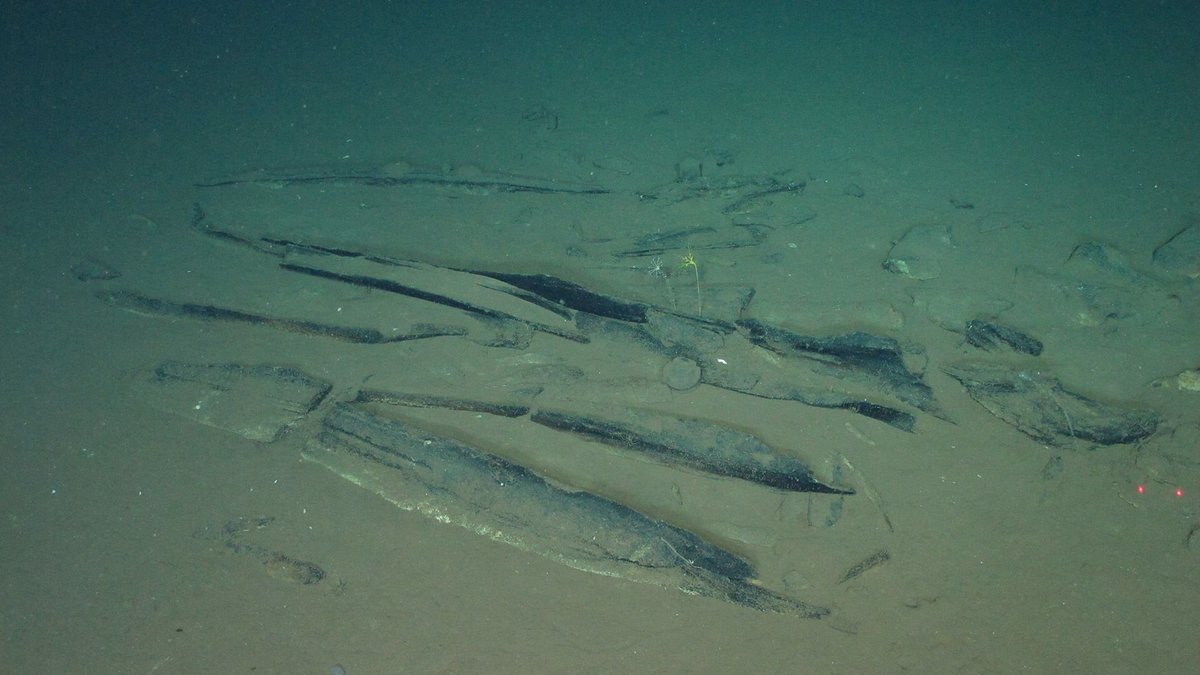
A study in Nature has revealed a vast whale graveyard deep in the southeastern Indian Ocean. Researchers led by Xiaotong Peng of the Institute of Deep-sea Science and Engineering at the Chinese Academy of Sciences documented hundreds of fossil whale remains and several modern carcasses across the Diamantina Zone, a remote region of ridges and fractures on the ocean floor.
The site stretches for about 1,200 kilometers, or roughly 750 miles, along the seafloor. Its deepest surveyed areas reach about 7,000 meters, close to 23,000 feet below the surface. At those depths, sunlight never arrives, pressure is immense and even a single whale carcass can become a rare source of food and energy.
The team described the site as a whale necropolis, a place where whale remains have accumulated over geological time. The oldest dated bones go back at least 5.3 million years, while newer carcasses still feed deep-sea communities today. That combination gives scientists an unusual window into both ancient whale evolution and the hidden ecology of the abyss.
In the paper’s words, the researchers found “a vast whale necropolis in the Diamantina Zone.” The discovery suggests that certain deep-sea landscapes can preserve biological remains for millions of years while also supporting living ecosystems fueled by death.
A 750-Mile Megasite on the Seafloor
The discovery began with deep-sea exploration in one of the least accessible parts of the Indian Ocean. Peng and colleagues used the Fendouzhe submersible, a crewed deep-diving vehicle, to survey the Diamantina Zone. After spotting an initial fossil, the team expanded its search through a series of dives across the rugged seafloor.
Across 32 dives, the researchers examined an area of about 0.64 square kilometers. Within that limited survey zone, they identified 476 fossil cetaceans and five more recent whale carcasses. The numbers are striking because deep-sea whale remains are usually found as isolated discoveries, separated by great distances and long search times.
The study reports that the broader necropolis extends about 1,200 kilometers along the seafloor. Based on the local density of remains, the researchers estimated that some parts of the area could hold about seven to eight recent carcasses and roughly 750 fossils per square kilometer. Those estimates come from a small surveyed area, so future work will be needed to map the full scale.
Even with that caution, the site stands out as an extraordinary deep-ocean deposit. Whale bones are large, mineral-rich objects, yet the deep sea usually hides or destroys biological remains over time. In the Diamantina Zone, unusual seafloor conditions appear to have helped bones remain exposed and recognizable for immense periods.
Ancient Bones and Modern Whale Falls
At the heart of the discovery are whale falls, the remains of dead whales that sink to the ocean floor. When a whale dies at sea, its body may drift for some time. Eventually, many carcasses sink, carrying carbon, fats and nutrients into a world where food is scarce.
The Diamantina Zone contains both modern whale falls and fossilized whale remains. The five active or recent carcasses were found at great depth, where bacteria and animals were still using them as food and habitat. Nearby fossil bones recorded a much longer history, reaching from modern species back into the Early Pliocene.
The researchers recovered 43 fossils and dated 33 of them using strontium isotopes. This method can help estimate age by comparing chemical signatures in bone with known changes in seawater chemistry over time. The dated fossils showed that whale falls have occurred in the region since at least 5.3 million years ago.
Many of the remains belonged to beaked whales, a group of deep-diving mammals that remain poorly known because they live far from shore and spend long periods underwater. The team identified fossils from several beaked whale species and one baleen whale species. The oldest specimen belonged to an extinct whale in the genus Pterocetus and another fossil represented a newly named species, Pterocetus diamantina.
Most fossil specimens were rostra, the bony upper jaw structures of these whales. In living beaked whales, rostra can be exceptionally dense and mineral-rich. That density may help explain why so many of these fossils survived on the seafloor long after softer tissues vanished.
A Deep-Sea Ecosystem Fed by Whale Skeletons
A whale fall can transform a patch of seafloor. In the dark ocean, falling organic matter from above is often sparse. A whale carcass delivers a concentrated burst of fat, protein and bone minerals, creating an oasis for microbes and animals adapted to extreme conditions.
In the Diamantina Zone, the active whale falls were covered with bacteria that can live without sunlight. These microbes break down oils in whale bones and produce hydrogen sulfide, a chemical that can fuel specialized life. The process helps support communities that differ sharply from the surrounding seafloor.
The researchers observed animals including jellyfish, brittle stars, bivalve mollusks and Osedax worms, which are often called bone-eating worms. At some whale falls, animal densities reached up to 2,840 individuals per square meter. For the deep sea, that is an unusually crowded scene.
Genetic evidence suggested that many of the animals associated with the carcasses may belong to species that science has yet to formally describe. The team could usually assign them to broad groups, such as genus or family. Only one sampled animal was confidently matched to a known species, the clam Abyssogena southwardae.
These modern communities also add context to the fossils. They show how whale bones first become ecological islands, then slowly enter the fossil record. Over time, chemical coatings can seal bone surfaces and help them persist as physical traces of ancient whale deaths.
Why So Many Whales Collected in One Place
Several forces may have worked together to create the Diamantina whale graveyard. The researchers observed squid and fish during dives, suggesting that the area may be a productive deep-water feeding ground. For beaked whales, which dive deeply in search of prey, such zones could attract repeated visits across many generations.
A higher presence of feeding whales could naturally lead to more deaths in the area. The study also raises the possibility that some whales may have followed prey into risky depths. Beaked whales are exceptional divers, yet extreme dives can place severe stress on the body.
Seafloor shape may also matter. The Diamantina Zone has a rugged, V-shaped topography in places, with ridges, fractures and deep troughs. Sinking carcasses could be guided into lower areas, concentrating remains that originally fell across a wider region.
Once bones reached the bottom, preservation depended on the local environment. The study notes extremely slow sediment accumulation near the Diamantina Zone. With low sedimentation, bones can remain exposed on the seafloor for hundreds of thousands of years in flat areas and potentially millions of years on slopes or raised sections.
Chemistry adds another layer. Bones that remain long enough can become coated with ferromanganese oxides, dark mineral crusts common in the deep ocean. These coatings can encase and protect the bone, turning fragile remains into more durable fossils on the seafloor.
A Fossil Record Still Taking Shape
The Diamantina Zone gives researchers a rare chance to study whale ecology across deep time. In one region, fossils of extinct whales overlap with remains from species that still live in the Indian Ocean. That overlap helps link ancient marine mammal history with present-day deep-sea biology.
Beaked whales are especially important here. Living species are hard to observe because they spend much of their lives offshore and underwater. Fossils from the Diamantina Zone may help scientists trace where these animals lived, how their diversity changed and how their deep-diving lifestyles developed over millions of years.
The site also broadens the meaning of a fossil deposit. Famous fossil beds on land often preserve ancient ecosystems that vanished long ago. This deep-sea necropolis is still forming, with modern whale falls feeding living communities near fossils that formed millions of years earlier.
The researchers suggest that similar necropolises may exist in other parts of the world’s oceans. Potential areas include waters off South Africa, the Iberian Peninsula and remote islands near Antarctica, including Crozet and Kerguelen. Some fossil whale remains have already been found in such regions through trawling, hinting that the Diamantina Zone may be the first detailed look at a broader deep-ocean pattern.
Future dives could test how continuous the deposit really is, how many species live on its whale falls and whether its fossils preserve a more detailed history of deep-diving whales. For now, the discovery shows that the ocean floor can hold a long memory of whale deaths, one skeleton at a time.