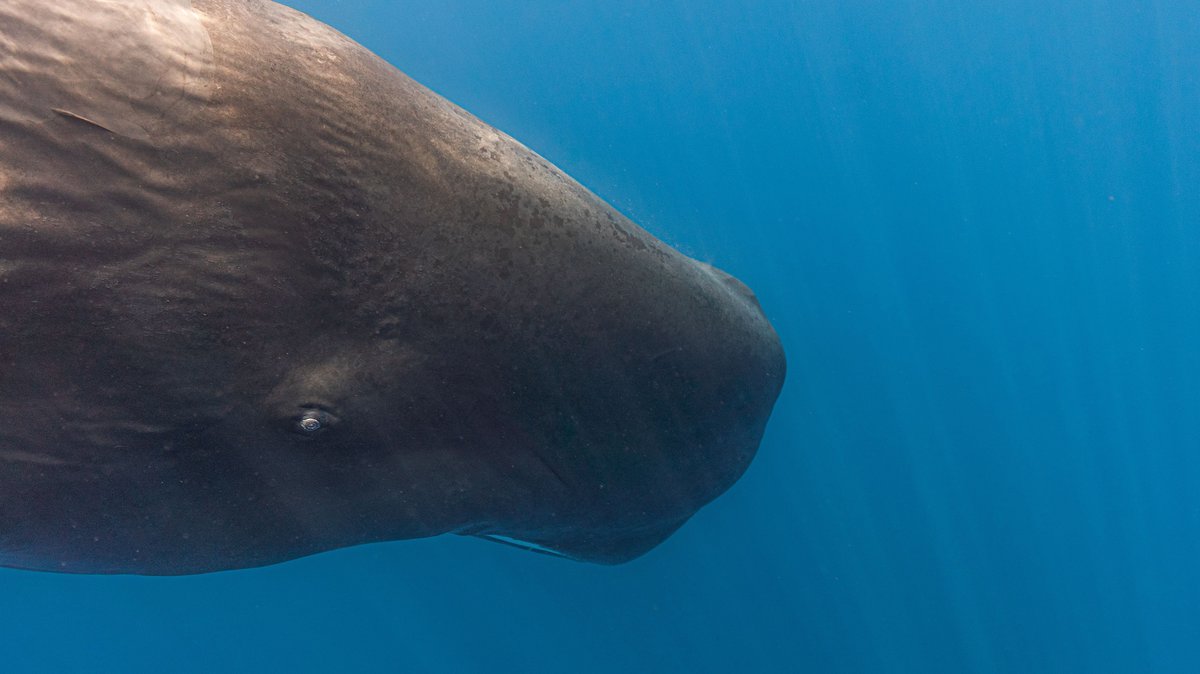
A study in Proceedings of the Royal Society B has found that sperm whales in the Mediterranean Sea appear to be splitting into two vocal dialect groups, offering a rare view of culture changing in a wild animal population. The study analyzed nearly two decades of underwater recordings from an endangered, isolated group of whales that lives inside the Mediterranean.
The research team, led by the University of St Andrews and including the University of Bristol, found that whales in the eastern Mediterranean around Greece’s Hellenic Trench use a faster version of a call pattern long associated with the broader Mediterranean population. Whales recorded farther west, around the Balearic Islands, kept using the slower form.
The finding gives scientists something unusual: a possible snapshot of dialect evolution as it happens. Sperm whales pass social sounds across generations. That makes their clicks more than noise in the deep sea. They can act like inherited cultural markers, carried by families and shared across larger social groups.
Dr Luke Rendell, a reader at the University of St Andrews Sea Mammal Research Unit, connected the discovery to the long human history of the region. “Over that entire period, sperm whale culture has also been evolving,” he said.
A rare glimpse of culture changing in the wild
Sperm whales communicate with short patterns of clicks called codas. These sounds are social signals, used by females and young whales in long-lasting groups. The patterns can identify whales as members of larger cultural communities known as vocal clans.
For years, Mediterranean sperm whales were thought to have a single dominant dialect. The key pattern was called the three-plus-one coda. It consists of three clicks, followed by a pause, then a fourth click. Across earlier work, this pattern appeared so often that it became a kind of acoustic signature for the population.
The new research complicates that picture. The whales still share a recognizable pattern, yet the eastern and western groups use it differently. That matters because sperm whale codas are learned socially. A change in the rhythm of a learned call can reveal how traditions shift over time.
Dr Taylor Hersh, lead author of the study and now at the University of Bristol, described the result as a window into the whales’ past. “These findings paint a picture of the history of sperm whales living in the Mediterranean,” she said.
How whale clicks became a dialect map
The study drew on 5,291 codas recorded from 2003 to 2021. Those recordings came from a long-running international effort to study sperm whales across the Mediterranean. The dataset allowed researchers to compare sounds from animals in the western basin with sounds from whales in the east.
That long span was crucial. Sperm whales can live for many decades and cultural change in such animals may unfold slowly. A 19-year recording record can still represent only part of a whale’s lifetime. Even so, it can reveal patterns that short field campaigns might miss.
The researchers focused on codas produced by whales in two areas. One was the western Mediterranean around Spain’s Balearic Islands. The other was the eastern Mediterranean near the Hellenic Trench, a deep-water region centered off Greece and Crete.
By comparing the timing of the clicks, the team found a clear geographic pattern. Western whales used the slower three-plus-one form. Eastern whales used a faster version of the same basic pattern. The difference suggests that the eastern whales have developed a distinctive dialect while retaining a connection to an older shared form.
The eastern whales speak faster
The eastern dialect keeps the same broad structure. Its rhythm has changed. The pause and timing in the three-plus-one coda are compressed, giving the eastern version a quicker feel.
Hersh put the difference plainly in an interview with Live Science. “It’s a very similar pattern of clicks, but it’s much, much faster,” she said.
That speed change may sound subtle to human ears, especially when described on the page. For sperm whales, timing is part of the signal. Their click patterns are precise enough that researchers can measure differences in rhythm and compare them across groups.
The result points to cultural evolution in action. A population that likely entered the Mediterranean through the Strait of Gibraltar thousands of years ago appears to have spread from west to east. During that process, one group’s inherited sound pattern seems to have changed as the animals established themselves in the eastern basin.
The study stops short of claiming that researchers know why the new dialect emerged. Social separation, local group identity and long-term isolation may all play a role. The key result is the documented split in sound use across space.
Old calls still echo in the east
The eastern whales did something especially intriguing. On some recording days, they produced the slower western form of the coda. That suggests the eastern groups remain familiar with the older pattern, even as they commonly use their faster version.
The research team described this as a kind of acoustic memory. The eastern whales seem to carry both the modified call and the ancestral-style rhythm. In the release, Hersh said the groups in the east “clearly remember that dialect as they have these ‘throwback’ days.”
This detail helps explain why the discovery is so valuable. Researchers are seeing two closely related dialects inside a single isolated population. The eastern form appears derived from the western form, which gives scientists a possible sequence of cultural change.
Animal culture can be hard to trace because it leaves few physical records. Sounds vanish as soon as they are made unless they are recorded. Long-term acoustic monitoring turns those brief signals into a timeline. In this case, the timeline hints at how a shared tradition can become regionally distinct.
The Mediterranean setting adds another layer. Human languages, customs and identities have shifted around the same sea for millennia. Under the surface, these whales appear to have been carrying their own traditions forward across generations.
Why this matters for endangered whales
The Mediterranean sperm whale population is small and genetically isolated from whales in the Atlantic. The animals face serious threats, including fishery entanglement and collisions with ships. Their endangered status makes every clue about their population structure important.
Dialect differences can help researchers understand how whale groups are organized. If eastern and western whales have distinct social traditions, conservation plans may need to account for those differences. Protecting numbers alone may miss part of what makes each group biologically and culturally important.
The study also strengthens the case for long-term international monitoring. The recordings used in the analysis came from years of collaboration among researchers working across the region. Without that shared record, the faster eastern dialect and the occasional return to the slower form would have been much harder to detect.
Dr Txema Brotons of Asociación Tursiops, part of the Spanish team involved in the study, framed the finding in broader terms. “The cultural history of the Mediterranean does not belong exclusively to humans,” he said.
Future work could pair sound recordings with individual whale identification and behavioral observations. That would help researchers learn which animals use which codas, when they switch and what social setting surrounds each call. For now, the study reveals a living record of cultural evolution in an endangered population, written in clicks across the deep Mediterranean.