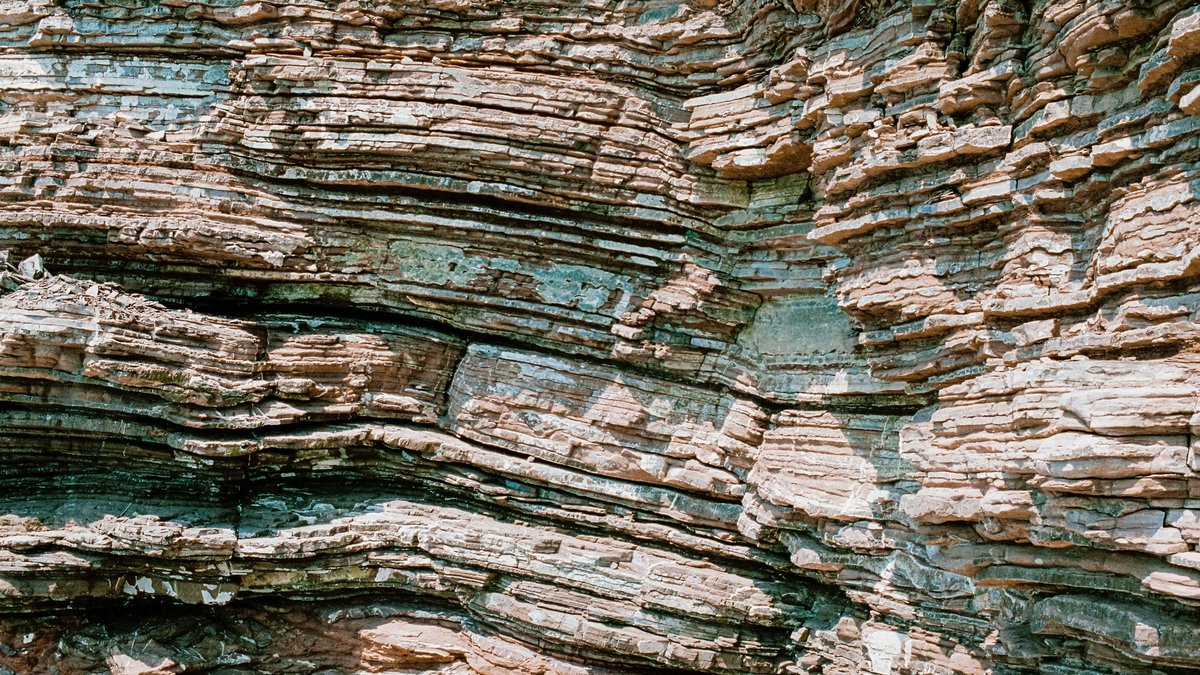
Researchers at UT Austin have reported fossilized microbial wrinkle structures in 180-million-year-old deep-water rocks from Morocco, pointing to ancient life that may have flourished in darkness. The finding, described in a study in Geology, suggests that some microbial communities left traces in places where scientists have rarely expected them to survive or fossilize.
The discovery began with a pattern on stone. While crossing rocks in Morocco’s Dadès Valley, geobiologist Rowan Martindale noticed fine, wrinkled textures spread across larger ripple marks. To a trained eye, the surface looked like a preserved microbial mat, a thin community of microorganisms that once covered sediment on an ancient seafloor.
That setting made the find especially striking. The rocks formed from turbidites, sediments laid down by underwater avalanches in deep water. At the estimated depth of about 180 to 200 meters, sunlight would have been scarce. The team’s interpretation points to microbes that drew energy from chemical reactions rather than light.
A strange pattern in Morocco’s Dadès Valley
The fieldwork took place in the Central High Atlas Mountains, where rocks now exposed on land preserve traces of an ocean that covered the region during the Early Jurassic. Martindale and colleagues were investigating ancient reef ecosystems when the unusual bedding plane caught her attention.
Across the rock surface, broad ripples recorded the force of moving sediment. Over those ripples sat a more delicate texture, with small ridges and depressions that resembled wrinkled skin. Such features are known as wrinkle structures and geologists often treat them as clues that microbial mats once stabilized the sediment surface.
The location added a layer of intrigue. These rocks came from the Tagoudite Formation in Morocco, a record of seafloor conditions during the Lower Toarcian interval of the Early Jurassic. The textures were preserved on sandy and silty layers that had been shaped by turbidity currents.
For Martindale, the pattern was clear enough to prompt a closer investigation. The team needed to test whether the wrinkles truly represented ancient biology and whether the surrounding rocks really formed in deep water. Those questions shaped the study’s next steps.
Why the rocks surprised researchers
Wrinkle structures matter because they can preserve the activity of microbial communities that lived long before larger organisms dominated many seafloor habitats. In much older rocks, similar textures have helped scientists study early life on Earth.
In younger marine rocks, these features are much rarer. Once animals became abundant on the seafloor, their burrowing and grazing often churned sediment before delicate microbial textures could harden into rock. That constant disturbance makes well-preserved wrinkles a valuable find.
The Moroccan rocks raised two challenges at once. First, the sediments were Jurassic in age, around 180 million years old, long after animals had become common in marine environments. Second, they were deposited below the sunlit zone where photosynthetic microbes would have struggled to grow.
Many known microbial mats thrive in shallow coastal environments where sunlight supports algae and photosynthetic bacteria. The Dadès Valley structures suggested a different path. The researchers had to explain how a mat-forming microbial community could develop on a deep seafloor and remain intact long enough to fossilize.
Microbial mats in the dark
In the team’s proposed scenario, the mats were produced by chemosynthetic microbial communities. These organisms can obtain energy through chemical reactions involving compounds such as methane or hydrogen sulfide. That ability lets them grow in dark ocean settings where sunlight plays little role.
Modern seafloor observations helped support that idea. Remotely operated submersibles have documented microbial mats in deep marine environments associated with organic-rich sediments and chemical gradients. These living examples show how microbial films can spread across seafloor deposits far below bright surface waters.
The Moroccan structures looked consistent with microbial wrinkle structures from shallower deposits. Their deep-water setting led the researchers toward a chemosynthetic explanation. In that model, bacteria grew during quiet intervals between sediment flows, binding grains together and creating the wrinkled surface texture.
These mats would have been fragile. A later underwater flow could have swept them away. In some cases, though, rapid burial may have sealed the surface quickly enough to preserve the texture in stone.
Chemistry pointed to life
The researchers examined the rocks for evidence that the wrinkles had a biological origin. One key clue came from elevated carbon in the sediment layers directly beneath the wrinkled surfaces. Carbon enrichment can be associated with organic matter and microbial activity.
The team also evaluated the sedimentary setting. The larger ripple marks and surrounding deposits supported the interpretation that the rocks were formed by underwater sediment flows. That context mattered because the study’s central claim depends on both parts of the story, the wrinkles and the deep-water turbidite environment.
By combining field observations with geochemical evidence, the researchers built a case for microbial mat formation in a setting far from the shallow, sunlit environments commonly linked to these structures. The evidence points to life shaped by chemistry and sediment movement.
Martindale emphasized the broader importance of these textures. “Wrinkle structures are really important pieces of evidence in the early evolution of life,” she said. In this case, they may preserve a glimpse of microbial ecosystems that existed in dark marine environments during the Jurassic.
What deep-sea landslides may have delivered
Turbidites form when underwater avalanches carry mud, sand and organic debris down slopes and across the seafloor. These flows can be sudden and powerful. They can also transport nutrients into deeper areas where microbial communities might use them.
In the Moroccan rocks, the researchers propose that turbidity currents supplied organic material to the deep seafloor. As that material decayed, it could have changed the chemistry of the sediment. Lower oxygen levels and chemical compounds from decomposition may have created favorable conditions for chemosynthetic bacteria.
Between flows, the seafloor may have entered calmer periods. During those pauses, microbial mats could spread over the sediment surface. Their growth would have helped bind grains and form the distinctive wrinkles now preserved in the rock record.
The same environment that fed the microbes could also threaten them. A later debris flow might bury, disrupt, or erase the mat. Preservation likely required a narrow set of conditions where the microbial surface formed, remained in place and was then covered in a way that protected its texture.
This cycle gives the discovery its unusual character. The underwater landslides may have provided both the ingredients for microbial growth and the burial conditions needed for fossil preservation.
A wider search for ancient life
The study suggests that geologists may need to look more closely at deep-water rocks when searching for ancient microbial traces. Wrinkle structures have often been associated with shallow settings, especially places where sunlight can support microbial mats. The Moroccan discovery expands the range of environments worth examining.
That shift could matter for studies of early life. If chemosynthetic mats can produce wrinkle structures in deep-water deposits, then some ancient rocks may hold microbial evidence that has been overlooked. Turbidites, once treated mainly as records of sediment gravity flows, may also preserve biological signals under the right conditions.
Martindale hopes future laboratory work will help clarify how these textures form. Experiments could test how microbial mats respond to sediment flows, low oxygen levels and chemical gradients. Such work would help researchers distinguish biological wrinkles from similar-looking physical patterns in rocks.
The discovery also connects the ancient seafloor with modern deep-ocean biology. Today, chemosynthetic communities occur in places where chemical energy supports life in darkness. The Moroccan rocks may show that related strategies shaped microbial habitats hundreds of millions of years ago.
Martindale put the stakes plainly: “We might be missing out on a key piece of history of microbial life.” For scientists reading Earth’s oldest and strangest textures, the message is simple. Some of the best clues may be hiding in rocks formed far below the reach of the Sun.