Researchers at Colorado State University and the Cooperative Institute for Research in the Atmosphere have assembled four centuries of reports about one of the ocean’s rarest spectacles. Their database combines sailors’ accounts with satellite observations of enormous areas of steadily glowing water known as milky seas.
The archive could help scientists anticipate where the next event will appear. That opportunity matters because researchers have struggled to reach a milky sea while it is glowing. A successful expedition could reveal which organisms create the light and how the phenomenon connects with the surrounding ocean.
Described in the journal Earth and Space Science, the database shows that sightings cluster around the Arabian Sea and Southeast Asian waters. The researchers also found statistical relationships with the Indian Ocean Dipole and the El Niño Southern Oscillation. These large climate patterns influence ocean temperatures, winds, rainfall and circulation across vast regions.
A 400-year record of glowing seas
Milky seas have appeared in maritime records since at least the early 1600s. Sailors described pale water extending to the horizon, sometimes beneath a moonless sky. The glow could remain visible for hours as ships crossed through it.
One vivid account came from Captain Kempthorne aboard the Moozuffer on January 25, 1849. He recorded an Arabian Sea that resembled snow or liquid mercury. The water was calm and its broad white radiance looked very different from the flashing blue-green light commonly produced when waves or ships disturb bioluminescent plankton.
Across four centuries, mariners repeatedly described several shared features. The light appeared steady and covered immense areas. It often surrounded ships in relatively quiet water. Some reports said the glow was bright enough to illuminate decks or make nearby objects visible.
Researchers gathered roughly 400 credible historical sightings from ship logs, scientific literature, individual records and decades of reports submitted to the Marine Observer Journal. The resulting archive is the first major reconstruction of the global milky-sea record in about 30 years.
Those observations remain uneven because shipping activity has changed over time. Many encounters occurred far from land and countless events may have passed without witnesses. Even so, the repeated concentration of reports in the northwestern Indian Ocean and around Indonesia provides a geographic pattern that scientists can compare with modern observations.
How satellites confirmed sailors’ reports
For centuries, scientific knowledge of milky seas depended almost entirely on human testimony. Their remote locations and unpredictable timing made direct confirmation exceptionally difficult. Satellites eventually gave researchers a way to search enormous stretches of ocean during the night.
An important breakthrough came when scientists matched a ship’s 1995 encounter off Somalia with an unusual feature in archived satellite imagery. The light formed a broad shape that persisted across several nights. Its position aligned with the location reported by the vessel, providing compelling evidence that the ocean’s glow could be detected from orbit.
Modern weather satellites carry instruments designed to measure extremely faint visible light. The VIIRS Day/Night Band aboard satellites such as Suomi NPP can detect moonlit clouds, city lights, fires and other low-light features. Its sensitivity also allows scientists to identify broad patches of ocean whose glow is far weaker than ordinary artificial lighting.
Satellite detection requires favorable conditions. Moonlight can overwhelm the signal, while clouds may hide the surface. Researchers must also distinguish milky seas from fishing fleets, ships, atmospheric light, coastal settlements and processing artifacts. Repeated observations and comparisons with environmental data help reduce those uncertainties.
The orbital record has strengthened the connection between modern detections and historical accounts. Both place the phenomenon mainly in the Arabian Sea, the northwestern Indian Ocean and waters near Indonesia. This agreement shows how old ship logs can become scientifically useful when paired with calibrated satellite measurements.
A glow as large as Iceland
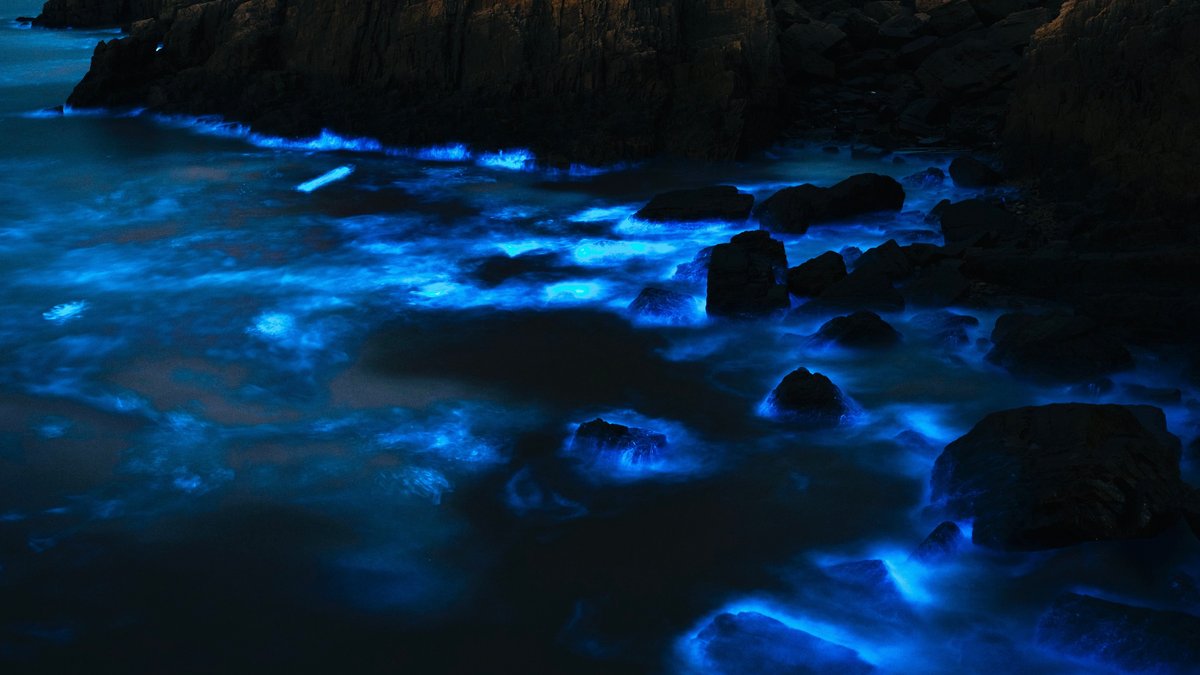
Milky seas stand apart because of their extraordinary size and persistence. Common marine bioluminescence often appears as brief flashes around breaking waves, swimming animals, or a vessel’s wake. A milky sea produces a broad and relatively uniform glow that can remain visible through the night.
A major event detected south of Java in 2019 covered more than 100,000 square kilometers. That area is comparable to Iceland. Satellite observations indicated that the glowing region drifted with the surrounding water and remained detectable over an extended period.
At such a scale, the light represents a biological process unfolding across an entire marine region. Ocean currents may shape the luminous area into arcs, swirls, or compact patches. Eddies can help gather organisms and nutrients while limiting how quickly the bloom disperses.
The total brightness remains faint when viewed from space. Its enormous surface area makes detection possible. Billions or trillions of tiny light-producing cells can collectively create a signal large enough for a sensitive orbital instrument to register.
Size estimates come with uncertainty because clouds and moonlight can obscure the boundaries. The surface may also contain brighter and dimmer zones. Even with those limitations, the largest observed events rank among the most extensive known forms of marine bioluminescence.
Why bacteria are the leading suspect
The most widely discussed explanation centers on dense populations of luminous marine bacteria. A rare direct sampling event in 1985 found glowing bacteria associated with microscopic algae and other biological material. That encounter remains a crucial piece of evidence because so few milky seas have been sampled while active.
One leading candidate is Vibrio harveyi, a bacterium capable of producing a continuous blue-green light. The color can appear white or gray to dark-adapted human eyes. Atmospheric effects and the way light travels through water may further soften its appearance.
Researchers think the bacteria may gather around an algal bloom or particles rich in organic matter. Algae release compounds that bacteria can use as food. A dense surface layer could therefore provide both nutrients and a physical environment where luminous cells accumulate.
Some organisms associated with blooms also produce mucus-like material. Such substances can alter the water’s surface and may contribute to the smooth conditions described by sailors. This proposed connection remains uncertain because scientists lack enough direct measurements of active events.
A research vessel reaching a milky sea could collect water at different depths and locations. Genetic analysis could identify the microbes, while chemical measurements could reveal their food sources. Researchers could also determine whether a single bacterial species dominates the glow or whether several organisms contribute.
Quorum sensing across an ocean
Individual luminous bacteria produce very little visible light. Their collective behavior becomes powerful once the population reaches a high density. Many species coordinate this response through a chemical communication process called quorum sensing.
Each bacterium releases small signaling molecules into its surroundings. At low population densities, the molecules disperse and remain scarce. As cells multiply within a confined area, the concentration rises. The bacteria detect that chemical buildup through specialized receptors.
Once the signal crosses a threshold, genes involved in light production become active across much of the population. Countless cells can then begin glowing within a similar period. This coordinated response provides a plausible mechanism for the steady appearance of a milky sea.
The ecological value of the light remains an open question. One hypothesis proposes that glowing bacterial colonies attract fish. When fish consume luminous material, the bacteria gain access to a nutrient-rich digestive system and may later disperse to another location.
Testing that idea would require direct observations of organisms living inside an active event. Scientists would need to measure bacterial abundance, signaling chemicals, light intensity, algal composition and animal activity. Such measurements could show whether bacterial communication truly operates across these enormous glowing regions.
Climate patterns offer predictive clues
The new database allowed researchers to compare the timing of milky seas with large-scale changes in the ocean and atmosphere. Their analysis found statistical links with the Indian Ocean Dipole and the El Niño Southern Oscillation.
The Indian Ocean Dipole describes changes in the temperature difference between the western and eastern tropical Indian Ocean. Its phases can reshape winds, rainfall, currents and biological productivity. El Niño and La Niña begin in the tropical Pacific, yet their effects can influence weather and ocean conditions around the world.
These relationships may help explain why milky seas favor particular regions and seasons. Winds and currents can concentrate nutrients or microscopic organisms. Changes in temperature may affect bacterial growth, while monsoon-driven circulation can promote the formation of large algal blooms.
The correlations do not establish a complete physical mechanism. Climate patterns operate across immense areas and several linked processes may create favorable conditions. A milky sea could require the right combination of nutrients, calm water, biological productivity, currents, temperature and bacterial abundance.
Even an imperfect relationship can improve the search. Researchers could use climate forecasts to identify broad periods of elevated probability. Satellite teams could then monitor likely regions more frequently during dark, cloud-free nights.
How researchers could reach the next milky sea
Prediction is the practical goal behind the database. Scientists need enough warning to direct a vessel toward an event before the glow fades or drifts beyond reach. That requires rapid satellite detection, reliable communication and access to ships operating near the likely regions.
An expedition would collect far more than a single bottle of glowing water. Researchers could map brightness across the event and measure conditions from the surface to deeper layers. They could record temperature, salinity, oxygen, currents, nutrients and the concentration of organic material.
Laboratory teams could use DNA sequencing to identify bacteria and algae in the samples. Instruments could measure the wavelengths and intensity of the emitted light. Chemical analyses might detect quorum-sensing molecules and reveal whether the microbial population had crossed a coordinated biological threshold.
Repeated sampling would be especially valuable. Measurements from the center, edges and surrounding dark water could show how the luminous community differs across the bloom. Observations over several days could reveal how the event forms, moves and eventually disappears.
Four centuries of sailors’ reports have now become part of a modern forecasting effort. By combining maritime history, satellite technology, climate analysis and microbiology, researchers may finally gain the opportunity to examine a glowing ocean while its hidden machinery is still running.