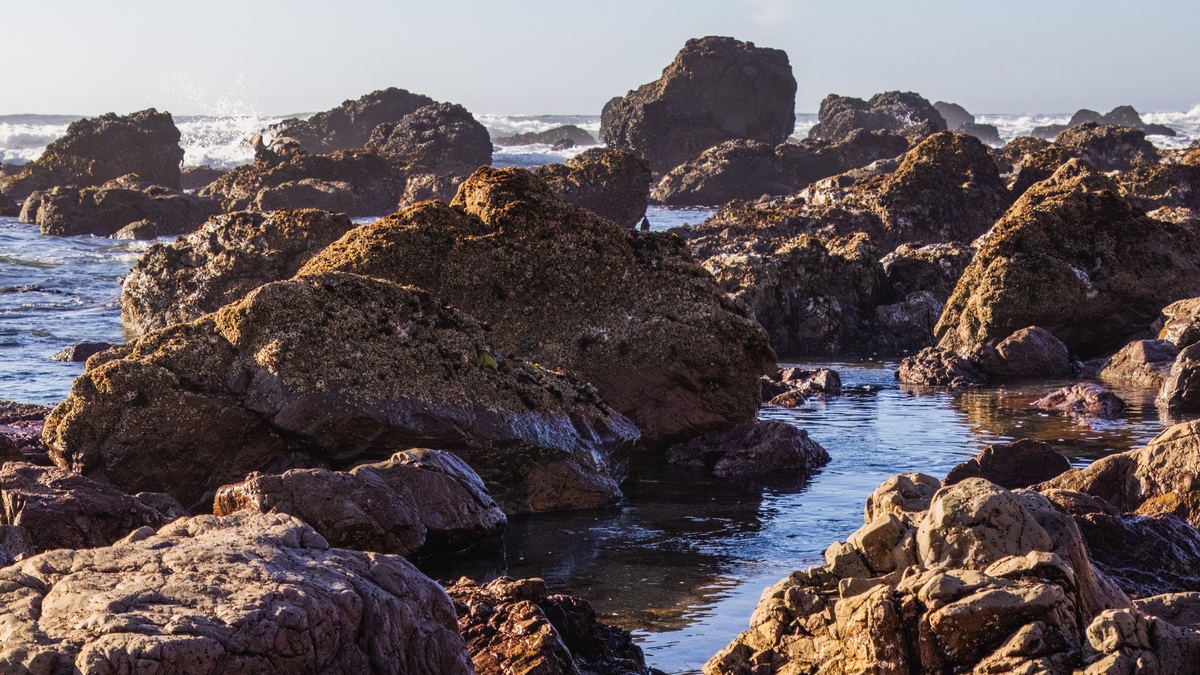
A tide pool is a pocket of seawater left in a depression on a rocky shore when the tide recedes. It may be only inches across or large and deep enough to hold fish. For the hours before the ocean returns, the pool becomes a small, partly isolated habitat where temperature, salinity and oxygen can change quickly. Its limits are physical rock, but its community remains connected to the sea.
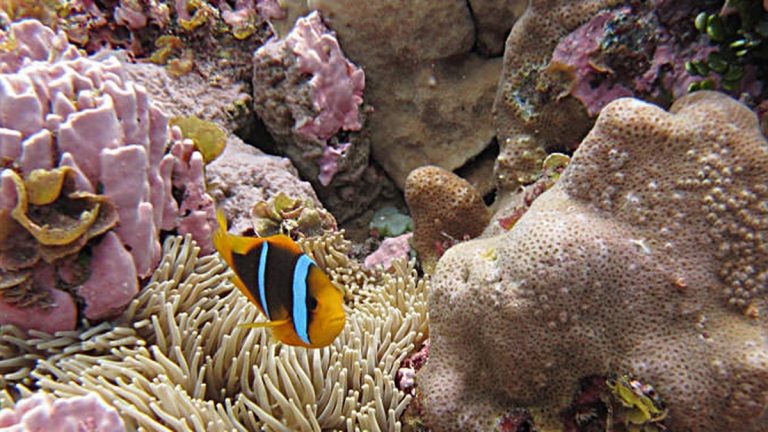
The organisms living there belong to the intertidal zone, the strip between the usual high and low tide lines. They must survive immersion, exposure and breaking waves. NOAA’s tide pool explanation describes a community that can include snails, barnacles, mussels, anemones, urchins, sea stars, crustaceans and small fish.
Retreating tides leave miniature marine habitats
High tide covers rocky ledges and fills cracks, bowls and channels. As sea level falls, water drains from exposed rock but remains in low spots. Each depression becomes a temporary pool connected to the sea by splash, seepage or the next rising tide.
A tide pool is not simply a puddle beside the ocean. Its residents, algae and microscopic life form a functioning food web. Water volume, depth, shade and distance from the open sea determine how strongly conditions change during low tide.
Pools also differ by height on the shore. A high-intertidal pool may remain isolated for long periods, while one near the low-tide line is exposed briefly. The National Park Service divides the intertidal shore into tidal zones whose communities reflect their time above water.
Conditions change during every low tide
Sunlight warms a shallow pool faster than the adjoining ocean. Evaporation removes water while leaving salts behind, which can raise salinity. Rain can drive salinity the other way, especially in a small pool with little mixing.
Oxygen also varies. Algae release oxygen during photosynthesis, while animals and microbes consume it through respiration. Warm water holds less dissolved oxygen and an isolated pool receives less replacement from waves. At night, photosynthesis stops but respiration continues.
Acadia National Park’s account of a tide pool through one tidal cycle describes warming water, evaporation and renewed mixing as waves return. The sequence repeats, but weather and tidal height make no two low tides identical.
These shifts can be steep across a short distance. A shaded crevice stays cooler and wetter than a sunlit rock surface nearby. Animals move into cracks, close their shells or retain water around their tissues to reduce stress.
Tide pool animals cling, seal and hide
Barnacles cement themselves to rock and close protective plates when exposed. Mussels use strong byssal threads to attach in groups. Limpets and snails press shells against the surface, limiting water loss while resisting waves.
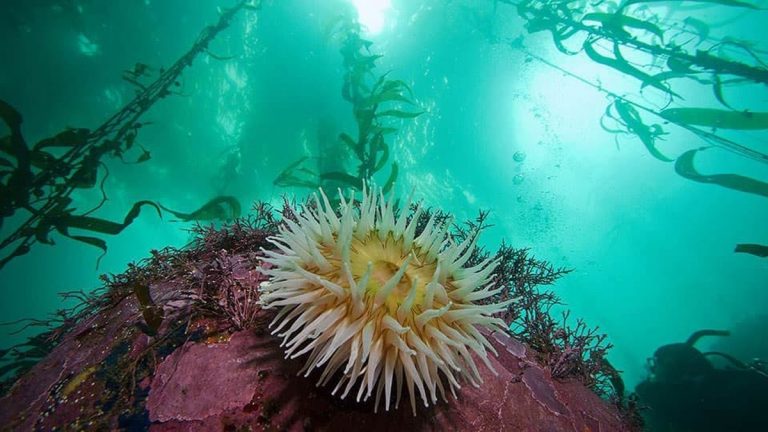
Anemones retract their tentacles and may cover themselves with shell fragments. Sea stars use tube feet to grip and move. Crabs shelter beneath rocks, while small fish occupy deeper water or crevices until the tide returns.
Every adaptation has limits. A mechanism that prevents drying may restrict feeding and a secure attachment can reduce mobility. Survival depends on enduring stressful hours without losing the chance to obtain food when water and plankton return.
Predators change with the tide. Fish can enter at high water, while birds hunt exposed pools at low tide. A resident may hide from one threat only to become visible to another.
The community also shows vertical zonation. Species able to withstand long exposure can live higher on the shore. Organisms that require steadier marine conditions cluster lower, where air exposure is brief.
Algae and plankton support the food web
Microscopic algae and larger seaweeds convert sunlight into food. Snails and urchins scrape algae from rock, while filter feeders capture plankton and organic particles carried by waves. Predatory sea stars, anemones and crabs feed on other residents.
Incoming water is therefore both physical relief and a delivery system. It restores temperature and chemistry closer to ocean conditions while bringing oxygen, plankton and drifting material. NOAA notes that waves supply nutrients and plankton to attached feeders such as barnacles.
Some food leaves the pool. Shorebirds remove prey and outgoing water carries particles to nearby habitat. The pool belongs to a broader rocky-shore system rather than operating as a sealed aquarium.
Why rocky shores produce different pools
Bedrock type and erosion control the shape of depressions. Cracks widen through weathering and wave action, while loose boulders create protected gaps. Lava coasts can contain sharply defined basins that isolate completely at low tide.
Pool geometry affects ecology. Deep pools change temperature more slowly and offer fish more refuge. Shallow pools receive intense light and may support abundant algae, yet they can also become hot or saline.
Wave exposure supplies food but applies mechanical force. Sheltered pools avoid the strongest surge, while exposed pools receive more frequent flushing. Local orientation can matter as much as height above the tide line.
Careful visits protect fragile residents
Tide pools are accessible wildlife habitats, which also makes them vulnerable to trampling and collecting. A misplaced foot can crush an animal that survives waves by remaining fixed to one patch of rock. Turning stones can expose hidden organisms to heat unless every stone is replaced gently in its original position.
Visitors should check tide tables and weather, keep an escape route from rising water and watch waves rather than turning their backs on the ocean. Safe observation is usually best from stable bare rock, not surfaces covered with mussels, barnacles or algae.
Shells should remain where they are. An apparently empty shell may shelter a hermit crab and dead shell material contributes habitat and calcium carbonate. Touching animals can remove protective mucus or force them to spend energy reattaching.
A tide pool offers a clear lesson in environmental change. Its residents endure repeated stress not because conditions are gentle, but because their bodies and behavior match a predictable tidal rhythm. Protecting the rocky shore keeps that compact display of marine adaptation intact.
Observers can learn more by watching one pool quietly than by handling many animals. As shadows settle, snails resume grazing, anemones extend tentacles and small fish leave crevices. Behavior reveals how organisms use the same limited space.
Scientists use pools as natural experiments
Tide pools allow repeated measurements of temperature, salinity, oxygen and species composition in a defined basin. Researchers can compare pools at different heights while recording the same weather and ocean conditions.
Long-term surveys detect changes in intertidal communities after heatwaves, disease outbreaks or shifts in predator abundance. Fixed photographs help separate real change from differences between observers.
Experiments in rocky intertidal habitat have also revealed how predation and competition influence which species occupy space. Results remain tied to the coast and organisms studied rather than serving as a universal rule for every shore.
Temperature sensors show that exposure depends on timing as well as air temperature. A low tide at midday can impose stronger heat stress than one occurring overnight.
Because pools are accessible, trained volunteers can contribute valuable observations. Consistent methods and careful species identification turn casual visits into evidence about coastal ecological change.
Climate stress reaches pools from air and sea
Marine heatwaves raise the temperature of incoming water, while hot air during low tide adds direct exposure. The combination can push organisms beyond conditions recorded from either environment alone.
Ocean acidification changes carbonate chemistry used by shell-building organisms. Local respiration and photosynthesis also alter pool chemistry over a day, so researchers need repeated measurements rather than one reading. The EPA’s ocean acidification overview explains the wider chemical process affecting coastal waters over time. Tracking the same pools through heat and changing chemistry shows whether familiar residents keep tolerating the shore’s repeated extremes.
Related reading: living shorelines and national marine sanctuaries.