Vampire squid and vampire fish are two unrelated animals linked only by dramatic common names. The vampire squid is a deep-sea cephalopod with webbed arms and light-producing organs. The vampire fish, usually the payara of South America, is a predatory freshwater fish with long lower-jaw fangs.
Neither drinks blood. The squid collects drifting organic debris, while the payara catches other fish. Treating them as biological counterparts hides the more interesting contrast between an oxygen-tolerant ocean scavenger and a fast river predator.
The NOAA comparison of vampire squid and vampire fish explains how appearance inspired both names. Their habitats, ancestry and feeding methods are entirely separate.
Vampire squid occupy their own cephalopod branch
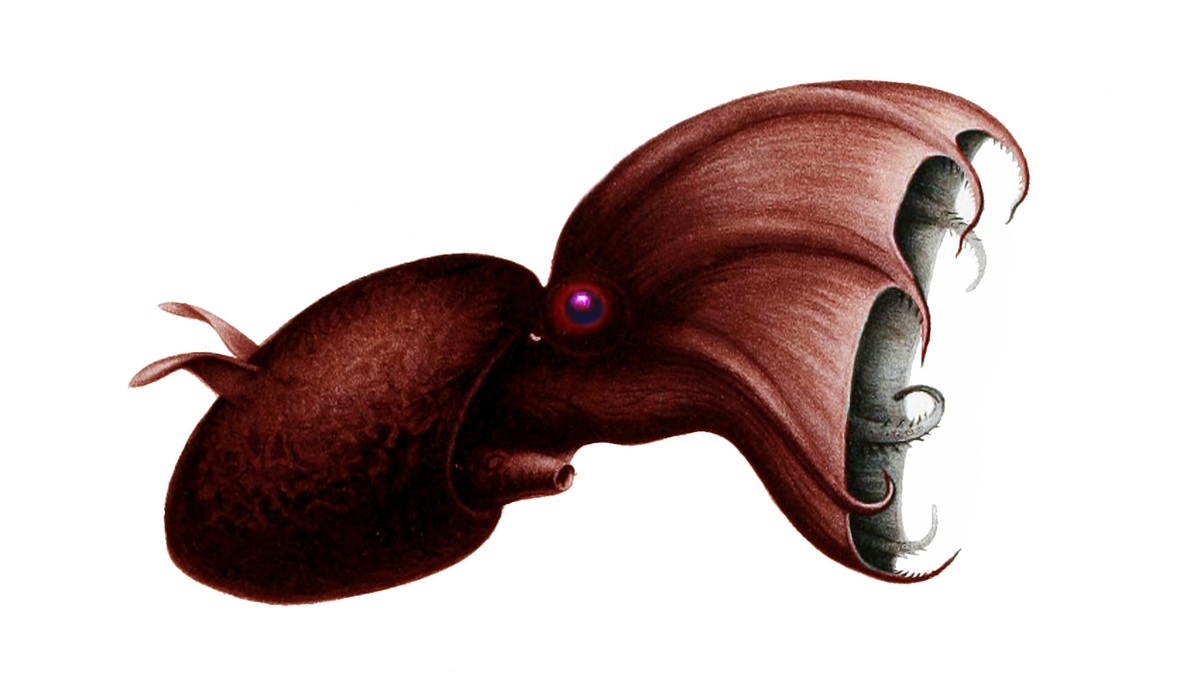
The vampire squid, Vampyroteuthis infernalis, is not a true squid in the order that contains familiar market squid. It is the sole living member of Vampyromorpha and shares ancestry with both octopus-like and squid-like cephalopods.
Eight arms are connected by a dark web that can be pulled over the body in a defensive posture. Two thin retractile filaments extend far beyond the arms and carry sensory structures used while gathering food.
Adults are small compared with giant squid, with a body length measured in centimeters. Large eyes improve sensitivity in dim water, while photophores produce controlled light. The red or black appearance depends on illumination and viewing angle.
Low-oxygen water offers refuge from many predators
Vampire squid live in deep tropical and temperate zones where dissolved oxygen can be extremely low. They have efficient oxygen-binding pigments, a low metabolic rate and large gill surfaces relative to body size.
The oxygen minimum zone excludes many active predators that cannot meet their energy needs there. Living within it reduces some dangers, but also limits prey and demands energy-saving movement.
Broad fins propel the animal with gentle strokes. It can accelerate when threatened, yet routine behavior avoids the costly jetting used by faster shallow-water squid.
MBARI’s profile of the vampire squid in Monterey Canyon describes its deep habitat, feeding and defenses based on direct submersible observations.
Marine snow replaces the imagined blood diet
Vampire squid collect marine snow, including fecal pellets, mucus, discarded feeding structures and fragments of dead organisms. A filament encounters particles, then an arm draws material toward the mouth.
Sticky mucus binds the particles into a food mass. This detritus diet is unusual among living cephalopods, which are better known as active predators. It suits a habitat where oxygen and mobile prey are scarce.
The squid may also consume small crustaceans caught with the debris, but it does not pierce large prey or suck blood. Its scientific name, translated as vampire squid from hell, describes theatrical anatomy rather than feeding behavior.
Light and mucus provide defense without ink
In deep darkness, black ink would offer little concealment. Vampire squid instead release a cloud of glowing mucus containing luminous particles. The display can distract a predator while the squid moves away.
Photophores on the body can glow and the animal may control their intensity. It can also invert its arm web, exposing spines called cirri and covering the more vulnerable head.
This pineapple posture changes the silhouette without using venom or teeth. The spines are soft, but the shape may make the animal harder to handle or recognize.
The Smithsonian Ocean portal places vampire squid within cephalopod diversity, where jet propulsion, camouflage and sensory systems vary across lineages.
Payara are freshwater predators with saber-like teeth
The fish called payara belongs to the genus Hydrolycus in South American river systems. Two long canine teeth rise from the lower jaw and fit into openings in the upper skull when the mouth closes.
Payara use those teeth to seize fish. A streamlined body and forked tail support strong swimming in river currents. Their feeding ecology bears no resemblance to the detritus-collecting vampire squid.
Several related species receive the vampire fish name, so size claims depend on identification. The best-known giant, Hydrolycus scomberoides, attracts sport fishers but is not the only fang-bearing member of the group.
Aquarium popularity can conceal difficult care
Payara require very large, oxygen-rich aquariums with current and ample swimming space. Their eventual size and predatory diet make them unsuitable for most home tanks. Captive stress can cause collisions with walls.
Feeding live goldfish carries disease and nutrition concerns. Specialist care uses appropriately sourced food and veterinary guidance. Releasing an unwanted fish can harm local ecosystems and may violate law.
The FishBase payara species account provides taxonomy, distribution and size records compiled from scientific sources. It is a better reference than sales listings that minimize adult requirements.
The shared name is a lesson in common-name limits
Common names often arise from color, teeth or folklore. They are memorable but do not guarantee evolutionary relationship. Scientific names let readers distinguish a cephalopod lineage from several freshwater fish species.
The vampire squid is adapted to low oxygen, feeds on falling debris and uses bioluminescent defense. The vampire fish is a river predator that captures fish with long teeth. The word vampire accurately predicts neither diet, which is the central fact behind both animals.
Vampire squid reproduction suits a low-energy life
Female vampire squid can release small batches of eggs repeatedly rather than one enormous terminal spawning event. This pattern differs from many shallow cephalopods that reproduce once and die soon afterward.
Repeated spawning spreads reproductive effort across time, an advantage where food arrives irregularly. It also requires long adult survival and careful energy allocation within the oxygen minimum zone.
Young vampire squid change fin pairs as they grow. A transitional stage may carry two pairs before the original fins are lost, which once confused classification of collected specimens.
Many life-history details remain difficult to observe because capture can injure deep-sea animals. Submersible video shows natural posture and movement, while specimens provide anatomy that cameras cannot resolve.
Pressure and temperature restrict deep-sea study
Bringing a vampire squid rapidly to the surface changes pressure, temperature and oxygen. Behavior in a tank may therefore reflect stress rather than ordinary ecology.
Remotely operated vehicles use low-light cameras to reduce disturbance. Bright illumination can trigger defensive displays, so researchers distinguish a response to equipment from spontaneous behavior.
In situ observation has revised the animal’s reputation. A creature once interpreted mainly from preserved anatomy is now known to collect marine snow and move with efficient fin strokes.
Environmental measurements taken beside each sighting connect behavior with oxygen and depth. Without those data, a video offers appearance but little explanation of habitat choice.
Payara belong to a complex river food web
Amazon and Orinoco river systems change with floods, channels and seasonal prey movement. Payara occupy flowing water where body shape and powerful swimming help them intercept fish.
Dams can alter current, migration routes and oxygen conditions. Fishing pressure also changes local size structure. A dramatic set of teeth does not make the species ecologically invulnerable.
Responsible sport fishing follows local harvest rules and handling guidance. Aquarium trade records should identify the species because several Hydrolycus differ in adult size and distribution.
The freshwater fish and deep-sea squid meet only in language. Comparing their real habitats replaces a monster-story pairing with two distinct examples of adaptation.
Precise names improve records and care
Names still influence conservation and trade. A frightening label may make an animal seem abundant or disposable, while its actual range and reproductive rate remain poorly known.
Museum collections preserve specimens from both groups for future comparison. New imaging can extract anatomy from old material and DNA can correct identifications made before related species were recognized.
Taxonomic precision is especially important for payara because several species enter fisheries and aquariums. Recording a genus alone may hide differences in distribution, adult size or habitat needs.
Related reading: animals that live on coral reefs and marine biogeography.