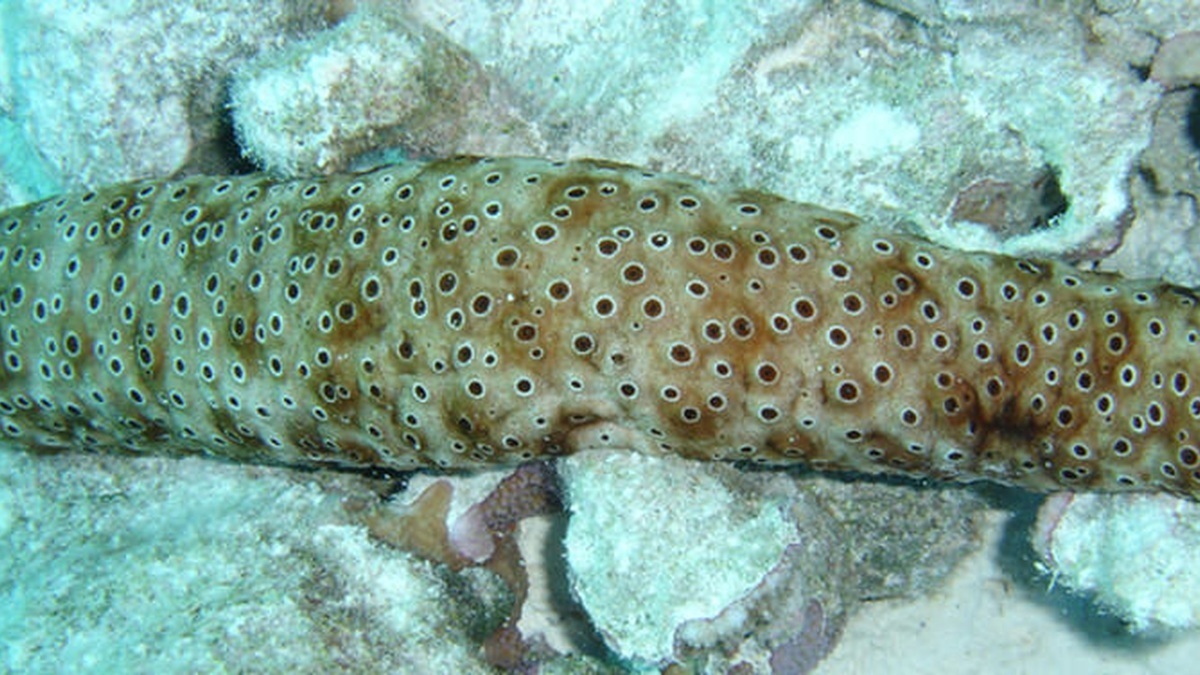
A sea cucumber is a soft-bodied marine animal related to sea stars and sea urchins. It belongs to the echinoderm class Holothuroidea and usually lives on or within the seafloor. Most species collect organic particles from sediment or filter them from water, recycling material that other organisms leave behind.
NOAA’s introduction to the sea cucumber describes an animal whose elongated body conceals the same basic radial organization found in other echinoderms. Tube feet, a water vascular system and a ring of feeding tentacles reveal that relationship.
Sea cucumbers are animals, not vegetables or simple worms. Thousands of species occupy tide pools, coral reefs and the deepest ocean floors.
Echinoderm anatomy appears in an elongated body
Most sea cucumbers have a leathery body wall with tiny skeletal pieces called ossicles embedded inside. Their five-part radial plan is reorganized so the animal has a functional upper and lower surface.
Rows of tube feet may provide traction, sensing and attachment. Burrowing species can have reduced feet, while reef species often crawl slowly across exposed surfaces.
At the front, modified tube feet form oral tentacles. These structures gather sediment, detritus or suspended particles and wipe food into the mouth.
Feeding reworks sediment and nutrients
The Smithsonian sea cucumber guide shows the striking variety of body forms and feeding tentacles across the group.
Deposit feeders swallow surface sediment and digest bacteria, microalgae and organic debris. Mineral grains pass through the gut and return to the seabed as processed sediment.
Bioturbation changes the habitat. Feeding and burrowing mix oxygen into upper layers, redistribute nutrients and break down organic material. The effect depends on species density and sediment type.
Suspension-feeding sea cucumbers extend branched tentacles into moving water. Sticky surfaces capture plankton or organic particles before each tentacle is drawn across the mouth.
Defense includes toxins and organ loss
Dense populations can process large areas, but claims about exact volumes require local measurements. Body size, temperature and food availability change feeding rates.
Some sea cucumbers expel sticky tubules that entangle a predator. Others release defensive chemicals called saponins, which can deter fish and other attackers.
Certain species eject internal organs when severely disturbed. They can regenerate lost structures over time, but evisceration is costly and does not make handling harmless.
Regeneration is not invulnerability. Repeated stress, injury or poor conditions can prevent recovery. Divers should observe without touching or provoking the animal.
The NOAA Fisheries giant red sea cucumber profile provides an example of a commercially important species and its biology.
Sea cucumbers support benthic food webs
Processed sediment can have different grain structure and chemistry after passing through the gut. On reefs, this activity may help keep surfaces from accumulating excessive organic matter.
Sea cucumbers are prey for fish, crabs, sea stars and specialized mollusks. Some small animals shelter on or inside them, forming relationships that range from harmless commensalism to parasitism.
Deep-sea species dominate many abyssal communities. Detritus arriving from surface waters is sparse and mobile deposit feeders track patches of fresh organic material.
Species identification is difficult after processing. Drying changes color and shape and market names may combine several taxa. Genetic tools and guides for ossicles help inspectors distinguish protected or regulated products.
Fishing pressure can reduce breeding density
Population surveys count animals along transects, but many species bury themselves or emerge at night. Detection therefore changes with season, time and habitat. Managers need consistent methods before comparing trends.
Reproduction often depends on density. Many sea cucumbers release eggs and sperm into the water. If harvest leaves adults too far apart, fertilization may fall even when some animals remain.
Larvae drift as plankton before settling, linking distant habitats through currents. Recruitment can vary sharply among years, so one pulse of juveniles does not necessarily indicate recovery.
Life cycles connect plankton and seafloor
Many species spawn in response to temperature, lunar cycles or chemical cues. Adults may lift the front of the body before releasing gametes into moving water.
Larvae pass through distinct feeding forms before settling and reorganizing as juveniles. Survival depends on currents, food and the availability of suitable bottom habitat.
Asexual reproduction occurs in some species through body division followed by regeneration. Its importance varies and cannot be assumed for heavily harvested populations.
Early stages are easy to miss. Plankton sampling and genetic identification help connect larvae with adults that may live far from the collection point.
Internal organs fit a bottom-dwelling animal
Water temperature influences metabolism and processing rates. Seasonal comparisons must separate a true abundance change from animals feeding more slowly or remaining buried.
Marine protected areas can preserve breeding density, though boundaries must cover habitat used by adults and enforcement must prevent concealed night harvest.
Market monitoring and underwater surveys work together because landings alone cannot reveal animals removed outside legal reporting systems.
Scientists identify species through external anatomy, ossicle shape and genetics. Color alone is unreliable because preservation and stress can change appearance.
Taxonomic uncertainty affects fishery statistics when several species share one trade name. Verified reference samples improve market monitoring and population assessment.
Symbionts use the body as habitat
Good management begins with the correct species. Growth, maturity and habitat differ enough that one quota cannot safely be transferred to every sea cucumber.
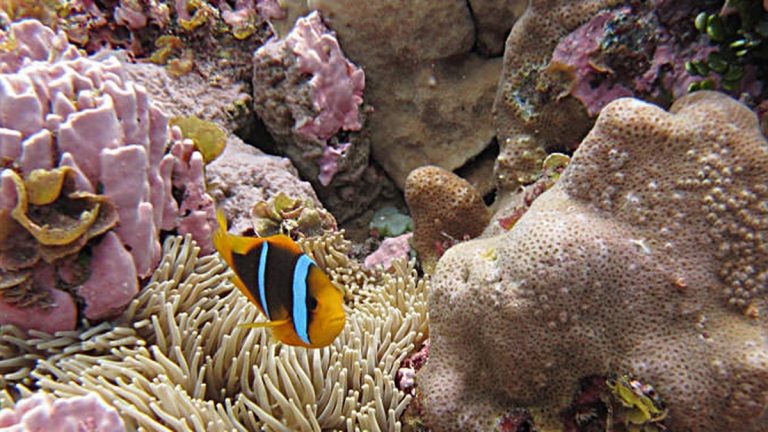
Pearlfish sometimes shelter inside a sea cucumber’s cloaca. Some associations are commensal, while others consume host tissue and act as parasites.
Small crustaceans and snails also live on the body surface. Their relationships depend on whether they merely use shelter, clean tissue or take resources.
Predators may learn to avoid saponins, yet specialized species tolerate them. Defensive chemistry therefore changes rather than eliminates predation.
Species identification guides fishery limits
Ecological value is context-dependent. High densities can alter sediment strongly, while sparse animals produce subtler effects that still accumulate over time.
Sea cucumbers breathe through respiratory trees connected to the cloaca in many species. Muscular pumping draws seawater into these branching internal organs for gas exchange.
The water vascular system operates tube feet and feeding tentacles. Unlike a sea star’s obvious arms, the five-part organization appears as longitudinal rows along the elongated body.
Ecological effects depend on local abundance
A ring of calcareous structures supports the throat, while a nerve ring and longitudinal nerves coordinate movement without a centralized brain. Sensory cells respond to touch, chemicals and light.
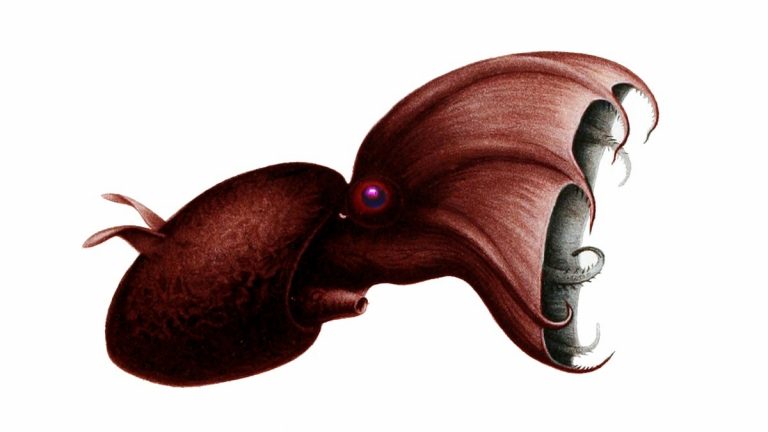
Some deep-sea species have fins or webbed structures and can swim briefly above the bottom. Transparent bodies or vivid colors are common in environments where sunlight never reaches.
Names can be misleading. The sea pig is a deep-sea sea cucumber and the Spanish dancer is a nudibranch rather than a cucumber. Scientific classification prevents superficial shape from obscuring relationships.
Understanding those systems replaces the impression of a passive tube with a more accurate animal: a mobile feeder, chemical defender and sediment engineer adapted to the seafloor.
Harvest and trade require species-level management
Dried sea cucumber, often called bêche-de-mer, is a high-value food and traditional product. Strong demand has depleted some accessible populations because the animals are easy to collect and may recover slowly.
Management tools include closed areas, minimum sizes, seasonal limits, quotas and trade controls. Enforcement is difficult where products are processed and species become hard to distinguish.
Aquaculture can supply markets and support restoration, but farms require broodstock, clean habitat and disease controls. Releasing juveniles cannot compensate for unmanaged harvest by itself.
The FAO sea cucumber fisheries review documents global fishery concerns and management approaches. Local regulations should guide any harvest or purchase.
A sea cucumber is best understood as a working member of the benthic ecosystem. Its feeding recycles organic matter, its movements rework sediment and its removal can affect processes extending beyond one unusual-looking animal.
Related reading: animals that live on coral reefs and marine biogeography.