Asian tiger shrimp are a coastal concern because they grow larger than native U.S. shrimp, eat other invertebrates and can carry pathogens that affect crustaceans. Their presence does not prove that they have caused ecological damage in every location. It creates a credible risk that agencies monitor before impacts become difficult to reverse.
The species, Penaeus monodon, is native to Indo-Pacific waters and supports major aquaculture industries. Non-native individuals have appeared along the U.S. Atlantic and Gulf coasts. Scientists use catch reports and genetics to determine whether these shrimp are reproducing locally or arriving repeatedly from elsewhere.
The NOAA Asian tiger shrimp overview describes possible pathways and ecological questions. Several ideas remain under investigation, so aquaculture escape, shipping and transport by currents should be presented as hypotheses rather than settled origins.
Large predatory shrimp can overlap with native species
Adult Asian tiger shrimp can become much larger than commonly harvested brown, white or pink shrimp in U.S. waters. They consume mollusks, crustaceans and other bottom animals. A large predator could compete for food or directly eat native juveniles.
Potential competition depends on habitat overlap and abundance. One tiger shrimp in a catch cannot deplete a fishery. A reproducing population at high density would create a different level of exposure, especially in estuaries used as nursery grounds.
The word threat therefore describes plausible mechanisms, not proof of a coast-wide decline. Scientists need diet data, population estimates and comparisons between invaded and uninvaded sites before assigning observed changes to the shrimp.
Disease risk extends beyond direct predation
Farmed and wild shrimp can carry viral pathogens, including viruses of concern to aquaculture. An introduced host might transport a strain into contact with native crustaceans, though detecting a pathogen in one animal does not prove transmission in the wild.
Disease surveillance tests tissues with molecular methods and examines animals for lesions. Researchers also compare viral sequences to identify likely relationships. Sample handling is important because contamination or degraded material can produce misleading results.
The USGS nonindigenous species profile notes both predation and pathogen carriage as concerns while describing ecological impacts in U.S. waters as uncertain. That wording separates hazard from demonstrated harm.
Biosecurity in aquaculture reduces escape and disease risk at the source. Screening broodstock, treating water and reporting unusual mortality protect farms as well as neighboring ecosystems.
Scientists are still testing whether populations are established
An introduced species is established when it maintains a reproducing population without repeated new arrivals. Adult sightings alone cannot confirm that status. Evidence may include juveniles from multiple years, reproductive females and genetic patterns consistent with local breeding.
Currents could carry larvae or adults from established populations elsewhere. Repeated transport can create many records without a self-sustaining U.S. population. Conversely, low detection does not rule out reproduction because coastal sampling is incomplete.
USGS researchers describe distribution and genetic work on Asian tiger shrimp that uses tissues to investigate sources and establishment. Genetic diversity can indicate whether records came from one release or several source populations.
Several introduction pathways remain possible
A South Carolina aquaculture facility accidentally released tiger shrimp in 1988 and animals were caught for several months afterward. Later records beginning in the Gulf in 2006 occurred after a long gap, so they cannot automatically be assigned to that event.
Aquaculture escapes in the Caribbean or other regions could seed wild populations whose larvae move with currents. Ballast water has also been proposed. Each pathway requires evidence about life stage, shipping route and survival during transport.
Genetics can reject some sources when populations differ enough, but widespread farm strains may share ancestry. Oceanographic models add another line of evidence by testing whether currents could connect a source region with a capture site during the relevant season.
Pathway uncertainty affects prevention. Stronger farm containment addresses escape, while ballast management targets shipping. Agencies may need several safeguards when no single route explains all records.
Identification prevents false reports
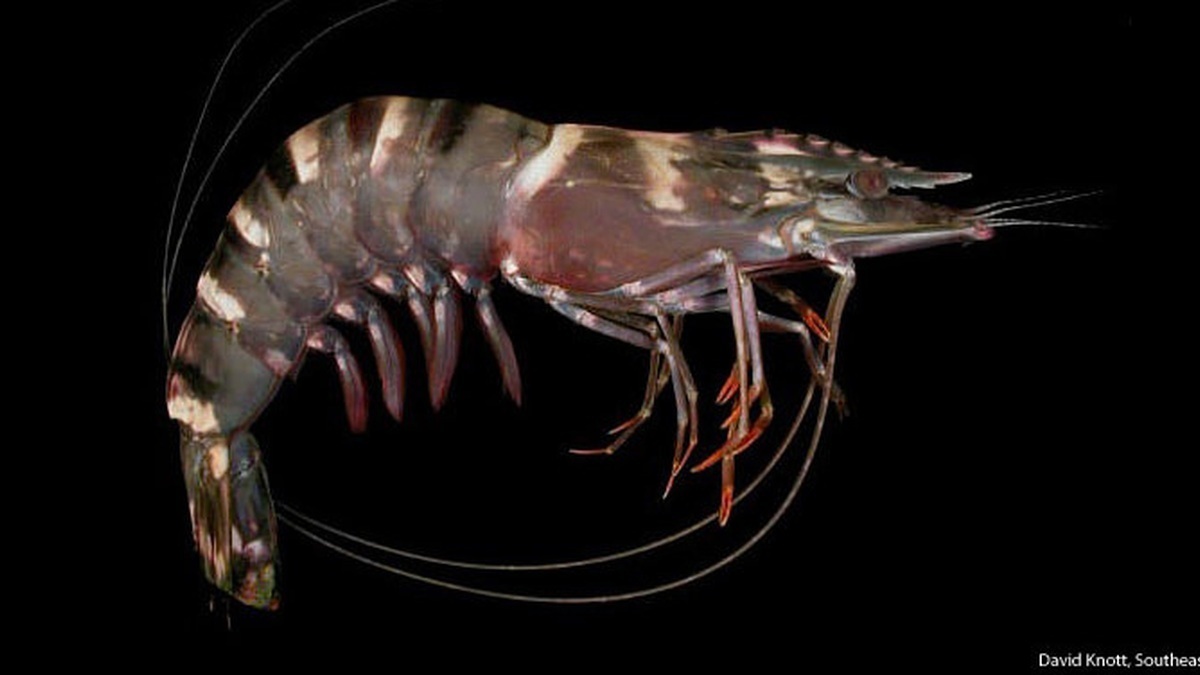
Asian tiger shrimp have dark bands across the shell and abdomen, but color varies after capture. Their large size is suggestive rather than diagnostic because juveniles are smaller and native shrimp sizes overlap.
Experts examine the rostrum, appendages and other structures. A clear photograph with a ruler, capture location and date makes a report more useful. A preserved specimen allows morphological and DNA confirmation.
The USGS sighting report system accepts nonindigenous aquatic species records. Fishers should follow current state instructions about retaining or freezing a suspected specimen because rules and research needs vary.
Monitoring works through fisheries partnerships
Commercial shrimpers sample broad areas through ordinary work and may notice unfamiliar animals before a dedicated survey does. Outreach materials help crews recognize a tiger shrimp, document the catch and connect with biologists.
Catch reports are not standardized abundance surveys. Changes in effort, gear and awareness influence how many records arrive. Researchers interpret them alongside trawls, environmental data and genetic samples.
Early detection matters because removal is more feasible when numbers are low and distribution is limited. Once a marine species spreads across interconnected estuaries, complete eradication may be unrealistic.
The coastal threat is credible but not fully measured
Asian tiger shrimp combine traits that justify concern: large body size, predatory feeding, fast growth in warm water and the capacity to host crustacean pathogens. None alone establishes that native shrimp fisheries have already been damaged.
The best response is continued identification, disease testing and source analysis. Accurate reports can show whether the pattern is fading, receiving new arrivals or developing into local reproduction. That evidence determines whether managers need prevention, containment or long-term control.
Warm coastal habitats may support expansion
Asian tiger shrimp naturally occupy tropical and subtropical estuaries. Temperature limits growth and winter survival near the colder edge of a range, while sheltered warm water can provide nursery habitat.
Climate warming could increase suitable seasons in some regions, but salinity, food and predators also control establishment. A climate envelope identifies possible habitat rather than proving a population will spread there.
Larval development passes through several planktonic stages before juveniles settle in coastal nurseries. Currents during those stages influence connectivity among estuaries and the distance an introduction can travel.
Storms can redistribute water and damage aquaculture infrastructure. Linking a particular catch to a storm still requires timing, genetics and a plausible source facility.
Economic effects would reach more than shrimp boats
Native shrimp support commercial fleets, processors and coastal restaurants. Predation or disease that reduced recruitment could move through that supply chain, although no such coast-wide effect should be claimed without fishery data.
An invasive shrimp might also be landed as a valuable product. Market value does not erase ecological risk and encouraging harvest before rules are clear could complicate reporting or transport live animals.
Managers compare control costs with expected damage under uncertainty. Early surveillance is relatively inexpensive because it uses existing catches, while a widespread response would require years of sampling.
Public reports contribute best when identification is verified. Counting every striped shrimp as an invader inflates range maps and directs resources away from real occurrences.
Field surveys test whether the risk is growing
Native predators may consume introduced juveniles, while competitors may limit their growth. These ecological filters are difficult to predict from laboratory performance alone and require field sampling across seasons.
Environmental DNA can screen water for genetic traces, but a positive sample may come from transported tissue rather than a living local population. Conventional catches remain necessary for confirmation.
Combining fishery reports, targeted trawls and genetic detection improves confidence. Agreement among methods can reveal a reproducing hotspot earlier than any one survey, allowing managers to focus limited monitoring on the most credible range expansion.
Related reading: animals that live on coral reefs and marine biogeography.