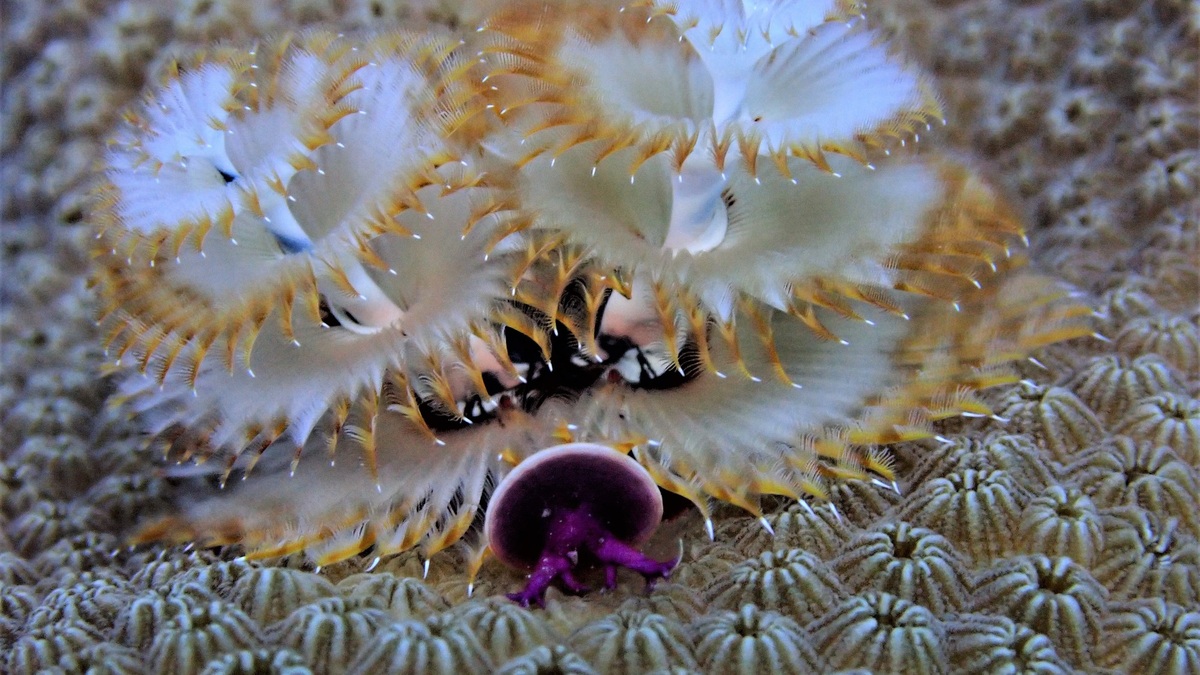
Christmas tree worms look like pairs of miniature fir trees planted across tropical coral. Each colorful spiral is a living crown used to breathe and capture food. Most of the animal remains hidden in a hard tube inside the reef, ready to pull the crowns out of sight when a shadow or vibration signals danger.
The species commonly associated with the name is Spirobranchus giganteus, a marine segmented worm in the polychaete group. Adults are small, averaging about 3.8 centimeters long according to NOAA’s overview. Their bright blue, yellow, orange, white and red crowns make them unusually easy to notice on a dive.
The resemblance to a decorated tree ends at appearance. The crowns are delicate organs called radioles and the worm’s food consists mainly of plankton and suspended particles. Its close association with living coral provides protection while adding another animal to the dense community occupying a reef’s surface.
The common name can make the animal seem seasonal, although it lives year-round on warm reefs. Individuals remain in their tubes while tides and currents deliver food. A single coral colony may hold crowns in many colors, each connected to a separate worm concealed beneath the surface. The visible display is therefore a feeding community rather than a plant-like growth.
A reef animal with a year-round life
Classification also clarifies what a visitor is seeing. Polychaetes are annelids, relatives of earthworms with repeated body segments, but marine families have evolved a broad range of appendages and lifestyles. Serpulid worms build rigid mineral tubes, unlike fan worms that occupy softer tubes made from mucus and sediment. The hard tube is central to a Christmas tree worm’s long residence within coral.
Its distribution follows suitable tropical and subtropical reef habitat rather than the calendar. Larvae disperse in the plankton before choosing a settlement surface, while adults depend on currents arriving at one fixed opening. The life cycle connects a mobile early stage with an adult that may spend years filtering water from the same patch of coral.
Reef water must bring oxygen as well as edible particles across the crowns. Changes in current can alter delivery, while suspended sediment may interfere with feeding surfaces. The worm’s small size does not isolate it from conditions affecting the wider reef.
The two trees belong to one hidden worm
A Christmas tree worm has a segmented body shaped for life inside a tube. Only two spiral crowns and a small trapdoor-like structure are normally visible. The crowns rise from the head, while the trunk of the animal extends down into the coral.
Each crown consists of feathered radioles arranged in a double spiral. Their large surface area supports gas exchange with seawater. Cilia move water and food particles along the radioles toward the mouth, allowing the same structures to serve respiration and feeding.
The Smithsonian Ocean Portal describes these appendages as tools for breathing and catching plankton. Colors vary within the species and do not identify separate tree-worm species by themselves. Pigments may help protect exposed tissues from intense light, although color also reflects genetics and local conditions.
A limestone tube anchors the animal
The worm begins life as a free-swimming larva. After settling on suitable coral, it secretes a tube made largely of calcium carbonate. Coral growth can surround the tube over time, leaving a permanent opening at the surface.
Once established, an adult is sedentary. It does not roam across the reef to search for meals. Water carries microscopic food past the crowns and the animal filters what it can use. A productive site therefore needs suitable flow as well as a living coral host.
The tube protects the soft body from predators and physical contact. A specialized operculum closes the entrance when the worm retracts. Its fit reduces access for small predators and debris while the crowns remain folded inside.
Coral and worm grow on different schedules. The worm must keep its opening clear as coral tissue and skeleton expand around it. Researchers have used coral growth bands surrounding tubes to estimate the ages of resident worms, showing that an individual can remain in one place for years.
A rapid retreat protects the crowns
A nearby swimmer may see every crown vanish almost at once. Christmas tree worms perform a rapid retraction in response to changes in light, water movement and direct disturbance. Contracting muscles pull their radioles into the tube because exposed crowns are vulnerable to fish and other reef animals.
Retraction has a cost. A hidden worm cannot filter food as effectively, so remaining withdrawn after every harmless shadow would reduce feeding time. Individuals adjust their behavior to local disturbance and gradually extend their crowns again when conditions seem safe.
The operculum seals the opening after the crown enters. Some related tube worms carry elaborate or spined opercula. In Christmas tree worms, the structure works with the calcareous tube as a compact defense system.
Divers should avoid touching a crown or trying to trigger repeated withdrawals. Contact can damage delicate radioles and fins or hands can injure the surrounding coral. Observing from a small distance reveals the natural filtering behavior without forcing the animal to spend energy hiding.
The response is also useful in research. Scientists can measure how long worms remain hidden after different stimuli, helping examine sensory thresholds and the costs of disturbance. Such experiments require careful controls because current speed, light and recent activity can change an individual’s response.
Christmas tree worms share a close life with coral
Living coral provides the hard foundation that surrounds a worm’s tube. In return, the movement of radioles may increase water flow near the coral surface, while the operculum can limit access to the opening. The association is complex and varies among coral species and environmental conditions.
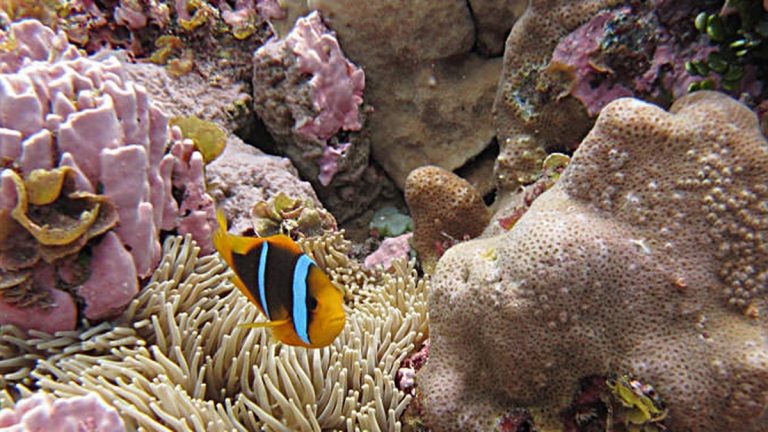
Tube growth and boring can affect the coral skeleton locally, yet healthy colonies often support many worms. The animals are widespread enough to resemble a tiny forest across some colonies. Photographs from the Flower Garden Banks National Marine Sanctuary show the kind of coral habitat where colorful reef invertebrates thrive.
Coral bleaching threatens the living host even if the worm survives the initial heat stress. When prolonged warming kills coral tissue, erosion and disease can weaken the skeleton holding the tube. Changes in plankton supply or water quality can also alter feeding conditions.
Ocean acidification makes it harder for many marine organisms to build calcium carbonate. The NOAA Ocean Acidification Program explains that additional carbon dioxide lowers seawater pH and reduces carbonate availability. Both a tube-building worm and its coral host depend on carbonate chemistry, although species respond at different rates.
The name covers a distinctive reef lifestyle
Polychaetes include thousands of segmented marine worms with very different bodies and diets. Christmas tree worms belong to the family Serpulidae, whose members build hard calcareous tubes. Their paired spiral crowns make this species one of the most recognizable members of the group.
The World Register of Marine Species maintains the taxonomic record for Spirobranchus giganteus. Scientific names help separate it from other fan worms that carry similar crowns or share common names in different regions.
Its beauty comes from functional anatomy. The spiral maximizes working surface in a small area, cilia transport captured particles and the tube provides a retreat. Every visible feature reflects the demands of feeding while remaining fixed in one exposed place.
A careful reef observer therefore sees more than decoration. The twin crowns mark the entrance to a long-term resident embedded in coral, connected to passing plankton and sensitive to changes in the surrounding water. Its small scale makes the animal easy to overlook, while its colors reveal the crowded ingenuity of reef life.
Related reading: animals that live on coral reefs and what coral reefs are made of.