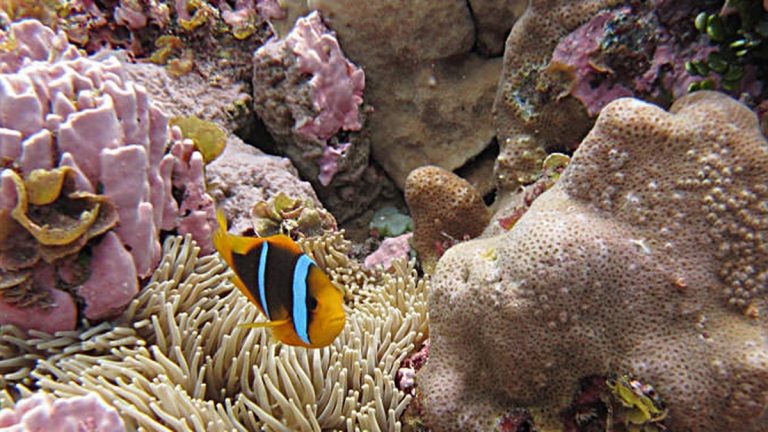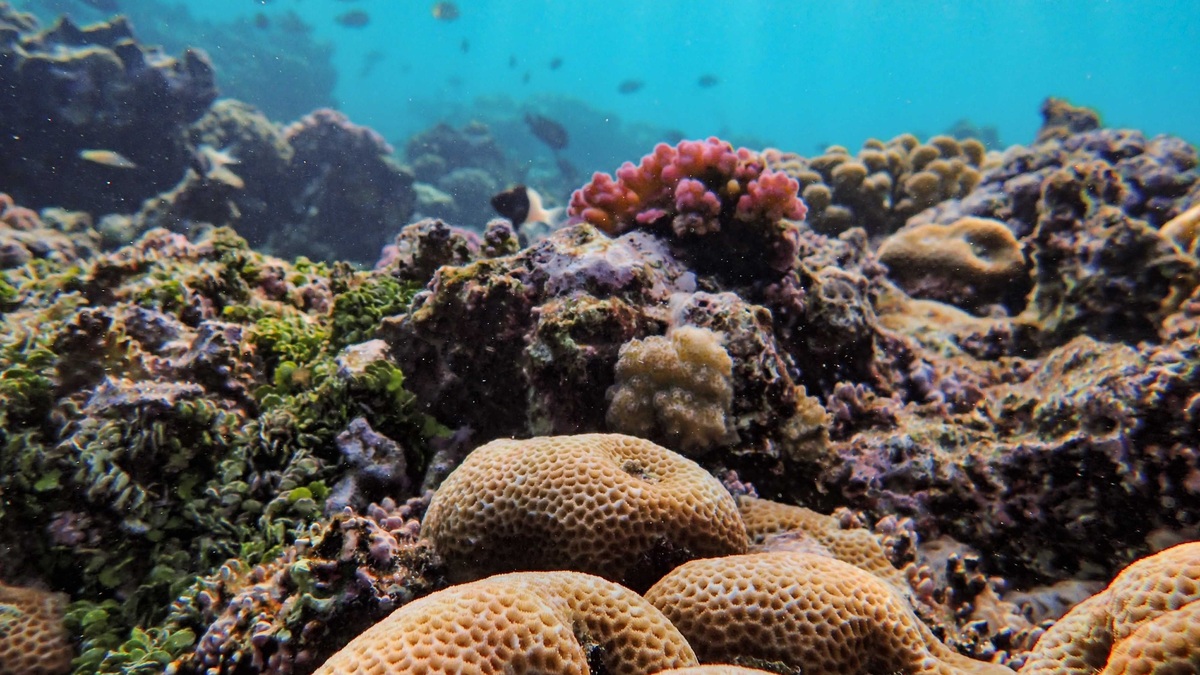
A coral reef is made from a limestone framework built and modified by living organisms. Reef-building corals provide much of the architecture, but the finished structure also contains coralline algae, shells, broken skeletons and carbonate sand. Living tissue covers only the active surface of a reef that may contain the accumulated remains of countless earlier generations.
The distinction between a coral colony and a coral reef helps explain the composition. A colony is a group of connected polyps belonging to one coral. A reef is the larger geological and ecological structure created as colonies grow together and their skeletons become cemented into a resistant calcium carbonate framework.
The National Ocean Service’s coral composition summary connects those living colonies with the limestone foundation they build.
Living polyps build the first layer
Every reef-building coral begins with soft-bodied animals called polyps. A polyp resembles a tiny sea anemone, with a mouth surrounded by tentacles. Hundreds or thousands may share a colony, linked by a thin layer of living tissue spread across the hard skeleton beneath them.
Each polyp extracts calcium and carbonate ions from seawater and deposits calcium carbonate around its base. The material forms a protective cup called a calice. NOAA’s coral reef anatomy identifies this skeletal cup as the foundation that supports the polyp and adds architecture to the colony.
Calcification takes place in a small controlled space between living tissue and existing skeleton. The coral regulates chemistry there so crystals can form. This biological control means a reef is not simply mineral precipitating from tropical water; it is the accumulated product of living calcifiers investing energy in construction.
Polyps remain in contact with the water above the skeleton. They extend tentacles to capture food and exchange substances with the surrounding sea. Most shallow reef builders also contain symbiotic algae that supply photosynthetic products, giving the animal energy to maintain tissue and continue calcification.
Hard coral skeletons accumulate through time
A single coral colony can branch, mound or spread across the bottom, depending on its species and environment. New polyps bud from existing ones and lay down more aragonite skeleton, a crystalline form of calcium carbonate. Growth enlarges the colony at its living surface while older skeleton remains underneath.
When parts of a colony die, the limestone usually stays in place. Other coral larvae may settle on that surface and surviving tissue can expand over nearby space. Repetition across many colonies gradually creates a three-dimensional framework much larger than any individual animal.
Growth rates vary widely. Massive corals generally add skeleton slowly, while some branching species extend faster under favorable conditions. NOAA Fisheries notes in its shallow reef profile that reef structures can persist for thousands of years even though their living builders are small.
The framework is not a solid block with a smooth surface. Gaps between branches and colonies create pores, caves and channels. Those spaces give reef habitats much of their ecological value by offering shelter to animals of many sizes.
Microbes and tiny invertebrates occupy the smallest pores, while fish use larger crevices as shelter from predators and strong flow. Water passing through the framework carries oxygen and food into this hidden habitat. Scientists therefore examine reef complexity as well as the area covered by live coral.
Coralline algae help cement the reef
Crustose coralline algae grow as hard pink or purple crusts on reef surfaces. They deposit calcium carbonate within their cell walls and can bind loose fragments together. Along wave-exposed reef crests, this natural cement helps the framework resist constant physical stress.
Some coralline algae also provide chemical or surface cues that encourage coral larvae to settle nearby. Their contribution is both structural and biological. A patch of stable, suitable substrate gives a young polyp a better chance to begin a colony than shifting sediment would.
Other calcifying organisms add material as well. Mollusk shells, tube-building worms and some algae leave hard remains that can enter the reef. The result is a biogenic limestone structure assembled by a community, even when corals supply the main visible framework.
Erosion creates sediment from old skeleton
Reefs grow while waves and organisms break them down. Storms can snap coral branches or dislodge colonies. Parrotfish scrape algae from hard surfaces and bite off small amounts of carbonate, while boring sponges and other organisms tunnel into the skeleton.
Broken material is ground into rubble and sand. Much of the pale sand around tropical reefs consists of calcium carbonate derived from coral skeletons, shells and calcifying algae. Currents move those grains into channels, reef flats and nearby beaches.
This process, called bioerosion when living organisms do the work, is a normal part of reef development. It opens surfaces for new growth and produces sediment that supports adjacent coastal environments. Problems arise when erosion consistently exceeds the reef’s ability to add and cement new carbonate.
Scientists often describe the balance through a carbonate budget. Calcification and cementation add material, while physical breakage, chemical dissolution and biological erosion remove it. A positive budget allows the structure to build or keep pace with changing sea level.
Budget measurements combine rates from several parts of the community. Researchers estimate skeletal production by corals and calcifying algae, then subtract losses caused by grazers, borers and dissolution. The calculation has uncertainty, but it reveals whether net reef production remains high enough to preserve elevation.
Water fills a complex three-dimensional habitat
A reef’s composition includes the seawater moving through its cavities as well as the solid framework. Flow brings oxygen and food to resident organisms, removes waste and carries larvae. The shape of the reef redirects waves and currents, creating a patchwork of exposed surfaces and sheltered pockets.
Living cover changes across that terrain. Coral tissue, turf algae, sponges and microbial films occupy the outer surfaces. Fish and mobile invertebrates move through the spaces, while animals such as worms or clams may live within the limestone itself.
The Smithsonian Ocean explains that the familiar reef is an ecosystem built around coral colonies rather than a single organism. Its physical material and biological community continually influence each other.
Reef composition changes when corals decline
Heat stress, disease and poor water quality can reduce living coral cover without immediately removing the limestone framework. A recently damaged reef may still look large, but its exposed skeleton becomes vulnerable to erosion and overgrowth. Loss of living builders gradually changes both the surface community and the strength of the structure.
Ocean acidification adds chemical pressure by reducing the availability of carbonate ions used in calcification. The U.S. Environmental Protection Agency reports that acidification can slow coral growth and weaken reef construction, with responses differing among species and locations.
A healthy reef therefore contains both inherited limestone and active construction. Living coral cover supplies new skeleton, calcifying algae reinforce exposed surfaces and a diverse community recycles material. Conservationists monitor all of these components because a photograph of coral color alone cannot reveal whether the underlying carbonate budget is gaining or losing ground.
Core samples preserve the reef’s history
Core samples let geologists look below the visible surface. Layers of old reef material record past growth, interruption and renewed construction as sea level changed. Dates from those layers show that the modern living community occupies the top of a much older carbonate archive.
The shortest accurate answer reaches across biology and geology. Coral reefs are made of living polyps on a foundation of calcium carbonate, strengthened by other calcifying organisms and reworked into rubble and sand. Both the living builders and the geological framework remain essential as construction and erosion continually alter the reef.
Related reading: mesophotic coral ecosystems and artificial reefs.