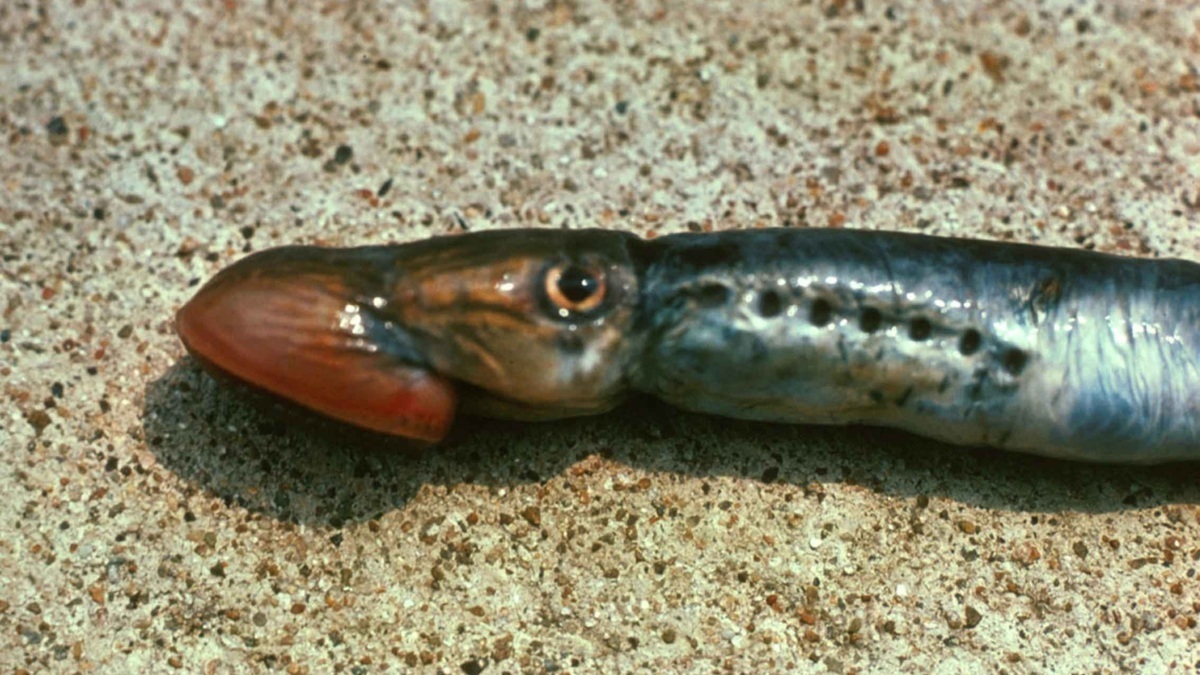
A sea lamprey is a jawless fish with a round sucking mouth and rows of keratin teeth. Adults attach to large fish and feed on blood and body fluids, while larvae spend years buried in stream sediment filtering microscopic food. The species is native to the Atlantic Ocean but invasive in the Great Lakes.
NOAA’s overview of the sea lamprey emphasizes this split identity. In its native range it belongs to natural food webs and faces conservation concerns in some rivers. In the Great Lakes it caused severe damage after gaining access around barriers.
Context determines management. Restoring a native migratory fish and suppressing an invasive population are both valid goals in different waters.
Jawless anatomy identifies an ancient fish
Lampreys lack the hinged jaws, paired fins and bony skeleton familiar in most fish. A flexible notochord supports the body and seven pairs of gill openings appear behind each eye.
The oral disc acts as a suction cup. Teeth rasp an opening in a host, while anticoagulant compounds keep fluids flowing during feeding.
Sea lampreys are not eels despite their long form. Eels are jawed bony fish with a very different skeleton and life history.
Larvae remain buried for years
The USGS sea lamprey explanation outlines identifying features and the damage invasive adults cause to Great Lakes fish.
Adults migrate into freshwater to spawn. They build nests in gravel, release eggs and die after reproduction. Hatching larvae drift downstream to quiet areas.
Called ammocoetes, larvae burrow into soft sediment and filter algae, microbes and organic particles. This stage can last several years.
Metamorphosis changes the feeding system. Eyes enlarge, the oral disc develops and juveniles move downstream. In ocean-connected rivers they enter salt water; in the Great Lakes they enter a lake.
The Great Lakes invasion damaged fisheries
After a period of parasitic growth, mature animals stop feeding and return to streams. Barriers and chemical cues influence which tributaries they enter.
Sea lampreys reached the upper Great Lakes through shipping canals that bypassed Niagara Falls. Populations expanded during the twentieth century and attacked native lake trout and other large fish.
A single host may survive an attachment, but wounds cause blood loss, infection and physiological stress. High lamprey abundance added pressure to fish already affected by harvest and ecosystem change.
The Great Lakes Fishery Commission program reports coordinated control across the United States and Canada. Suppression has reduced abundance dramatically from historic peaks without eradicating the species.
Selective lampricides are applied in infested tributaries to kill larvae. Treatment requires surveys, precise dosing and monitoring because streams contain other organisms.
Control targets concentrated life stages
Barriers block spawning adults while allowing desirable fish passage where designs permit. Traps remove adults and provide data. Sterile-male and pheromone approaches have also been studied.
No single tool works everywhere. Managers combine methods according to stream size, lamprey density, non-target risk and cost. Repeated control is necessary because surviving populations reproduce.
The NOAA Fisheries control account explains why long-term binational work remains essential to fish restoration.
Host choice changes with availability. Great Lakes adults attack lake trout, salmon, whitefish and other large species. Scars record some encounters, but scar counts underestimate attacks that kill hosts or heal without an obvious mark.
Native populations have ecological value
Managers estimate abundance using spawning runs, larval surveys and marking studies. Treatment decisions target tributaries producing enough larvae to justify control, rather than applying chemicals indiscriminately.
Lampricides exploit physiological differences but are not harmless by definition. Application crews monitor concentration and exposure, assess sensitive non-target species and follow regulatory requirements.
Barriers pose their own tradeoff. A structure that blocks lampreys may also obstruct native fish and alter river connectivity. Adjustable or selective passage technologies seek to separate desirable migrants from invaders.
Identification protects other lamprey species
Attachment removes fluids and tissue while anticoagulants prolong bleeding. A surviving fish must repair the wound and may have less energy for growth or reproduction.
Host size and condition influence survival. Large fish can bear scars, while repeated attacks or infection increase the risk of death.
Not every circular wound proves a sea lamprey attack because healing changes appearance. Standard scar classifications improve comparisons among surveys.
Fishery impact depends on abundance. Native ecosystems evolved with lamprey predation, whereas invasive Great Lakes densities created mortality beyond historical experience.
Feeding wounds affect host survival
Larval lampreys can survive several years before transformation, so successful treatment may not produce an immediate change in every adult indicator. Monitoring spans the delay.
Native predators consume eggs or larvae but do not control an invasive population alone. Biological interactions complement rather than replace targeted management.
Shipping canals remain part of the invasion history, while modern ballast rules address different pathways. Preventing the next invader requires pathway-specific controls.
Public education works best when it preserves the geographic distinction. Killing sea lampreys in native Atlantic rivers can damage restoration, while releasing one in the Great Lakes undermines control.
Public perceptions often focus on the toothed mouth, but larval habitat determines future adult numbers. Mapping soft sediment in tributaries makes surveillance more efficient.
Pheromones guide spawning migrations
Floods can redistribute larvae and alter treatment access. Crews resurvey rather than assuming last year’s distribution remains fixed.
Lifecycle knowledge drives control. The best intervention targets a stage that is concentrated and detectable instead of chasing widely dispersed feeding adults.
Managers track larval abundance, spawning adults, wounding rates and host fish populations. Falling trap catches alone could reflect weather or stream flow.
Economic assessment considers treatment costs alongside recovered fisheries. Binational funding continues because lampreys disperse across political boundaries.
Monitoring measures whether control works
Climate and river restoration can change suitable spawning habitat. Control plans need updated surveys rather than permanent assumptions about productive streams.
Suppression is adaptive management. Results from each treatment cycle guide where the next survey, barrier improvement or lampricide application will be most useful.
Several smaller lamprey species live in North American waters. Some are nonparasitic as adults, while others feed on fish. Larvae can be especially difficult to identify visually.
Geography determines the management goal
Genetic and morphological tools help survey teams distinguish species before management. Accidental treatment of rare native lampreys would undermine conservation goals.
Sea lampreys can climb wetted barriers using repeated suction and body contractions. Their ability explains why passage structures designed for jumping fish do not always stop them.
They sense pheromones released by larvae when selecting spawning streams. Researchers use this chemical communication to investigate traps, repellents or guidance systems.
Public reporting can assist control when agencies request observations, but handling rules vary. Anglers should follow local guidance rather than moving or releasing an unfamiliar lamprey.
Life-cycle biology makes control difficult
The animal’s biology explains both its invasion success and the difficulty of control. A long concealed larval stage, mobile feeding adults and strong spawning cues require surveillance across the entire life cycle.
In Atlantic rivers, adults transport marine nutrients inland when they spawn and die. Their nests can create habitat used by other organisms, while eggs and carcasses provide food.
Dams and degraded water quality can reduce native migrations. Fish passage designed for salmon may require features suited to lamprey climbing behavior if native recovery is an objective.
The species is neither universally harmful nor beneficial. Its ecological role follows biogeography. Management should use watershed history rather than the animal’s frightening feeding method alone.
Native and invasive populations require different policy
A sea lamprey is consequently an ancient migratory fish, a native component of Atlantic ecosystems and a serious Great Lakes invader. Keeping those facts together prevents invasive-species policy from being misapplied to declining native populations.
Because each life stage occupies a different habitat, effective programs coordinate tributary surveys with lake observations rather than treating the invasion as a single-season problem.
Related reading: animals that live on coral reefs and marine biogeography.