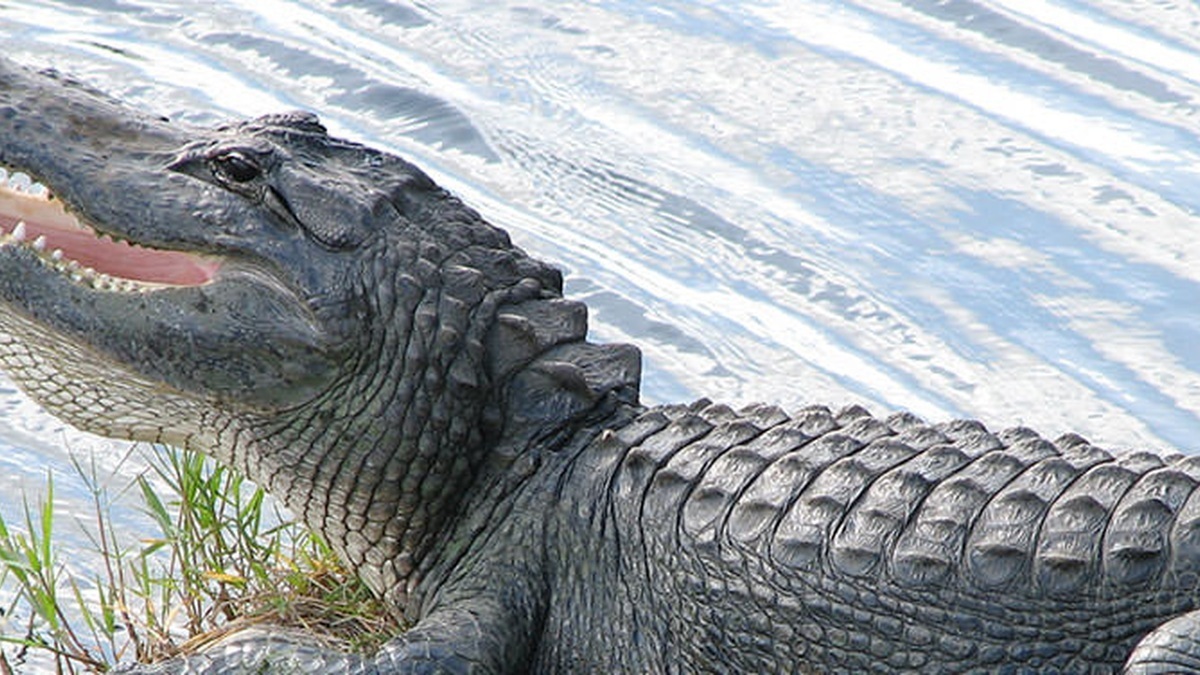
American alligators can enter ocean water, but they are freshwater reptiles rather than permanent residents of the open sea. They regularly use brackish marshes and tidal creeks and some cross salty bays or visit beaches. Long exposure to full-strength seawater creates physiological stress because alligators lack the specialized salt glands found in crocodiles adapted to marine conditions.
The practical answer depends on what “live” means. An alligator can swim, feed and travel through coastal saltwater for a limited period. Its long-term habitat still needs access to fresher water. NOAA’s coastal alligator explanation describes their occasional appearance in the ocean and their need to manage excess salt.
Alligators are built for freshwater
The American alligator occupies rivers, lakes and swamps across the southeastern United States. Its kidneys conserve water, but they cannot remove a heavy salt load efficiently enough for continuous life at sea.
Saltwater crocodiles and American crocodiles possess more effective glands in the tongue that excrete salt. Alligators have related structures with much lower capacity, leaving them less able to maintain internal balance in seawater.
Drinking seawater worsens dehydration because eliminating the absorbed salts requires water. An alligator can avoid drinking for a time and gain moisture from prey, but those strategies provide temporary tolerance rather than marine specialization.
Freshwater access allows coastal alligators to recover from salt exposure. Rainfall also freshens marshes and shallow pools, creating usable windows in places that may become saltier during drought.
Brackish marshes create a middle ground
Brackish water contains less salt than the open ocean because rivers or rainfall mix with seawater. Salinity can change with tide, season and distance from an inlet.
Alligators use tidal marshes where channels connect fresh and salty habitat. They may feed on crabs and fish, then return toward fresher ponds or rivers.
A USGS account of Florida alligator habitat notes that animals venture into brackish areas during the wet season, when rainfall reduces salinity and blue crabs offer rich prey.
Individuals do not all use the coast equally. Body size, sex and local food affect movement. A sighting on a beach cannot establish that the animal lives offshore year-round.
Short ocean trips can connect habitats
Alligators are strong swimmers and can ride currents during coastal movement. Large crocodilians can plan travel around tides, conserving energy as water changes direction.
An animal may cross an inlet, move between barrier islands or explore a shoreline. Calm nearshore water is different from a prolonged journey across exposed ocean.
Storms and floods can displace alligators into unusual locations. Others arrive through ordinary movement. Without tracking an individual, the route behind one ocean sighting often remains unknown.
The National Park Service describes American alligators in Everglades wetlands, a landscape where freshwater flow meets coastal mangroves. Maintaining that salinity gradient supports more than the reptile alone.
Behavior reduces the salt burden
Alligators can close their nostrils and a valve in the throat while submerged. Those features keep water out of airways, but they do not remove salt already swallowed or absorbed with food.
They may limit time in seawater, select fresher surface layers after rain and return inland. Resting with the mouth open helps regulate temperature, while salt balance depends chiefly on avoiding excessive intake.
Food supplies water through tissue. Marine prey also contains salts, so feeding cannot provide unlimited protection. The balance becomes harder to maintain as exposure lengthens.
Osmoregulation is the control of water and dissolved salts inside the body. Alligators manage brief coastal exposure through behavior and freshwater recovery rather than through the strong salt-excretion machinery of marine reptiles.
American crocodiles tolerate salt better
Florida is home to both American alligators and American crocodiles. Crocodiles have a narrower snout and exposed lower teeth when the mouth is closed, while alligators usually show a broader, rounded snout.
American crocodiles commonly use mangrove estuaries and coastal lagoons. Their salt glands make them better suited to brackish and marine water, though they also use freshwater.
The Florida Fish and Wildlife Conservation Commission explains the American crocodile’s coastal habitat. Confusing the two species can lead people to overestimate an alligator’s saltwater capacity.
Location alone does not identify a crocodilian. Both species can occur in coastal South Florida and safe observation should never depend on approaching closely for a better look.
Ocean sightings still require caution
An alligator on a beach may appear out of place, yet it remains a powerful wild predator. People should keep their distance, restrain pets and contact local wildlife authorities when the animal is near a public area.
Feeding alligators is dangerous because it teaches them to associate people with food. Habituated animals may approach boats or shorelines and are more likely to require removal.
Swimming near an observed alligator is unsafe in fresh, brackish or salt water. The animal’s presence in the ocean does not make it weak or harmless.
Sea-level rise may alter coastal encounters
Saltwater intrusion pushes saline water into low coastal wetlands during drought and sea-level rise. Alligators may shift toward remaining freshwater refuges or use changing brackish zones differently.
Roads and development can separate coastal marsh from inland water. Preserving movement corridors lets animals respond without crossing heavily used human spaces.
Changes in prey and nesting habitat may matter alongside salinity. Females build nests from vegetation above water, so flooding patterns affect reproduction as well as adult movement.
The EPA’s South Florida resilience guidance describes how rising seas can increase coastal flooding and saltwater effects on fresh water. Alligator sightings are one visible expression of a much broader shift.
Ocean survival has a clear limit
An alligator can survive an ocean visit because a strong swimmer does not immediately lose salt balance. The animal can avoid drinking, tolerate a temporary load and later return to fresh water.
Permanent life in the open ocean would require continual salt removal and reliable drinking water. Alligator physiology does not supply that capacity.
The best description is a freshwater predator with coastal tolerance. Brackish feeding and brief marine travel expand its options without changing the habitat its body ultimately requires.
Seeing one in surf is unusual but biologically plausible. The encounter reflects a mobile animal using a connected coast, not an ocean species establishing a life at sea.
Coastal movement follows connected habitat
Estuaries form a gradient rather than a sharp border between river and ocean. Rainfall, tides and river discharge move the salinity boundary from day to day. An alligator using marsh channels can encounter nearly fresh water, brackish pools and salty inlets during one period of movement without making a long offshore journey.
Young animals and adults do not necessarily use the coast in the same way. Body size affects travel, heat storage and vulnerability to larger alligators. Food availability also changes with season. These differences help explain why one sighting cannot define the normal behavior of every age class or every coastal population.
Tracking evidence is more informative than a photograph alone. Location, tide, recent rainfall and the distance to freshwater habitat provide context for a beach observation. Repeated records can reveal whether an animal is using a regular corridor, while a single appearance may represent brief exploration after storms or high river flow.
Coastal planning can reduce conflict by protecting wetland connections and limiting food attractants near shore. Wildlife officials can then focus on animals that repeatedly approach people rather than treating every marine sighting as proof of abnormal physiology. The ecological setting explains how a freshwater reptile can appear in surf without becoming adapted to ocean life.
Freshwater ponds within coastal marshes can function as stopping points. Their distribution changes with drought, storms and human water management, so the route available in one season may disappear in another. Mapping these freshwater refuges and nearby tidal channels gives researchers a practical way to interpret movements near beaches.
Related reading: living shorelines and national marine sanctuaries.