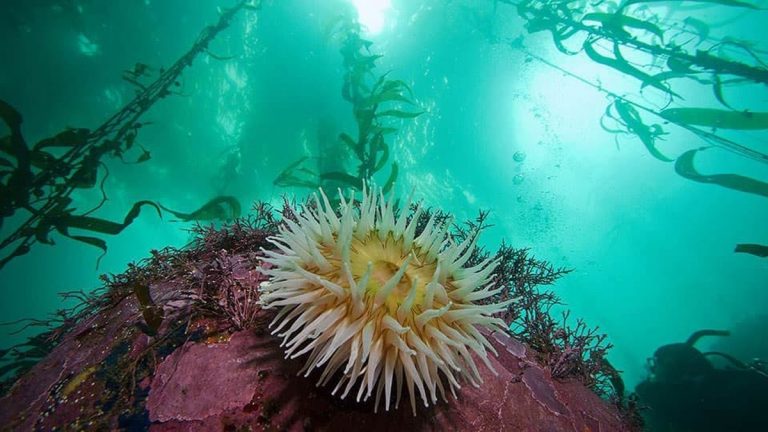
A kelp forest is a dense underwater habitat formed by large brown algae along cool, shallow, rocky coasts. Kelp is not a tree or even a plant in the botanical sense. It is algae, yet tall species can create a canopy, shaded middle layers and a crowded seafloor that function much like the levels of a forest on land.
These habitats need a particular combination of rock, light, nutrients and suitable temperature. Where those conditions meet, kelp can grow rapidly and support fish, invertebrates, marine mammals and birds. NOAA’s introduction to kelp forests places most of them in shallow coastal water, usually at depths of 49 to 131 feet.
Kelp forests are built by large brown algae
Kelp belongs to a group of brown algae rather than to the land-plant lineage. It has no true roots, stems or leaves. A holdfast grips rock without drawing water from soil, a flexible stipe supports the body and broad blades expose photosynthetic tissue to sunlight.
Some species carry gas-filled floats that lift their blades toward the surface. Giant kelp can form a broad surface canopy, while shorter kelps occupy the water below. The Office of National Marine Sanctuaries describes about 30 kelp species worldwide, each adapted to a somewhat different coastal setting.
A forest develops only when many individuals grow close enough to modify their surroundings. Fronds slow currents, dim the light below and create countless surfaces where small organisms can settle. Detached blades also carry food and shelter beyond the standing bed.
Rock, sunlight and nutrients set the boundaries
Most kelp needs hard substrate because the holdfast cannot anchor securely in shifting sand or mud. Rocky reefs therefore provide the foundation. Sunlight imposes a second limit, since kelp makes its food through photosynthesis and cannot persist far below the illuminated part of the ocean.
Cold coastal water often contains abundant nitrate and other dissolved nutrients. Upwelling can replenish those supplies by bringing deeper water toward the surface. Warm periods may reduce nutrient delivery even before the temperature itself becomes physiologically stressful.
Waves and currents present a balance. Moving water brings nutrients and removes waste, but powerful storms can tear kelp from rock. Flexible stipes allow blades to bend rather than resist every surge. NOAA Fisheries explains how temperature, currents, light and grazing jointly determine where kelp persists on the West Coast.
Conditions vary through the year. A bed can expand during a favorable growing season, lose canopy during storms and return from surviving tissue or new recruits. A single view therefore captures one stage in a dynamic habitat rather than a permanent wall of vegetation.
The canopy creates several living zones
Near the surface, floating blades intercept strong light and provide cover for juvenile fish. The midwater forest consists of stipes and blades moving with the swell. Rockfish, kelp bass and other species feed or hide among that vertical structure.
The seafloor has its own community. Holdfasts create crevices used by worms, small crustaceans and brittle stars, while the surrounding reef supports sea stars, anemones, crabs and grazing snails. These layers make habitat complexity one of the forest’s defining features.
Kelp also changes water movement. Drag from a dense stand can reduce current speed inside the forest, creating a calmer local environment. The effect is uneven because gaps, edges and channels expose organisms to different flows.
When a plant breaks loose, it does not immediately stop supporting life. Floating kelp paddies shelter small fish and invertebrates in open water. Material that sinks or washes ashore transfers kelp-derived food to deep seafloors and beaches.
The forest’s influence consequently extends beyond its visible boundary. Predators may visit to hunt, offshore animals can use drifting mats and shore communities consume stranded blades and the invertebrates around them.
Food webs depend on both growth and grazing
Kelp converts light and dissolved nutrients into new tissue, making it a powerful primary producer. Animals may graze the living blades directly, eat small organisms growing on them or consume fragments after microbes begin breaking the tissue down.
Sea urchins are especially important grazers. At moderate numbers they occupy the food web without removing the forest. When predators decline or another disturbance changes their behavior, dense urchin populations can consume holdfasts and young kelp faster than the bed replaces itself.
Predators can help restrain that pressure, although the relationships differ by region. Sea otters eat urchins along parts of the northeast Pacific coast. Lobsters, fish and sea stars can also influence grazers. It is safer to describe these as local food-web processes than as one universal chain operating identically everywhere.
Kelp forests benefit wildlife and coastal communities
Kelp beds provide refuge and feeding grounds for commercially important fish. Seals and sea lions hunt among the fronds, sea otters rest in the canopy and seabirds take fish or invertebrates around forest edges. The habitat supports life at several stages rather than serving one species alone.
People value the same places for fishing, diving, paddling and wildlife viewing. Harvested kelp enters foods, fertilizers and products that use alginates as thickeners. These benefits depend on keeping the source ecosystem productive rather than treating every standing blade as raw material.
Dense vegetation can also dissipate some wave energy. The degree of shoreline protection depends on forest width, species, water depth and storm conditions, so kelp is not a substitute for every coastal defense. It is one living component of a broader nearshore system.
Why kelp forests decline and recover
Marine heatwaves, nutrient changes, storms, disease and intense grazing can reduce a forest. Pollution and sediment can affect water quality or available light. Fishing may alter predators and grazers, while coastal construction can disturb rocky habitat.
Loss is not always permanent. Recovery can begin when cool, nutrient-rich conditions return, reproductive kelp reaches suitable rock and grazing pressure remains low enough for young plants to survive. Nearby surviving beds may supply spores, but isolated sites can recover more slowly.
Managers monitor canopy area with satellites, aircraft, divers and repeated shoreline surveys. Those records separate seasonal fluctuation from a sustained decline. Restoration projects may remove concentrated urchins, transplant fertile material or grow young kelp for outplanting, yet every method has ecological and practical limits.
A kelp forest is best understood as a changing community built around foundational algae. Its health reflects physical conditions, food-web balance and connections with nearby habitats. Protecting only the canopy without addressing water quality, climate stress or grazing would overlook the processes that keep the forest standing.
Recovery targets also need a reference point. Historical photographs, fishing records and long-running ecological surveys can show whether a site once supported persistent canopy or naturally experienced sparse kelp. A goal based on evidence avoids forcing forest onto unsuitable habitat.
How scientists measure a kelp forest
Surface canopy is visible from aircraft and satellites because floating blades reflect light differently from open water. Repeated images reveal the area and persistence of canopy-forming species, although they miss kelp that remains entirely below the surface.
Divers record kelp density, size, recruits and associated animals along fixed transects. Temperature loggers and nutrient samples connect biological change with water conditions. These observations explain more than canopy area alone.
Autonomous vehicles and sonar can survey deeper beds that are difficult to reach safely. Genetic tools help distinguish populations and track diversity. Each method sees a different part of the ecosystem.
Long-term records are crucial because storms can remove a canopy without killing every holdfast or spore. A forest may reappear within a favorable season, whereas repeated recruitment failure signals a deeper problem.
Combining remote sensing with field measurements produces the clearest assessment. It shows where foundational kelp remains, which animals use it and whether recovery is sustaining more than a temporary surface canopy.
Related reading: living shorelines and national marine sanctuaries.