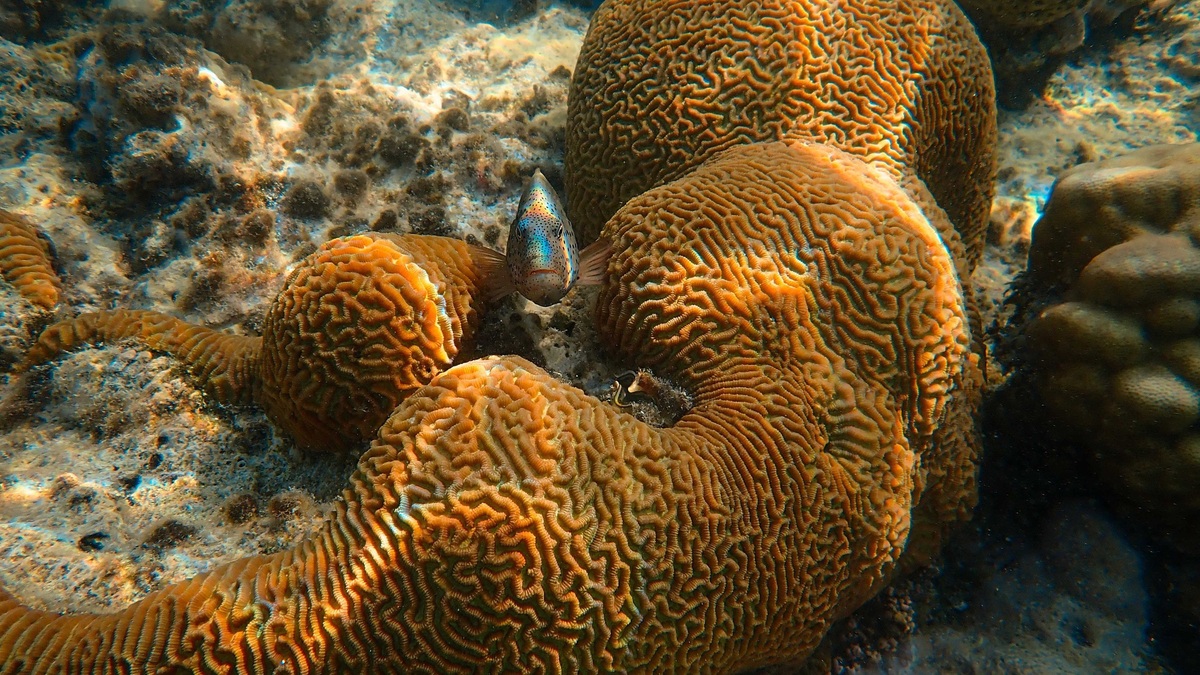
Brain corals are massive stony corals whose winding ridges and grooves resemble the folds of a brain. The pattern belongs to a colony of small animals rather than a single organism. Thousands of coral polyps share a limestone skeleton that can grow into a heavy dome over many years.
The name describes a growth form, not one species. Several related Caribbean coral genera produce brain-like surfaces and other massive corals form smoother boulders. NOAA identifies brain corals as slow-growing reef foundations whose strength helps build durable habitat.
Their rounded shape tolerates waves better than fragile branching forms. Large colonies create hard structure for other organisms and preserve annual or seasonal growth bands that scientists can study for clues about past ocean conditions.
A brain coral is a colony of polyps
Each coral polyp is a soft animal related to jellyfish and sea anemones. It lives in a small skeletal cup and extends tentacles to catch plankton. Polyps within a colony remain connected by living tissue across the skeleton’s surface.
Many shallow brain corals host photosynthetic dinoflagellates in their cells. Commonly called zooxanthellae, these partners use sunlight to make energy-rich compounds and pass much of that material to the coral. The coral supplies shelter and access to waste nutrients.
Polyps secrete calcium carbonate beneath themselves. As the living layer grows upward, older skeleton remains below. The result is a massive coral with much of its volume made from the mineral framework produced across years of growth.
The surface valleys often contain rows of polyps. Tentacles may be more visible at night, when colonies feed on passing plankton. During the day, the ridged skeleton and retracted tissue produce the familiar maze-like appearance.
Ridges and domes resist wave force
A low rounded colony presents less leverage to moving water than a tall branch. Its dense skeleton also resists breakage. Massive growth therefore suits many shallow sites where storms or constant wave action punish delicate forms.
Resistance does not make brain coral indestructible. Powerful waves can overturn or fracture colonies, while anchors and vessel groundings can scar tissue. Once exposed skeleton is damaged, algae and boring organisms may slow recovery.
At reef scale, the solid framework roughens the seafloor and helps waves lose energy. NOAA notes that coral reefs can absorb up to 97 percent of wave energy during storms, with brain corals contributing to the structure that performs this service. The exact protection at a coastline depends on reef width, depth and condition.
Slow growth creates long biological records
Brain coral colonies enlarge slowly, often on the scale of millimeters per year. A large dome may consequently be decades or centuries old. Growth continues at the living surface while older material forms an archive inside.
Some massive coral skeletons contain alternating high-density and low-density bands. Researchers can reveal them with X-rays or computed tomography, then count the pattern much as tree rings are counted. Chemical ratios within a band can reflect temperature, rainfall influence or other conditions during growth.
Such records need careful calibration because coral biology can affect skeletal chemistry. A signal in one colony may also represent very local water. Multiple cores, instrumental measurements and known dates help researchers separate broad environmental change from individual variation.
The colony remains valuable after sampling, so scientists remove narrow cores and plug the opening where possible. The procedure aims to preserve living tissue while obtaining a continuous timeline from the skeleton below.
Brain corals support reef life
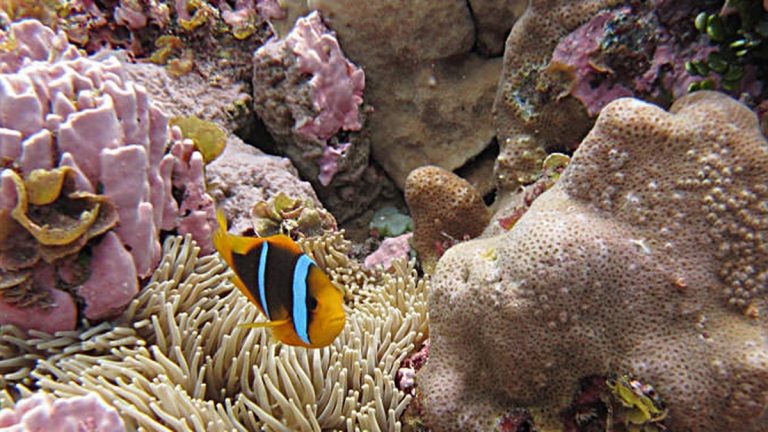
The curves of a brain coral add crevices and edges to the reef. Small fish can shelter around its base, while worms and crustaceans occupy tiny spaces in the framework. Grazers move over the surface and nearby hard bottom.
Massive colonies persist when some branching corals break, providing long-lived structure through repeated storms. Their survival helps maintain relief on a reef, although no single growth form can replace the full variety of habitat created by a diverse coral community.
NOAA Fisheries describes shallow coral habitat as home for thousands of marine creatures. The benefits arise from the combined architecture and ecological activity of many coral forms, with brain corals serving as durable components.
Heat and disease can kill old colonies
Unusually warm water can disrupt the partnership between coral polyps and their photosynthetic algae. The coral expels many of the cells and becomes pale, producing coral bleaching. A bleached colony remains alive for a time but loses a major energy source.
Brain corals can also suffer black band disease, white plague and other tissue-loss conditions. Disease susceptibility varies among species and environmental settings. Pollution, sediment and physical injury can add stress or create openings for further damage.
The IUCN assessment found a high global threat level among warm-water reef-building corals. Because massive colonies grow slowly, the death of an old brain coral removes structure that cannot be replaced in a few seasons.
Protection combines global and local measures. Limiting warming addresses the largest broad threat, while clean water and careful anchoring improve conditions at individual reefs. Monitoring old colonies also helps scientists detect disease, bleaching and growth changes before damage spreads across a site.
The name covers several related corals
Common names do not align perfectly with taxonomy. In the Caribbean, species in genera such as Diploria, Pseudodiploria, Colpophyllia and Meandrina can carry brain-like ridges. Scientists identify them through valley shape, skeletal details, tissue form and genetics.
Grooved brain coral has a different surface pattern from symmetrical brain coral, even though a casual observer may group them together. Correct identification becomes harder when tissue is bleached or partly lost.
Taxonomic names can change when genetic evidence reveals relationships that outward shape concealed. Monitoring programs preserve photographs and location records so older observations can be reinterpreted under an updated classification.
The growth form appears because neighboring polyps build connected ridges and valleys. It does not indicate nervous tissue or a brain. The maze is a skeletal architecture that exposes living tissue to light and moving water.
Spawning begins the next colony
Many brain corals reproduce sexually by releasing eggs and sperm around the same time. Fertilization produces swimming larvae called planulae. After a planktonic period, a larva settles and changes into the first polyp of a new colony.
A single recruit is vulnerable to sediment, grazing and competition. If it survives, budding adds genetically identical polyps beside it. The young colony begins laying down the massive skeleton that becomes more resistant as it enlarges.
Colonies can also reproduce through fragments in some circumstances, although a round massive form does not break and spread as readily as many branching corals. Restoration therefore relies heavily on careful propagation methods and sexual recruits for genetic diversity.
Genetic diversity affects the range of responses within a population. Nurseries and outplanting projects track parentage where possible, then monitor survival rather than assuming every genotype performs equally at every site.
Restoration follows a slow biological clock
Spawning usually follows seasonal and lunar cues that differ by species and region. Field teams watch local colonies or collect gametes during a narrow window. Successful fertilization then requires clean handling and controlled water conditions before larvae are returned to reef habitat.
A restored juvenile cannot instantly replace the coastal protection or habitat supplied by an old dome. Restoration timescales should reflect slow skeletal growth. Outplanting adds living colonies while water quality and heat exposure still determine whether they persist. Teams must revisit colonies across seasons, document partial tissue loss and compare survival with unrestored reference areas before judging a technique successful over time. Long records reveal whether recovery persists.
Related reading: mesophotic coral ecosystems and artificial reefs.