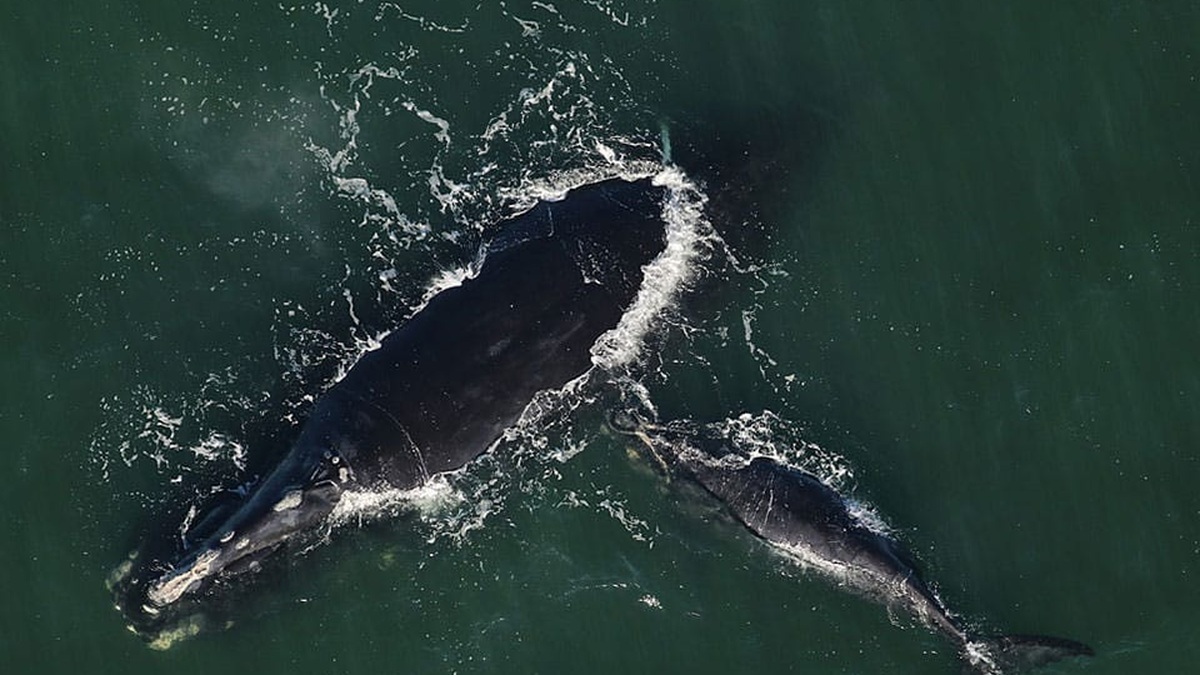
Right whales received their name from commercial whalers, who considered them the “right” whales to hunt. They swam slowly, often stayed near the surface and yielded large amounts of oil and baleen. Their bodies also tended to float after death, making recovery easier from small boats.
The name preserves the viewpoint of an industry that drove right whales close to extinction. NOAA’s history of the right-whale name explains why the same traits that helped whalers find and tow them now contribute to modern danger from ships and fishing gear.
Whalers valued a slow, floating whale
Before powered vessels and explosive harpoons, whalers approached animals in open boats and used hand-thrown weapons. A species that moved slowly and remained near the surface was easier to pursue than a fast or deep-diving whale.
Right whales have thick blubber that produced valuable oil. Their long baleen plates also supplied a flexible material used in products before modern plastics and spring steel became common.
A killed whale could be lost if it sank. Right whales often floated because of their blubber, allowing hunters to tow a carcass to a ship or shore. Those economic features lie behind the grim phrase right whale to hunt.
The name dates from whaling culture rather than scientific taxonomy. It continued into common and formal species names even after commercial hunting ended in many waters.
Three living species carry the name
Scientists recognize the North Atlantic right whale, North Pacific right whale and southern right whale. They belong to the genus Eubalaena and share a heavy body, broad back without a dorsal fin and roughened patches of skin called callosities.
North Atlantic right whales range along the eastern coasts of the United States and Canada. Southern right whales occupy the Southern Hemisphere. North Pacific right whales live across parts of the North Pacific and are especially rare in the eastern portion of that ocean.
The bowhead whale belongs to the same family but a different genus. Early English speakers sometimes called it the Greenland right whale, which can create confusion in older sources.
Genetic and anatomical studies helped establish the three right-whale species recognized today. Their common name reflects shared appearance and whaling history, while each population has its own range and conservation status.
Callosities help identify individual whales
Right whales have raised, pale patches on the head. The tissue itself is dark, but colonies of small crustaceans called cyamids make many callosities look white or cream.
The pattern varies among individuals and remains stable enough for photographic identification. Researchers compare images of the head, lips and scars to match new sightings with cataloged whales.
Photo-identification catalogs allow scientists to follow births, deaths and movements without attaching a tag to every animal. A clear photograph can connect observations separated by years and hundreds of miles.
NOAA Fisheries maintains extensive information on North Atlantic right whales, including population monitoring and threats. Aircraft, vessels and acoustic instruments contribute different kinds of sightings.
Baleen filters small prey from seawater
Right whales are baleen whales. Instead of teeth, they have long plates hanging from the upper jaw. Fine fringes along the plates strain prey as water exits the mouth.
They often feed by swimming slowly through dense patches of copepods with the mouth open, a method called skim feeding. The enormous mouth and arched jaw hold exceptionally long baleen.
Feeding depends on prey becoming concentrated enough to repay the energy required to travel and filter water. Temperature and currents influence where copepod layers form.
Whales may feed near the surface or at depth. Surface feeding makes them difficult for mariners to see because the dark back has no dorsal fin and may sit low in the water.
Industrial whaling caused severe declines
Centuries of hunting removed right whales across the North Atlantic and Southern Hemisphere. In the North Pacific, intensive nineteenth-century hunting was followed by illegal Soviet catches during the twentieth century.
NOAA Fisheries reports that North Pacific right whales were called the right whales to hunt because they were slow, oil-rich and buoyant. Its North Pacific history describes the eastern population as numbering fewer than 50 animals.
Southern right whales have recovered more strongly in several regions after protection, though recovery varies among breeding populations. The North Atlantic species remains critically endangered.
Low abundance makes every preventable death consequential. Long reproductive intervals mean populations cannot quickly replace adults lost to human activity.
Ships and fishing gear remain major threats
Modern commercial whaling no longer drives North Atlantic losses, but the whales migrate through busy coastal waters. Vessel strikes can cause blunt-force injury or propeller wounds.
Ropes from fixed fishing gear can wrap around the mouth, flippers or tail. A whale may drown quickly or drag gear for months, losing energy while wounds deepen.
Scientists use scars to estimate how often whales encounter gear. Entanglement can affect health and reproduction even when an animal survives, so counting confirmed deaths captures only part of the damage.
Speed limits in selected areas reduce the force of collisions. Fisheries are testing on-demand fishing gear that keeps vertical lines out of the water column until retrieval, though adoption involves technical and economic challenges.
The Marine Mammal Commission summarizes North Atlantic right whale threats and recovery actions. Effective protection must follow whales as their seasonal distribution responds to changing prey.
Acoustic monitoring finds whales beyond sight
Right whales produce low-frequency calls that travel through water. Fixed recorders, autonomous vehicles and listening buoys detect calls when weather or darkness prevents visual surveys.
Near-real-time acoustic systems can alert mariners that whales are present in a region. Silence does not prove absence because an animal may pass without calling or remain beyond detection range.
Aerial surveys provide location, body condition and identification photographs. Shipboard observers collect additional behavior and prey data. Combining methods produces a more complete picture than any one survey.
Researchers also analyze fecal samples, skin biopsies and hormones to study stress, genetics and reproduction. These measurements help explain why a living whale may still be in poor condition.
The old name now carries a conservation lesson
“Right whale” sounds approving until its origin is known. The name records how people once judged a species according to the ease and profit of killing it.
The same biology has a different meaning under conservation. Slow surface travel increases collision exposure, thick blubber contributes buoyancy after a fatal strike and coastal migration overlaps fishing grounds.
Renaming the animals would not remove those risks or erase the historical record. Explaining the name makes the consequences of exploitation harder to overlook.
Right whales now serve as closely watched indicators of whether shipping, fishing and wildlife protection can coexist. Their recovery depends on reducing deaths faster than the population’s slow reproductive pace, a reversal of the logic that once made them the “right” target.
Names and scars preserve individual histories
Research teams assign many cataloged right whales names based on callosity patterns, scars or memorable events. A name helps scientists and the public follow one life across years of sightings.
Individual histories reveal population pressures in concrete form. Photographs may document a new calf, declining body condition or fresh entanglement scars without assuming the cause of every change.
Catalog records also prevent repeated sightings from being counted as different whales. Matching the same identified right whale across surveys improves estimates of survival and reproduction.
The historical species name came from exploitation, while modern individual names support observation and recovery. Both uses of language remain attached to the same animals, but they reflect opposite relationships with them across the history of whaling and conservation.
Related reading: animals that live on coral reefs and marine biogeography.