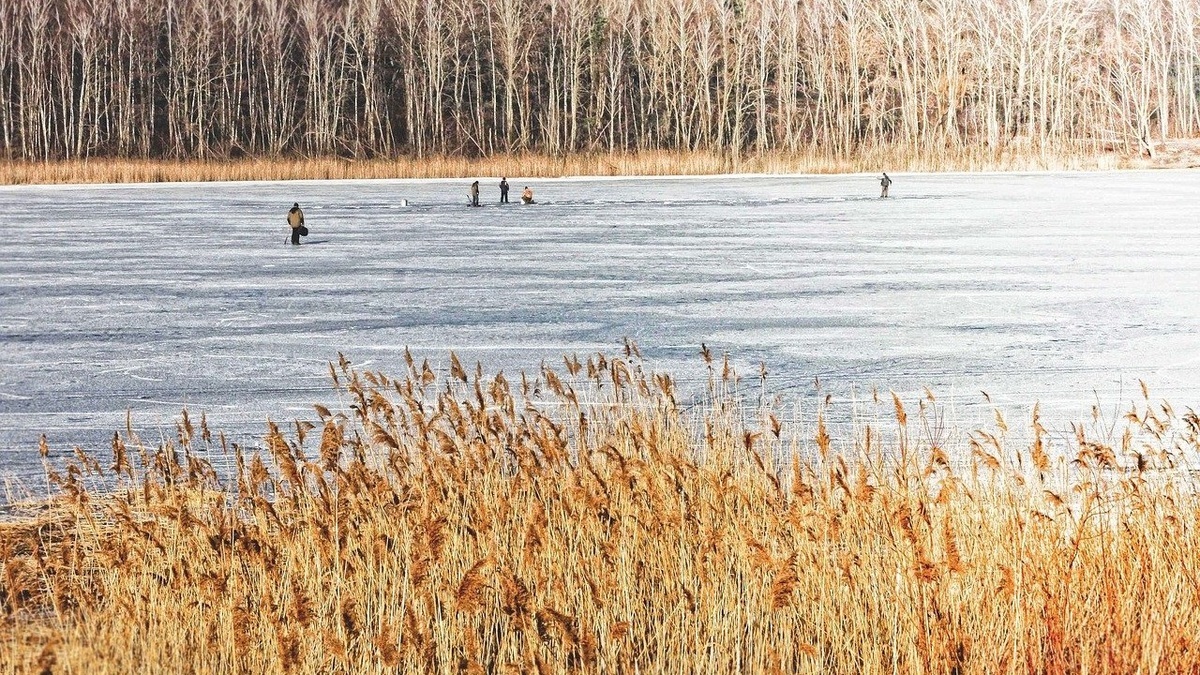
Fish remain in liquid water beneath a frozen lake. Ice forms at the surface and floats, insulating the water below from colder air. Most fish move into deeper or more stable habitat, reduce their activity and survive on oxygen already dissolved in the lake until spring mixing restores stronger exchange with the atmosphere.
The safe winter zone depends on depth, oxygen and species. NOAA’s frozen-lake explanation describes how water’s unusual density keeps lakes from freezing solid under ordinary conditions.
Ice floats because solid water is less dense
Fresh water becomes densest near 4 degrees Celsius. As a lake cools in autumn, dense surface water sinks and mixes the water column until much of it approaches that temperature.
Further cooling makes surface water less dense, so it stays above the deeper layer. Once it reaches the freezing point, ice crystals form and remain at the top.
The open structure of ice occupies more volume than the same mass of liquid water. Floating ice prevents freezing from progressing downward as quickly as it would if ice sank.
Snow and ice slow heat loss from the lake. The bottom may stay close to 4 degrees even while air above the surface is far below freezing.
Fish settle into winter habitat
Many species move away from the coldest surface water and occupy deeper zones with relatively steady temperature. “Where” differs among fish because oxygen, food and preferred structure also matter.
Some gather near the bottom, while others remain suspended over deep water. Fish may use submerged vegetation, rocky structure or channels where current carries oxygen.
The movement is less a single migration than an adjustment to local conditions. A shallow pond offers fewer choices than a large lake with deep basins.
Cold-water fish and warm-water fish have different temperature preferences. Both must keep water flowing across their gills and maintain enough energy to survive.
Cold water slows metabolism
Fish are ectotherms, so body temperature follows the surrounding water. Cooling slows chemical reactions in their tissues and reduces the energy required for routine activity.
Lower winter metabolism lets many fish live on smaller or less frequent meals. They still move, feed and respond to predators, but often at a slower pace.
Species differ. Some remain active beneath ice and support winter fisheries. Others become relatively inactive in protected habitat.
Energy reserves accumulated during warmer months can support maintenance when prey is scarce. Small or poorly conditioned fish may face greater winter risk.
Oxygen becomes the main constraint
Once ice seals the surface, wind can no longer mix atmospheric oxygen into the lake. Photosynthesis by algae and plants continues where enough light penetrates.
Fish, invertebrates and microbes consume dissolved oxygen. Decomposition of dead plants and organic sediment can create especially strong demand in productive shallow lakes.
Snow blocks light and reduces photosynthesis. A long period of thick, snow-covered ice can therefore push oxygen downward even though cold water can hold more oxygen than warm water.
The USGS explains why dissolved oxygen is central to aquatic life. Fish species differ in tolerance and oxygen also varies by depth.
Animals may crowd into a thin layer where temperature and oxygen remain acceptable. When no refuge remains, winterkill can occur.
Winterkill is most likely in shallow productive lakes
A shallow lake contains less water and often more plant material per unit volume. Decomposition can consume its oxygen before ice leaves.
USGS monitoring at Muskellunge Lake documents how extended snow and ice can lower oxygen toward levels dangerous for fish. The exact threshold varies among species and exposure times.
Winterkill may remove sensitive fish while tolerant species survive near inflows or remaining oxygen. Severe events can affect much of the community.
Natural winterkill is part of some shallow-lake ecology, but nutrient enrichment can increase organic matter and oxygen demand. Reducing runoff may lower the risk over time.
Plants and algae still work under ice
Clear ice transmits some sunlight. Microscopic algae and submerged plants can photosynthesize, releasing oxygen while building tissue.
Snow depth often controls whether enough light reaches them. Cloudy ice and sediment in the ice further reduce transmission.
Photosynthesis stops at night, while respiration continues. Oxygen can rise near plants during daylight and fall after dark.
Some lakes support active under-ice plankton communities. Winter is therefore a living season rather than a complete biological pause.
Streams and springs create local refuges
Flowing water can remain open or keep ice thinner. Tributaries bring oxygen, although they may also carry sediment or low-oxygen water depending on the watershed.
Groundwater springs provide stable temperature and can create small areas attractive to fish. The value depends on the groundwater’s oxygen and chemistry.
Current itself costs energy, so a fish balances oxygen access with the effort of holding position. Predators can also learn where prey gathers.
These refuges become important when oxygen elsewhere declines. Protecting connected channels preserves options during severe winters.
Spring turnover resets the lake
Melting ice restores contact with air. As surface water warms toward 4 degrees, wind can mix oxygen through much of the water column.
Nutrients that accumulated in deep water also move upward. This mixing helps fuel spring biological activity before summer stratification develops.
The USGS overview of seasonal lake temperature shows how density drives turnover. Lake shape and climate determine whether mixing reaches the bottom.
Fish redistribute as temperature, oxygen and prey change. Winter habitat is temporary and different species resume spawning or feeding movements on their own schedules.
Safe ice says little about fish habitat
Thick ice can support recreation while oxygen below is declining. Thin ice can cover a deep, well-oxygenated lake. Surface safety and underwater habitat are separate questions.
Anglers should follow local ice guidance and never infer strength from appearance alone. Springs and currents can weaken one area while nearby ice remains thick.
Fish survive winter because ice floats, water remains liquid and metabolism slows. Their success still depends on enough oxygen lasting until melt and mixing reconnect the lake with the atmosphere.
In most lakes, fish do not leave or hibernate in mud. They adjust within a layered winter environment whose temperature is stable but whose oxygen can become increasingly scarce.
Species use winter habitat in different ways
Cold-water fish often remain active at temperatures that greatly slow warm-water species. Their preferred depth still depends on oxygen, prey and the lake’s thermal history. A fish may move away from its ideal temperature when the alternative offers better oxygen or feeding opportunities, so winter location reflects several constraints at once.
Bottom-oriented species can use deep habitat as long as oxygen remains available. Others follow schools of small fish through open water. Vegetated shallows provide structure, but dense plant decay can make those areas risky late in winter. No single depth serves as a universal refuge across species or across lakes.
Eggs and young fish face their own limits. Some species spawn before ice forms, leaving eggs to develop through winter, while others prepare for spring reproduction. Stable cold water can slow development and conserve stored energy. Severe oxygen loss, however, can affect early life stages before adults show obvious distress.
Biologists interpret winter survival through species-specific tolerance rather than a simple rule about cold. Temperature sets metabolic demand, oxygen sets an immediate boundary and food determines how long reserves last. This combination explains why a winter that barely affects one population can cause losses in another part of the same lake.
Winter sampling can test those explanations directly. Oxygen meters trace conditions by depth, sonar locates schools and tagged fish reveal movement without relying only on catches. Repeated measurements show whether a winter refuge remains usable as the season progresses and identify lakes where late-winter oxygen deserves closer attention.
Related reading: why lakes freeze from the top down and how long lakes take to freeze.