Lakes freeze from the top down because winter removes heat at the air-water boundary and freshwater becomes less dense after it cools below about 4°C. The coldest liquid remains near the surface, reaches its freezing point and forms ice there. The deeper water can stay liquid beneath the new cover.
Floating ice then slows further heat loss by separating water from cold air and reducing wind mixing. The familiar pattern is strongest in freshwater lakes with calm winter conditions. Salinity, currents, springs and shallow depth can change how the process unfolds.
Cooling begins at the surface
Air temperatures fall first, so the lake loses heat through its upper boundary. During autumn, surface water cools and becomes denser than the warmer water beneath it. It sinks and deeper water rises to be cooled in turn. Wind adds mechanical mixing.
Autumn overturn can bring much of a lake toward a similar temperature. The USGS guide to temperature and water shows how seasonal density changes mix many temperate lakes. Lake shape and exposure influence whether circulation reaches the bottom.
The process changes near 4°C, or 39.2°F. Freshwater reaches its maximum density around this temperature at ordinary surface pressure. Water cooled below that point becomes slightly less dense, so it tends to remain above the 4°C water.
Water’s density anomaly keeps cold water on top
Most liquids grow denser as they cool until they solidify. Water behaves differently near freezing because hydrogen bonding favors a more open molecular arrangement. The USGS water-density table gives about 0.99984 gram per milliliter at 4°C and a slightly lower density near 0°C.
The difference is small, but it organizes an entire lake. Once most water is near 4°C, further-cooled surface water no longer sinks efficiently. A shallow upper layer can reach 0°C while deeper water retains heat.
The common claim that every lake bottom remains exactly 4°C is too rigid. The USGS technical guidance on lake temperature and stratification explains that pressure, dissolved material and incomplete mixing affect density. Deep water may lie somewhere between 0°C and 4°C and some lakes do not follow the textbook profile.
Ice forms and floats
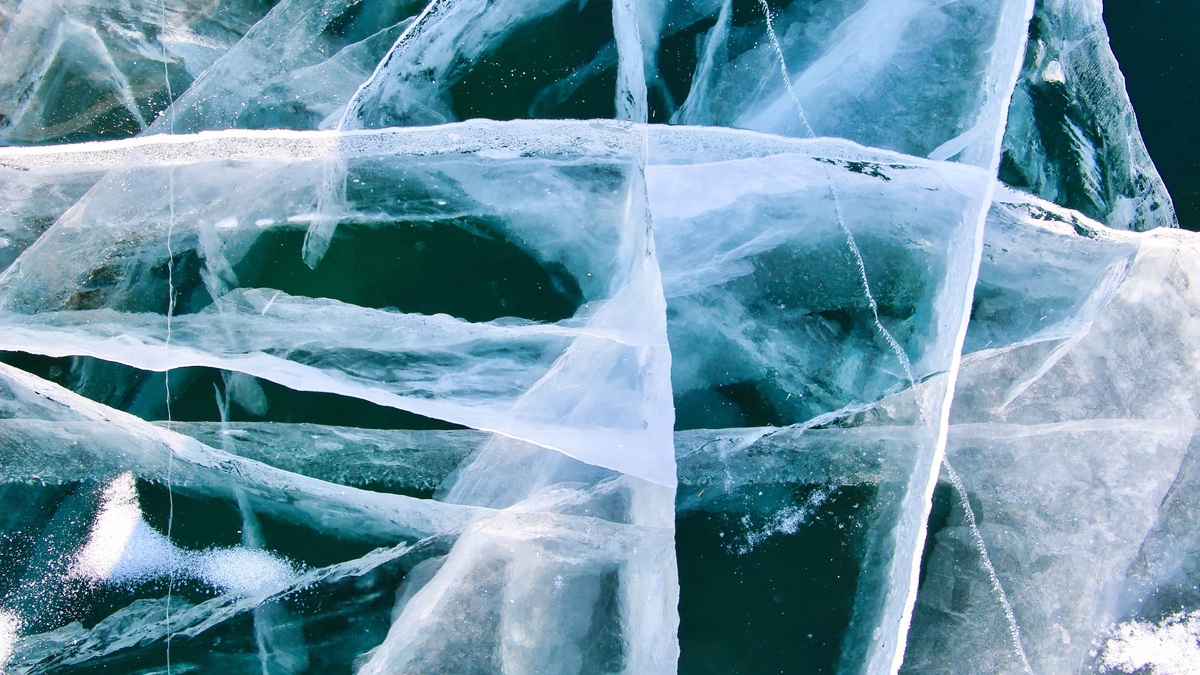
At the freezing point, crystals begin forming at or near the surface where heat is being removed. Ordinary ice has an open structure and is less dense than liquid water. It floats, allowing crystals and frazil to gather into a surface sheet instead of sinking to build ice on the bed.
USGS estimates the density of ordinary ice at about 90 percent of liquid water, with variation from trapped air. The same property explains why an ice cube floats with most of its volume submerged. If newly formed ice sank, repeated surface freezing could carry solid water downward.
Heat must leave before ice can grow
Freezing is an energy problem as well as a temperature threshold. Water must first cool to its freezing point, then release latent heat as liquid molecules join an ice crystal. That heat travels upward through the ice toward the colder atmosphere. A brief cold snap may cool the surface without removing enough energy to build thick ice.
Sunlight, snow and clouds influence the exchange. Dark open water absorbs solar energy, while fresh snow reflects much of it. Snow also insulates the ice beneath, so a bright snowy surface can reduce both daytime warming and nighttime heat loss. The net result depends on conditions over time.
Flowing water brings another energy source. A stream entering the lake may carry water above freezing and create a weak area. Water moving through an outlet can prevent stable crystal growth. These places remain hazardous even when nearby sheltered ice appears uniform.
Ice cover acts as insulation
Ice conducts heat much more slowly than open-water convection aided by wind. Snow on top can add further insulation because it contains abundant air spaces. Growth continues at the ice-water boundary, where heat from freezing is conducted upward through the existing ice.
As ice thickens, the path for heat grows longer and the freezing rate generally slows. Clear, cold, snow-free weather can produce strong ice, while early snow may insulate a thin sheet. Local safety depends on measured thickness and quality rather than the number of cold days alone.
Argo’s guide to how long lakes take to freeze explains the weather and size controls. A broad deep lake stores more heat and may remain open long after a sheltered pond freezes.
Why the water below can support life
Liquid water remains because the entire lake does not need to reach 0°C before surface freezing begins. Ice limits direct wind contact and the water below retains heat. This leaves habitat for fish and microorganisms through winter.
Ice cover also restricts gas exchange with the atmosphere. Respiration and decomposition continue consuming oxygen, while snow can reduce light available for photosynthesis. Shallow, productive lakes may experience winterkill if dissolved oxygen falls too far.
Spring warming weakens the ice and eventually opens the surface. When water temperatures become nearly uniform, wind can mix oxygen and nutrients through the water column. The seasonal cycle connects freeze-up, winter stratification and spring turnover without requiring the deepest water to remain at one exact temperature.
When lakes do not follow the simple pattern
A shallow pond can freeze to the bottom during a long cold period because it contains little stored heat. Springs may deliver relatively warm water and keep openings ice-free. River-fed reservoirs can retain currents that delay a continuous sheet, especially near inlets or outlets.
Dissolved salt lowers the freezing point and changes the density relationship. Sea ice therefore follows a more complicated process than freshwater lake ice. Argo’s article on how the ocean freezes covers brine rejection and ocean mixing.
Depth and pressure also matter in very deep lakes. USGS notes that the temperature of maximum density changes slightly with pressure. Persistent stratification or geothermal inputs may leave deep water warmer than the idealized diagram suggests.
Ice thickness alone does not describe strength
Clear ice formed by direct freezing generally differs from cloudy snow ice created when flooded snow refreezes. Cracks, pressure ridges and thaw cycles weaken a cover unevenly. Official local guidance and direct measurements are more useful than a formula based only on air temperature.
Springs can make persistent openings or thin patches that are difficult to see under snow. Structures, currents and changing reservoir levels produce additional weak zones. The scientific explanation for top-down freezing therefore offers no guarantee that a particular surface is safe.
Climate trends can shorten ice seasons and increase midwinter breaks, but each lake responds to local depth and weather. Long observation records use defined freeze-up and break-up criteria. Comparing dates requires the same definition, because “first ice,” “complete cover” and “safe access” are separate events.
Measurements test the textbook explanation
Under-ice temperature profiles can be measured with instrument strings placed at several depths. Dissolved-oxygen sensors reveal whether respiration is drawing down the lake’s winter supply. These observations let limnologists distinguish inverse stratification from simple assumptions based on air temperature.
The process begins with surface heat loss. Once freshwater passes its maximum density near 4°C, the coldest liquid stays near the top. Crystals form as buoyant ice, creating a cover that slows subsequent freezing.
Argo’s explanation of Earth’s freshwater stores places seasonal lake ice in perspective. For measurement methods, the NOAA Lake Ice reference covers terminology used in ice observations.
The short answer
Winter cooling acts from above. Freshwater that cools below about 4°C becomes less dense, so the near-freezing layer stays on top. Ice is less dense still, which lets it float and form an insulating cover.
The mechanism explains why most temperate freshwater lakes freeze at the surface while retaining liquid below. It does not guarantee safe ice, a 4°C bottom or complete protection from oxygen loss. Those outcomes depend on the lake’s depth, mixing, chemistry and weather history.