Seaspeak was a controlled form of maritime English designed to make radio messages between ships clearer. Its limited vocabulary and fixed message markers reduced ambiguity. Numbers followed equally precise rules for crews who did not share a first language.
The term still appears in popular explanations, including NOAA’s history of the language used at sea. Modern mariners are formally trained in the International Maritime Organization’s Standard Marine Communication Phrases, or SMCP, which developed from earlier efforts such as Seaspeak and now provides the international safety standard.
Why ships need standardized English
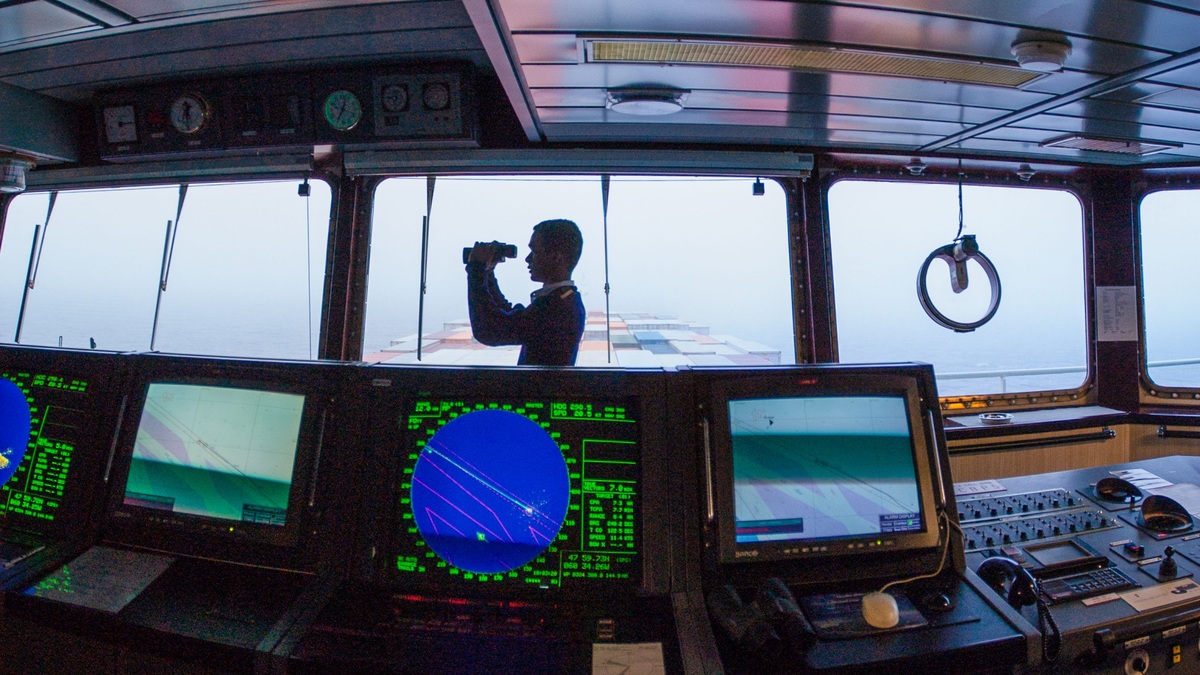
A ship’s bridge may bring together officers and crew members from several countries. It must also communicate with pilots and port authorities, as well as nearby vessels. Ordinary conversational English leaves room for idioms and regional pronunciation, while a radio channel may add static or interruptions.
At sea, a misunderstood verb or number can affect course and speed. It can also change the timing of a maneuver. Standardized phrases reduce the number of possible meanings and give trainees a defined body of language to practice before they assume watchkeeping duties.
English became the shared base because it was already widely used in shipping and aviation. Standardization does not require every seafarer to speak like a native English speaker. It establishes a common safety vocabulary that trained listeners can recognize under pressure.
How Seaspeak organized a message
Seaspeak placed a marker at the start of a transmission to announce its purpose. “Question” told the listener that a reply was expected, while “Warning” signaled danger. Other markers separated information from advice or instructions. The structure helped a listener interpret the words that followed.
Numbers were spoken digit by digit. A vessel could give 33 as “three three,” reducing confusion with 13 in poor radio conditions. Times used Coordinated Universal Time, a common reference that avoids uncertainty when ships cross time zones.
Seaspeak and SMCP are related but different
People often use Seaspeak as a general label for simplified maritime English. The official system in current international rules is the IMO Standard Marine Communication Phrases. The IMO adopted SMCP through Resolution A.918(22) in November 2001, replacing the older Standard Marine Navigational Vocabulary.
SMCP is more comprehensive than the original Seaspeak project. It covers ship-to-ship and shore-to-ship radio traffic, plus communication on board vessels with multilingual crews. The phrases address routine work such as berthing as well as emergencies.
The official resolution explains that SMCP does not replace collision regulations, local routing rules or the International Code of Signals. It supplies language for carrying out those duties. Radio procedures still govern how a call begins and ends, including the change between speakers.
Context still guides interpretation. The same words can carry different urgency during routine docking and a collision threat, which is why the message marker and situation report belong together. Standard phrases narrow ambiguity without removing the watch officer’s duty to assess conditions.
The SMCP resolution and text are deliberately repetitive. Familiar wording lets a mariner anticipate the shape of a message even if reception is incomplete. Creativity is less useful than consistency when two vessels are closing on each other.
What standard phrases sound like
A vessel asking about another ship’s plans can begin with “Question” and use a standard phrase for intention. A reply identifies the requested action in the same vocabulary. The marker separates a factual report from an order or recommendation.
Pronunciation guidance accompanies critical terms. Position and bearings follow established conventions, as do courses. The International Telecommunication Union publishes procedures for maritime mobile radiotelephony, which work alongside the language standard.
SMCP also includes phrases for distress and search and rescue. Separate forms cover fire or medical assistance. A crew does not need to invent a polished sentence while managing an emergency. The standard supplies compact wording that communicates the condition and needed response.
How officers learn maritime communication
The International Convention on Standards of Training, Certification and Watchkeeping for Seafarers links communication ability to professional certification. IMO states that officers in charge of a navigational watch on ships of 500 gross tonnage or more must be able to understand and use SMCP.
Training combines vocabulary with realistic bridge situations. Students practice receiving a message accurately and confirming important details. They must also challenge an unsafe instruction. Maritime simulators can add traffic and weather while instructors assess whether communication stays clear.
The STCW Convention sets international training standards, while national maritime authorities issue certificates. Shipping companies may add their own closed-loop communication procedures for work on deck or in the engine room.
Closed-loop communication requires a receiver to repeat or confirm an instruction, allowing the sender to catch an error. Its value reaches beyond language proficiency. Fatigue and assumptions can undermine communication even when everyone shares a native language.
Regular drills keep the vocabulary available under stress. A phrase learned only for an examination may be slow to recall months later. Bridge teams rehearse speaking and listening as part of the maneuver, with confirmation replacing a separate classroom exercise.
Why ordinary language still has a place
No phrase book can cover every mechanical failure or local circumstance. Mariners use ordinary English when the standard lacks the necessary detail, then return to familiar terminology for the critical instruction. Skilled communication balances precision with enough context to prevent a new misunderstanding.
Recordings from voyage data systems can support accident investigations and training. Investigators compare what was said with vessel movements and bridge actions. The purpose is to identify where information was lost, misunderstood or never challenged, giving future crews a concrete communication lesson.
Modern ships also exchange digital data through systems such as the Automatic Identification System. Digital messages can report identity, position and course, but voice radio remains essential when crews negotiate immediate action or explain a developing emergency.
Seaspeak’s lasting idea is simple: safety improves when people agree in advance on how important messages will be framed. Today’s standard maritime phrases preserve that principle in a larger international system built for busy waterways and multilingual crews.
Radio discipline supports the words
A standard phrase can still fail if two stations transmit at once or a speaker talks too quickly. Maritime radio practice calls for brief messages, clear identification and listening before transmission. The sender chooses the correct channel and leaves enough space for an urgent call to interrupt routine traffic.
“Over” indicates that a reply is expected, while “out” closes the exchange. Using both together creates conflicting instructions. These procedural words are separate from the message markers, but they help listeners follow who has control of the conversation.
Important details are repeated when reception is uncertain. A mariner may spell a vessel name with the international radiotelephony alphabet and repeat a position. Read-back gives the original speaker a chance to correct a mistaken course or time before anyone acts on it.
Shared expectations reduce ambiguity
Standard pronunciation is especially valuable for numbers that sound alike. Individual digits slow the message slightly, yet the added clarity is worthwhile for a bearing or channel number. The listener can request repetition instead of guessing from context.
Digital selective calling can send a distress alert and vessel identity automatically, but it does not explain every developing condition. Voice communication adds the information needed to coordinate assistance. Crews therefore train with both digital equipment and maritime English.
The system succeeds through shared expectations rather than perfect accents. A phrase that every watch officer has practiced is more resilient than an elegant sentence heard for the first time through noise. Seaspeak helped establish that design principle and SMCP applies it across modern ship operations.
Related reading: the law governing activity at sea and how mariners receive high seas forecasts.