Bioluminescence is visible light made directly by a living organism. It produces the blue sparks that sometimes outline breaking waves and the points of light recorded around deep-sea animals. The glow comes from a chemical reaction rather than stored sunlight and marine species use it to communicate, find food or avoid being eaten.
NOAA’s definition of bioluminescence covers organisms from the ocean surface to the deep seafloor. Many broad animal groups include luminous members, along with light-producing bacteria and single-celled plankton. The particular chemistry and light organs vary because the ability evolved many times.
The blue glow often appears decorative to a human observer, but producing and detecting light has immediate consequences for survival. A flash can reveal one animal while concealing another. Color, direction and timing determine who receives the signal. Bioluminescence is therefore best understood as controlled information carried by photons, built on a precisely regulated chemical reaction.
A chemical reaction releases light
The core light-producing molecule is called a luciferin. When it reacts with oxygen, energy is released as a photon. An enzyme called luciferase often speeds the reaction without being consumed, although different organisms use different luciferins and reaction systems.
Some species package the chemistry in a photoprotein that responds when a specific ion, often calcium, becomes available. Others store ingredients in separate compartments and mix them when a nerve signal arrives. Control over the components lets an animal flash briefly or maintain a glow.
Cold light describes the efficient conversion of chemical energy into visible light with little heat. A hot incandescent source loses much of its energy as heat, while biological light would be dangerous if it heated delicate tissue. NOAA Ocean Exploration’s chemistry fact sheet explains the luciferin and luciferase reaction in detail.
Chemical diversity shows that there is no universal luciferin shared by all luminous life. Some animals obtain a light-producing compound through diet, while others rely on symbiotic bacteria. The reaction evolved independently in different lineages and can occur inside cells or in material released to the water.
The energy begins in chemical bonds. During oxidation, an excited reaction product returns to a lower-energy state and releases a photon. Organisms regulate the reaction so light appears at a useful moment instead of leaking continuously. The exact molecules determine color and reaction requirements.
Blue travels well through seawater
Most marine bioluminescence appears blue or blue-green. Seawater absorbs red wavelengths more readily, while blue light penetrates farther. Many deep-sea eyes are correspondingly sensitive to the part of the spectrum most likely to reach them.
Red light is rare in the deep ocean and can offer a special advantage. A few animals produce or detect longer wavelengths, allowing them to illuminate prey that cannot see the beam. The adaptation works only because visual systems differ among species.
Bioluminescence should be separated from biofluorescence. A fluorescent organism absorbs incoming light and emits it at another wavelength, so it needs an external source. A bioluminescent organism supplies chemical energy for its own light.
Sunlight fades rapidly with depth. NOAA notes in its ocean light profile that the upper sunlit zone gives way to faint twilight, followed by darkness at greater depth. Biological flashes become especially important where sunlight cannot support ordinary vision.
Visual sensitivity is part of the system. A signal helps only if another organism can detect its wavelength and brightness against the background. Deep-sea eyes may sacrifice sharp detail to gather more light, while some species retain specialized filters for particular colors.
Light can hide an animal from predators
A flash may startle a predator or draw attention to an attacker. Some small organisms release luminous material into the water, leaving a glowing distraction while they escape. Another strategy resembles a burglar alarm: light attracts a larger predator that may interrupt the original attack.
Counterillumination solves a different visual problem. An animal viewed from below forms a dark silhouette against faint surface light. Photophores on its underside can match that background and reduce the outline. Squid and fish adjust the intensity as ambient light changes.
The Smithsonian’s bioluminescence overview documents defensive flashes, detachable glowing body parts and counterillumination. No single function applies to every species and researchers infer purpose from anatomy, behavior and experiments.
Signal timing helps separate a defensive response from ordinary illumination. Cameras record whether light follows touch, a nearby predator or a change in ambient brightness. Repeated observations strengthen an interpretation, while one dramatic flash can have several possible causes.
Predators and prey signal in the darkness
Anglerfish carry a luminous lure near the mouth. The light draws curious prey within striking distance, reducing the need to chase food through dark water. Other fish use photophores like a headlight to illuminate the area ahead.
Prey can betray itself when movement disturbs luminous plankton. A swimming animal triggers flashes along its path, giving a hunter a visible trail. The same response may discourage feeding by making the disturbance conspicuous.
Light also supports communication. Species-specific flash patterns can help potential mates recognize one another, while groups of tiny crustaceans create timed displays. In a habitat with little daylight, a controlled signal can carry information without the continuous energy cost of a permanent glow.
Some animals make their own chemicals, while others depend on symbiotic bacteria housed in specialized organs. The host supplies a protected environment and nutrients and it controls how bacterial light is exposed. Shutters or pigment layers can switch the visible signal on and off.
Photophores can include reflectors and lenses as well as light-producing tissue. Their structure directs photons toward a target or spreads them across the underside. The arrangement of these organs often provides clues about whether the animal uses light for camouflage or signaling.
Glowing waves begin with microscopic plankton
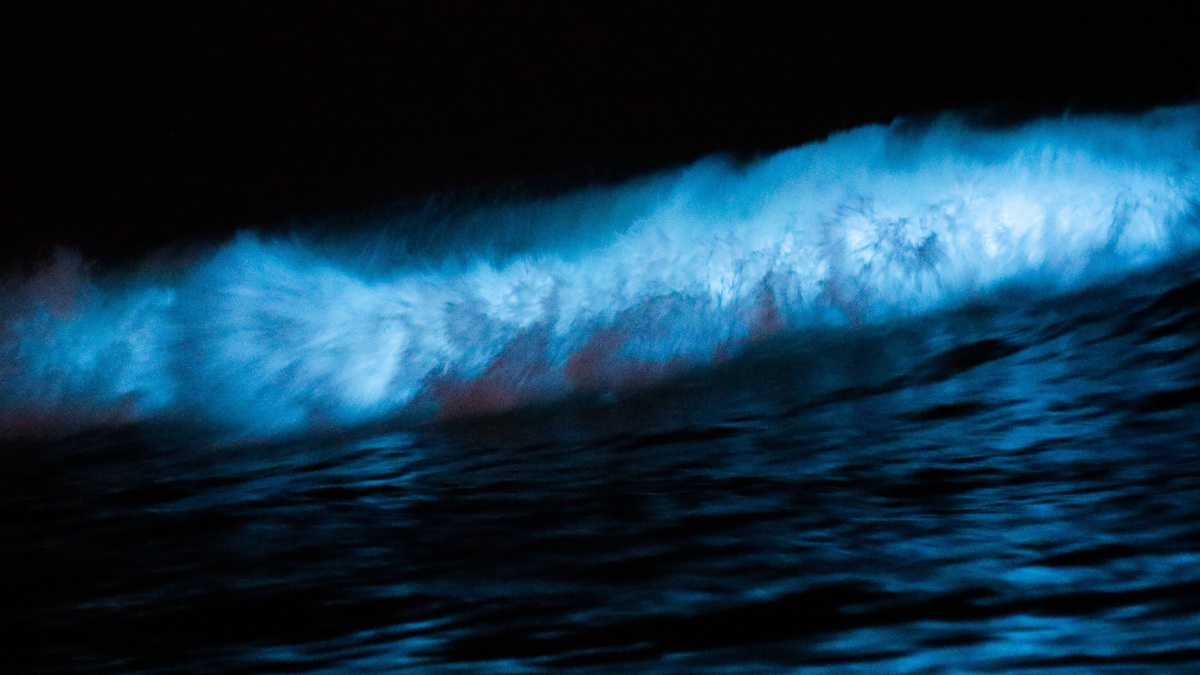
Coastal displays often occur when dense populations of dinoflagellates flash in response to mechanical disturbance. A breaking wave, paddle or hand creates shear in the water and stimulates many cells at once. The resulting blue line can be bright even though each organism is microscopic.
A luminous display does not automatically mean that the water is safe or dangerous. Different species produce different compounds and bioluminescence itself is not a toxicity test. People should still follow local harmful-bloom advisories and avoid entering water when officials warn of a hazard.
Specialized low-light cameras let scientists record flashes that ordinary imaging would miss. Submersibles must also limit their own lights because bright illumination can overwhelm faint signals or change animal behavior. Observations continue to reveal new luminous species and unfamiliar patterns.
Bioluminescence is both chemistry and ecological language. A reaction releases a photon, but evolution determines when the organism uses it. In the dark ocean, those controlled photons can conceal a body, expose movement or connect two members of the same species across otherwise invisible water.
Measuring natural light remains technically demanding. Research vehicles can trigger flashes through movement and their lamps alter the scene. Low-light instruments, dark approaches and careful calibration help scientists distinguish undisturbed behavior from a response to the observer. Laboratory studies complement field cameras by testing a specific stimulus under controlled conditions. Pressure, temperature and animal stress can make deep-sea behavior difficult to reproduce at the surface. Conclusions are strongest when observations from natural habitat and carefully designed experiments point toward the same function. Instruments must also record wavelength and intensity because human eyes or ordinary video can miss a signal outside their most sensitive range.
Related reading: marine snow and the deep ocean’s SOFAR channel.