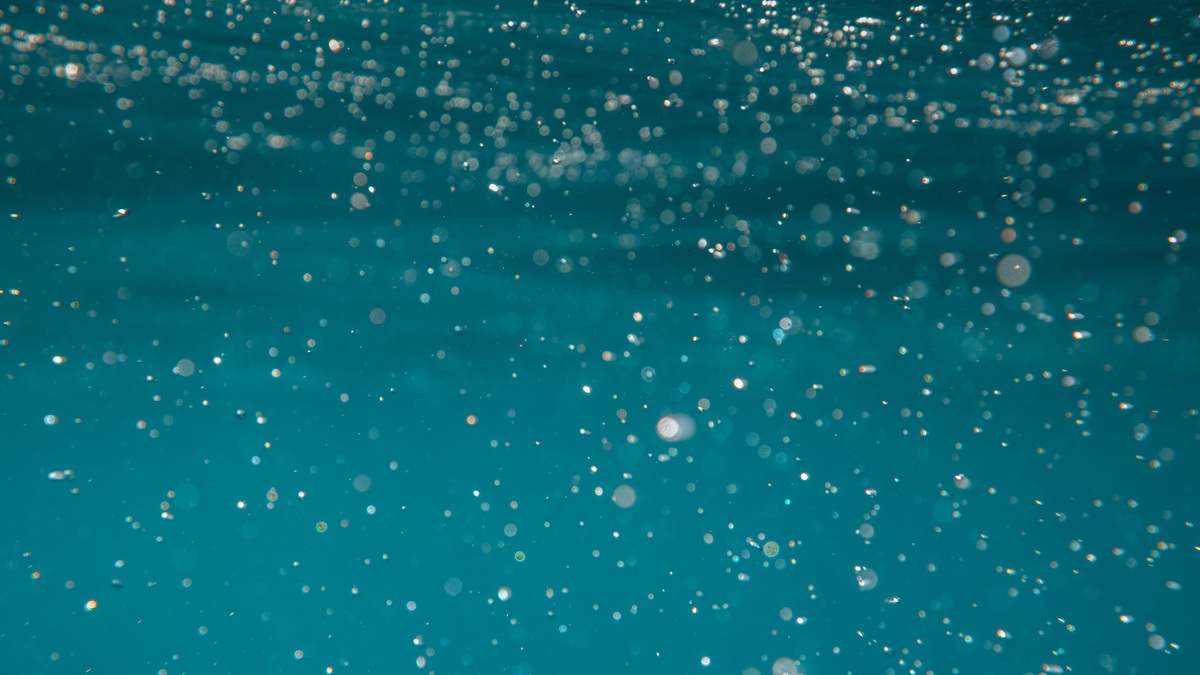
Marine snow is the steady fall of particles from the sunlit ocean into deeper water. It includes dead plankton, fecal pellets, mucus, mineral grains and other fragments that stick together as they sink. The name describes its appearance in underwater lights, where pale flakes drift through dark water like snow. It does not describe frozen water.
This particle rain connects surface photosynthesis with animals and microbes living far below the reach of sunlight. Much of it is eaten or decomposed on the way down. The fraction that reaches great depth also carries carbon away from the atmosphere-facing surface, making marine snow part of the ocean’s biological carbon pump.
What marine snow is made of
Most marine snow begins with life near the surface. Phytoplankton build organic matter through photosynthesis. Zooplankton eat the phytoplankton and produce fecal pellets, while dead cells, discarded feeding structures and fragments of larger organisms add more material. NOAA’s marine snow overview also lists sand, soot and other inorganic dust among the particles that can join the fall.
Individual particles often collide and adhere to one another. Sticky substances released by plankton help form loose aggregates that may grow to several centimeters across. A flake can therefore contain a small community rather than a single kind of debris. Bacteria colonize it, tiny animals graze on it and chemical reactions continue inside it while it descends.
Fecal pellets can move material downward especially efficiently because they package small food particles into denser bodies. Shells and mineral grains can act as ballast, increasing an aggregate’s sinking speed. Shape, density and water motion still matter, so marine snow does not descend at one universal rate.
How the flakes travel through the water column
Gravity pulls aggregates downward, but their route is repeatedly interrupted. Zooplankton consume them, microbes respire their organic carbon and turbulence can break large flakes apart. Other particles merge. The result is a constantly changing stream in which both particle abundance and nutritional quality usually decline with depth.
The journey can take weeks for slowly sinking flakes, according to NOAA. In the ocean’s vertical zones, the greatest transformation occurs through the twilight zone, where sunlight is too weak for much photosynthesis but abundant animals intercept material arriving from above. Many migrate upward at night to feed and return to depth by day, moving carbon through their own bodies as well as through sinking particles.
Scientists measure this flux with sediment traps, optical cameras and chemical tracers. NOAA’s biological-pump fieldwork describes traps deployed hundreds of meters below the surface to collect particles. No single trap captures the entire process perfectly because currents tilt the path of falling material and swimming organisms can enter collectors.
Images add information that traps cannot preserve. Underwater cameras record aggregate size, abundance and sinking behavior without first moving the particles into a container. Chemical analyses then identify carbon, nitrogen or mineral components. Combining methods reduces the chance that one collection bias will be mistaken for the true flux.
Depth changes the meaning of a measurement. Carbon collected at 100 meters has only just left the surface ecosystem, while carbon found below 1,000 meters has survived a much longer sequence of feeding and decomposition. Researchers therefore compare fluxes at several depths to estimate how rapidly the particle supply is being attenuated.
Why deep-sea animals depend on it
Below the sunlit zone, organisms cannot rely on local photosynthesis. Marine snow becomes a major external food supply for filter feeders in the water, scavengers on the seabed and microbes throughout the deep ocean. The connection helps explain how a deep-sea food web can persist in darkness.
Food is not delivered evenly. A large carcass creates a concentrated fall, while ordinary marine snow arrives as a diffuse background rain. Seasonal plankton blooms can increase particle export after surface populations grow and collapse. Ocean currents then redistribute some material before it reaches the bottom.
Animals have evolved different ways to intercept the supply. Suspension feeders collect particles from moving water. Deposit feeders consume material that settles into sediment. Some midwater animals capture fresh aggregates before microbes remove much of their energy. NOAA notes that the usable carbon and nitrogen in marine snow support many deep-sea scavengers, even though only a minority of surface production reaches the abyss.
Particle quality changes with age. Fresh material from a bloom can contain more easily digested compounds than an aggregate repeatedly processed by microbes. Deep animals respond to both the quantity and composition of the arriving food.
Marine snow and the biological carbon pump
Phytoplankton take up carbon dioxide in surface waters and convert it into organic carbon. When part of that material sinks below the layer that readily exchanges with the atmosphere, carbon is exported downward. Woods Hole Oceanographic Institution says about 90 percent of the carbon reaching the mesopelagic is eaten there, while a small portion sinks deeper.
Being eaten is not the same as permanent storage. Animals and microbes respire or remineralize much of the organic matter, returning its carbon to dissolved forms at depth. Ocean circulation may eventually carry some of that carbon toward the surface. Carbon incorporated into deep sediment can remain isolated much longer, although the buried fraction is small compared with the amount first produced near the surface.
The efficiency of this pump varies with plankton communities, temperature, oxygen, nutrient supply and particle mineral content. Warmer water can accelerate some microbial processes, but ecosystem responses are not captured by one simple rule. NOAA researchers studying ocean carbon uptake emphasize that the future response to warming and declining pH remains an active question.
Marine snow is consequently both food and transport. It feeds dark-water ecosystems while transferring a portion of newly produced organic carbon into the ocean interior. Those roles overlap, since every animal or microbe that consumes a flake changes what continues downward.
How marine snow differs from other deep-ocean food sources
Marine snow is not the only energy source below the photic zone. At hydrothermal vents and methane seeps, microbes use chemical energy to build organic matter through chemosynthesis. Large falls such as whale carcasses create temporary food islands. NOAA Ocean Exploration describes how these chemically powered systems coexist with ecosystems supported primarily by falling surface material.
The boundaries also blur. Chemosynthetic animals may still receive organic particles from above and a carcass ultimately breaks into smaller material that joins sediments. The term marine snow is most useful for the pervasive rain of particles rather than every object that sinks.
Plastic fragments can become incorporated into aggregates as well. Their presence does not make plastic a nutritious part of marine snow and it raises separate questions about how contaminants move through food webs. The basic structure of aquatic food chains helps show why the route of a particle matters as much as its final depth.
What a drifting flake reveals
A visible flake contains evidence of processes spread across the ocean above it. Its components reflect which organisms grew at the surface, who ate them, how quickly material clumped and how much was recycled before reaching that point. Comparing flakes across seasons and regions helps researchers connect surface conditions with carbon delivery to depth.
Marine snow is therefore a moving record, not inert waste. It is repeatedly eaten, repackaged and decomposed. The portion left on the seabed contributes to deep-ocean sediment, while the rest supports organisms or returns to dissolved forms within the water column.
The simple answer remains useful: marine snow is organic and mineral debris sinking through seawater. Its wider importance comes from the distance it bridges, linking sunlight, plankton, deep-sea life and long-lived carbon storage through one continuous downward flow.