NOAA’s estuary food-pyramid material starts with a simple observation that governs ponds, rivers, marshes and seas: every bite carries energy that entered the ecosystem earlier. An aquatic food chain traces one possible route for that energy. A tiny alga may be eaten by a zooplankton animal, which may be eaten by a small fish, which may then feed a heron or a larger fish.
That straight line is a useful first map. NOAA uses an estuary food pyramid to show why energy becomes scarcer at higher feeding steps. Living waters hold many overlapping routes, however. Understanding the roles on those routes explains why a change near the water’s surface can eventually reach animals far above it.
The chain starts with captured energy
Sunlight supplies the first major energy input for most aquatic ecosystems. Plants and algae capture light and store some of it in sugars and other carbon-rich material. This stored chemical energy can be passed on when one organism eats another. The transfer is called energy flow because energy moves through the community as organisms feed, grow and use energy to stay alive.
Every transfer has a cost. Animals use much of the energy in their food for movement, body maintenance and other life processes. Some leaves the body as heat and some remains in waste. Less energy is therefore available to build new living tissue at the next feeding step. That helps explain why a body of water can support many small grazers while supporting fewer large predators.
Energy keeps moving forward through feeding and eventually leaves the system as heat. Nutrients follow a different path. Atoms such as nitrogen and phosphorus can return to the water or sediment and be used again by producers. Keeping those two ideas separate makes a food pyramid easier to read. It displays a declining amount of available energy at higher levels while the materials that form living tissue remain available for reuse.
Producers make the first meal
Primary producers form the base of most aquatic food chains. They include rooted aquatic plants, seaweeds, microscopic algae and cyanobacteria. These organisms can build their own food from simple materials. In sunlit water, photosynthesis uses light energy along with carbon dioxide and water to make energy-rich compounds.
In oceans and estuaries, phytoplankton are often the most important producers. They are tiny drifting algae that live where enough light reaches the water. NOAA notes that phytoplankton provide food for creatures ranging from shrimp and snails to jellyfish. Their size can be misleading. Their productivity gives many larger animals a starting point for survival.
Some aquatic systems also draw on energy-rich material that arrived from outside the water. Fallen leaves can enter a stream. Dead marsh grass can wash into an estuary. This material begins a detrital route through the ecosystem, where microbes and small animals feed on fragments and the organisms growing on them. The same habitat can be powered by more than one route at once.
Consumers occupy feeding levels
Animals and other organisms that get energy by eating are consumers. A grazer that feeds on algae, such as some zooplankton or snails, is a primary consumer. A fish that eats those grazers is commonly a secondary consumer. A larger fish, bird, seal or other predator can occupy a still higher step.
Scientists call each feeding position a trophic level. The U.S. Environmental Protection Agency lists aquatic producers, algae and cyanobacteria at level one. Herbivorous fish and many bottom-dwelling invertebrates can occupy level two. Fish that feed on invertebrates or plankton often appear higher, while fish-eating species can occupy the next level.
Real diets make these labels flexible. A young fish may graze on tiny animals and later hunt fish. An omnivore can eat both plant material and animals. The EPA notes that a fish such as bass may fit different trophic levels depending on its life stage and habitat. A food chain shows the main route in a specific example, while a living species may have several routes.
Feeding place also matters. A dragonfly larva can hunt small animals near the bottom of a pond. A small open-water fish may filter or pick zooplankton from the water column. Both can become prey for a larger fish or bird. Trophic levels offer a way to describe these jobs. Species names and exact connections depend on the lake, river, wetland, estuary or coastal sea being studied.
Decomposers keep nutrients moving
Every aquatic ecosystem also depends on decomposers. Bacteria, fungi and other microorganisms break down dead plants, animals and waste. In the process, they use organic material and return nutrients to forms that producers can use again. NOAA defines a decomposer as an organism that breaks down dead plant or animal matter, making organic nutrients available to the ecosystem.
Much of this work takes place in bottom mud, on submerged surfaces and throughout the water. Dead material, called detritus, can be eaten directly by small animals or processed first by microbes. That path supports insects, worms, shellfish and other creatures that in turn become prey. Decomposition connects the remains of every trophic level back to the ecosystem’s supply of usable materials.
Why chains become food webs
A food chain is clear because it selects one path of eating and being eaten. A real aquatic community contains many producers, many prey species and consumers with changing diets. These links overlap into a food web. The U.S. Geological Survey describes food webs as links among species and notes that many species feed at various levels.
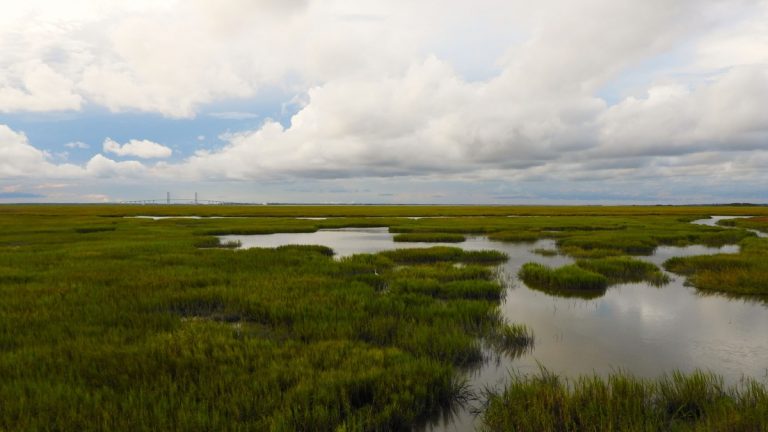
Consider an estuary. Zooplankton can consume phytoplankton. Small fish may eat zooplankton, insects or both. A wading bird may eat several fish species as well as crabs. Each choice creates another connection. Seasonal shifts, migrations and growth can add more. The web records a community’s feeding relationships more faithfully than one line can.
Connections also help explain ripple effects. A sharp decline in one producer can reduce food for grazers, then for the animals that eat those grazers. A new predator can change the behavior and abundance of its prey. Food webs reveal where an ecological change may travel and help frame the observations needed to assess its effects.
Arrows in a web turn that complexity into a working picture. Each arrow represents a feeding connection, usually from the food organism toward the consumer. Following several arrows can show why a bird may depend indirectly on algae, or why a fish may connect muddy bottom habitat with open water. Researchers can then compare the picture with observations of diet, abundance and habitat conditions.
What a food web reveals
Food-web diagrams are practical tools for asking better questions about water ecosystems. They show which organisms draw energy from algae, which depend on bottom-dwelling prey and which predators have several options. They can also point to important weak links, such as a brief bloom of plankton that supports young fish during a narrow season.
Higher trophic levels matter for another reason. Some contaminants can build up in organisms and become more concentrated as they move through feeding relationships. The EPA describes this process as biomagnification. Tracking diet links helps scientists assess which fish, birds or mammals may face greater exposure in a given habitat.
The broad pattern remains easy to remember: producers capture energy, consumers pass some of it onward and decomposers recycle materials. The details are wonderfully busy. From a sunlit patch of algae to apex predators, aquatic life is held together by many feeding connections that keep energy moving and nutrients cycling.
The physical setting for these food chains appears in Argo’s ocean currents overview. One especially productive process is ocean upwelling.
Freshwater primary producers include algae and plant-like growth that people often call seaweed. Learn what grows like seaweed in lakes and how it supports aquatic life.
Below the sunlit surface, marine snow and chemosynthesis support the deep-sea food web.
Food chains are one part of the larger set of biotic factors in the ocean, including competition, predation, decomposition and symbiosis.
A regional example appears in Argo’s Hawaii food-web guide, which follows energy from producers to reef consumers and apex predators.
For habitat-specific examples, see Argo’s guides to a pond food chain from algae to birds and a wetland food web.