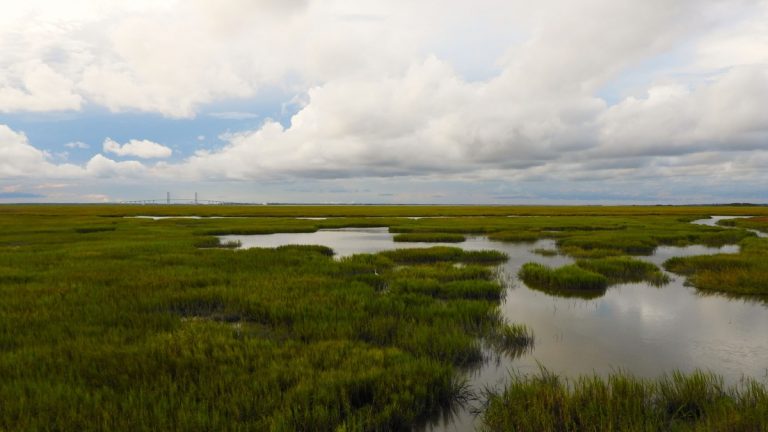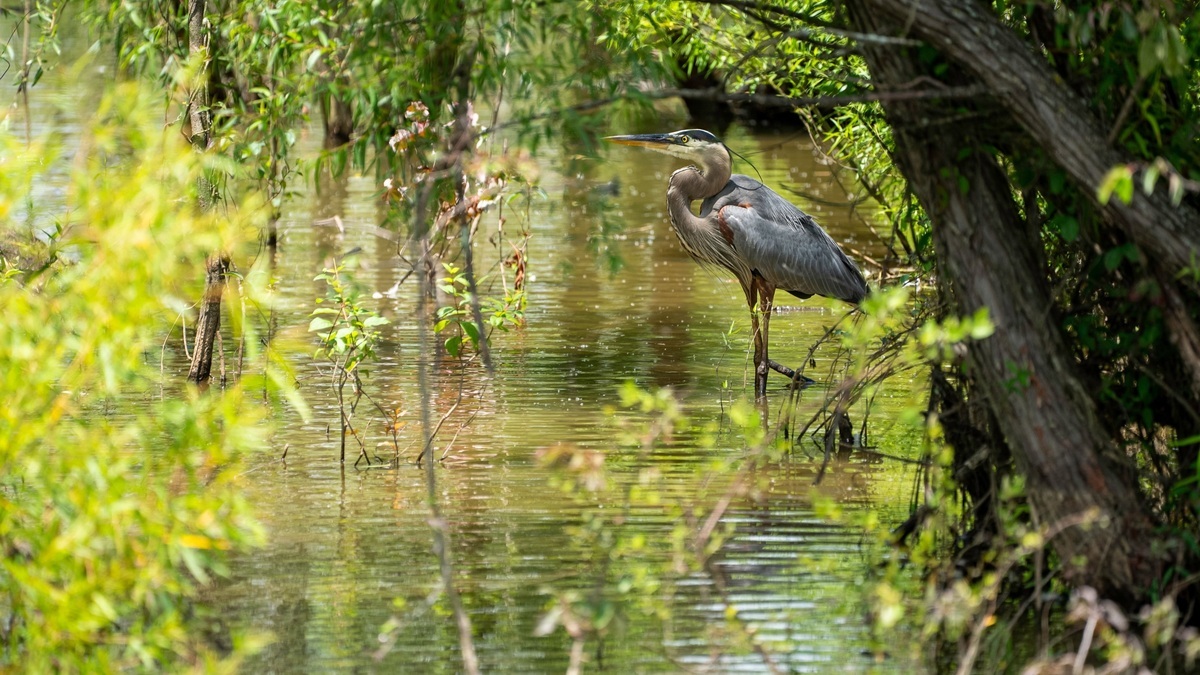
A wetland food web connects organisms through the movement of food energy and nutrients. Producers capture energy. Animals consume living material or organic remains, while decomposers break the remains into simpler compounds. Many wetlands rely heavily on detritus made from dead plant tissue.
The exact web differs among wetland types. Water depth selects which organisms can enter, while chemistry favors species adapted to the local conditions. Seasonal flooding repeatedly rearranges access to food. A marsh therefore supports a different web from a swamp or bog.
Producers capture the first usable energy
Primary producers use sunlight to build organic matter from carbon dioxide and water. Emergent plants such as cattails hold leaves above the surface, while submerged plants photosynthesize underwater. Algae grow in open water or as films attached to stems and sediment.
Plants create far more than food. Their stems slow water and provide surfaces for microbes. Roots hold soil and release organic compounds. Some species also transport oxygen into the otherwise oxygen-poor sediment surrounding their roots.
Production depends on available light and nutrients. The hydroperiod, meaning the pattern of flooding and drying, determines how long aquatic producers can remain active. A shaded forested wetland channels energy differently from a sunny shallow marsh. Nutrient-poor bogs support plants adapted to scarcity rather than the high growth associated with many floodplain wetlands.
Plant eaters form the first consumer level
Herbivores feed directly on living producers. Aquatic snails scrape attached algae, while insect larvae graze plant surfaces. Some waterfowl consume seeds or tender vegetation. Zooplankton filter microscopic algae from open water.
Few consumers can use every part of a mature wetland plant efficiently. Tough stems contain structural compounds that resist digestion. Much of the aboveground production enters the web only after leaves die and begin decomposing.
Primary consumers transfer plant energy into animal tissue that predators can use. Their abundance changes with water level because flooding opens habitat to fish, while drying concentrates or removes aquatic prey.
Detritus supports a major pathway
Dead leaves and stems fragment in water and become detritus. Bacteria and fungi colonize the material. Their activity alters its chemistry and adds microbial biomass. Small invertebrates shred or gather the conditioned particles.
The EPA wetland overview describes this enriched organic material as food for aquatic insects, shellfish and small fish. Those animals then support larger predators.
Detrital energy can move beyond the wetland. Floodwater carries fine particles and organisms into a river or lake, while fish enter flooded vegetation to feed and later return to open water. The exchange links wetland production with the surrounding watershed.
Temperature controls how rapidly many decomposition reactions proceed. Oxygen availability determines which microbial pathways can operate, while plant chemistry affects how easily tissue breaks down. Waterlogged sediment often lacks oxygen, slowing some pathways and allowing organic matter to accumulate as peat.
Decomposers recycle nutrients
Decomposers include bacteria and fungi that use dead organic matter. Their respiration releases carbon dioxide, while enzymes break complex material into forms that can be absorbed. Other microbes transform nitrogen and sulfur compounds under oxygen-rich or oxygen-poor conditions.
Decomposition returns nutrients to water and sediment, where producers can use them again. Energy follows a different route: organisms lose much of it as heat during respiration, so it does not cycle indefinitely.
The EPA’s Clean Lakes guidance explains the distinct roles of producers and consumers. Decomposers complete nutrient cycles, while respiration dissipates usable energy at every step. A nutrient atom may pass through the web repeatedly, while new sunlight must continually power production.
Predators connect several feeding pathways
Predatory insects consume smaller invertebrates and fish feed across both open water and vegetation. Amphibians may eat aquatic prey as larvae or adults, depending on the species. Reptiles add further connections, as do wetland birds and mammals.
A predator’s diet often changes with age and season. A young fish may eat zooplankton before shifting toward insects or smaller fish. Migrating birds use a wetland only briefly but can remove substantial prey and carry nutrients elsewhere.
Omnivores feed at multiple levels, weakening the idea of a fixed trophic ladder. A duck may consume seeds during one period and aquatic invertebrates during another. Food-web diagrams therefore use arrows among many nodes.
EPA’s food-chain resource explains how producers and decomposers connect to consumer populations. It also describes contaminant transfer, a concern when persistent chemicals move from prey into predators.
Water level reorganizes the web
Flooding expands aquatic habitat and lets fish reach insects or seeds among plants. Receding water concentrates prey in pools and exposes mud to shorebirds. Complete drying can eliminate fish locally while favoring organisms with resistant eggs or terrestrial life stages.
The timing is as important as the depth. A brief spring flood may support breeding amphibians, while permanent deep water can allow fish predators to become established. Repeated disturbance prevents one feeding pathway from dominating every part of the wetland.
Hydrologic connections also determine what enters. A floodplain wetland receives river sediment and organisms during overbank flow. An isolated depression depends more heavily on local production, with rainfall and groundwater supplying its water.
Oxygen changes which decomposers can work
Wetland soil becomes oxygen-poor when water fills spaces that would otherwise contain air. Oxygen diffuses through water slowly and microbes consume it during respiration. Anaerobic microorganisms then use alternative chemical pathways.
Those pathways influence nutrient availability and greenhouse-gas production. Methane can form where strongly reducing conditions persist, while other microbes consume methane near an oxygen boundary. Rates vary with temperature and organic supply.
Plant roots and burrowing animals create small oxygenated zones within reduced sediment. Wetland chemistry forms a patchwork, so samples taken only centimeters apart can represent different processes.
Food webs differ among wetland types
A salt marsh receives tidal water and supports salt-tolerant grasses or algae. A freshwater marsh may center on emergent plants and seasonal fish access. Forested swamps contribute large amounts of leaf litter and woody debris.
Bogs receive much of their water from precipitation, often making them acidic and nutrient-poor. Sphagnum moss can dominate production and decomposition proceeds slowly. Fens receive more groundwater and dissolved minerals, supporting a different plant community.
The EPA notes that climate, landscape form, geology and water movement determine which organisms inhabit a wetland. Broad labels such as producer or consumer remain useful, but the species occupying those roles must be identified locally.
Wetland loss removes connections
Draining a wetland removes aquatic habitat and changes decomposition by exposing soil to air. Filling simplifies the surface and breaks pathways used by fish or amphibians. Pollutants can reduce sensitive prey before effects become obvious among larger predators.
Protecting a wetland also protects its position in the watershed. Argo’s watershed guide shows how water links uplands with downstream lakes. Wetland food and nutrients can move through those same connections.
Measures that reduce water pollution protect more than individual species. A functioning web needs producer habitat and suitable water conditions. Seasonal movement then brings consumers into contact with the available food.
Food-web recovery takes biological evidence. The return of vegetation alone may not restore decomposer communities or access for fish. Monitoring several trophic levels reveals whether the connections are rebuilding.
Contaminants can move through feeding links
Organisms absorb some contaminants directly from water or sediment. They may receive a larger dose through food when a chemical persists in prey tissue. Predators integrate exposure from many individual prey over time.
Bioaccumulation describes a chemical building up in an organism from its environment and diet. Biomagnification describes increasing concentrations at higher trophic levels for substances with the required persistence and biological behavior. It does not occur for every contaminant.
A food-web study can measure tissue alongside water and sediment. Species choice matters because feeding location and diet determine exposure. The result belongs to the sampled web rather than every wetland of the same type.
Scientists reconstruct wetland diets
Direct observation reveals some feeding, while gut-content analysis identifies recently eaten material. Stable-isotope measurements can integrate diet over a longer period by comparing chemical signatures in consumers with potential food sources.
Each method has limits. Gut contents may overrepresent prey that digests slowly and stable isotopes can overlap among sources. Combining approaches produces a stronger map of the web.
Seasonal sampling captures changing connections. A wetland during spring flooding may host migratory fish or birds that are absent after water recedes. One survey cannot represent the full annual exchange of energy.