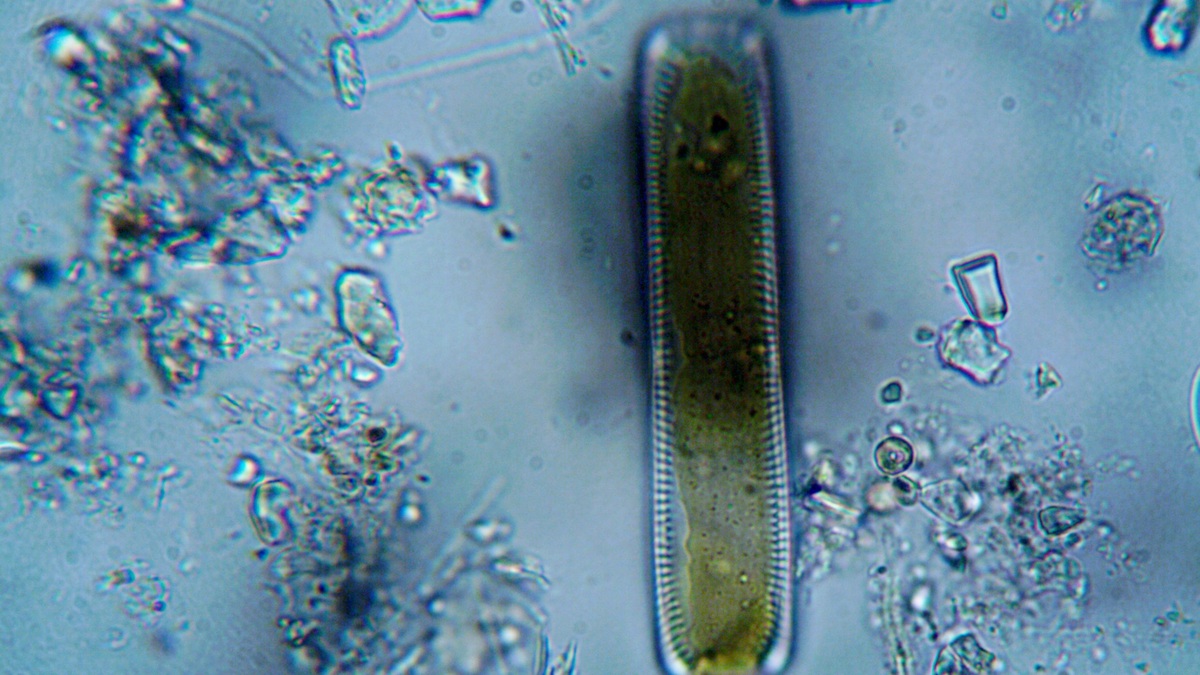
Biotic factors in the ocean are its living organisms and the relationships among them. They include microscopic phytoplankton, bacteria, kelp, corals, fish and whales. They also include predation, competition, decomposition and symbiosis, because those interactions alter which organisms survive and how energy moves through a marine community.
Biotic factors differ from temperature, light, salinity, pressure and nutrients, which are nonliving or abiotic. The two categories continually interact. Argo’s companion guide to ocean abiotic factors explains the physical and chemical setting; this page follows the organisms that use resources, modify habitats and affect one another within that setting.
Primary producers capture energy
Primary producers build organic matter from carbon dioxide and other inorganic materials. In sunlit water, phytoplankton and algae use photosynthesis. Seagrasses perform the same role where light reaches shallow sediment. These producers form the energetic base for most ocean food webs.
The NOAA Fisheries ecosystem overview describes tiny photosynthetic cells as the base that ultimately supports large fish, marine mammals and seabirds. Production still depends on abiotic supplies of light and nutrients. Phytoplankton abundance therefore changes down the water column and through the seasons as currents move the necessary resources.
Sunlight cannot support photosynthesis in the deep ocean. Around hydrothermal vents and cold seeps, chemosynthetic microbes use chemical energy instead. Their organic production supports animals in locally rich communities far below the photic zone.
Producer identity also changes with habitat. Microscopic cyanobacteria contribute in the open ocean, while attached algae dominate many rocky shallows. Seagrasses are flowering plants rooted in sediment. Grouping all producers as “plants” would hide important biological differences in structure and nutrient use.
Consumers connect feeding levels
Consumers obtain energy by eating other organisms. Herbivorous zooplankton graze phytoplankton, while larger animals eat those grazers. Carnivores occupy higher feeding levels, but real food webs contain many cross-links. An omnivorous fish may feed at different levels as prey availability changes.
NOAA’s guide to aquatic food webs explains that predators in the open ocean often feed opportunistically. A shortage of one prey can shift feeding toward another. Argo’s aquatic food-chain overview introduces trophic levels, while a food web better represents the multiple pathways operating at once.
Consumers also move energy between places. Zooplankton and fish that feed near the surface at night may descend during daylight. NOAA Ocean Exploration’s water-column account describes how such migration carries organic matter deeper, strengthening the biological pump rather than leaving all production near the surface.
Feeding categories describe a role at a particular moment, not an animal’s permanent rank. A fish can consume plankton while young and larger prey as an adult. Some plankton combine photosynthesis with feeding, further blurring the simple producer-consumer divide.
Predation changes more than prey abundance
Predation directly removes prey, yet its ecological effect can spread through the food web. If a predator suppresses a dominant grazer, algae or smaller prey may increase. The outcome depends on diet flexibility and on whether another predator or competitor fills the same role.
Marine scientists incorporate predator consumption into some fish-stock assessments because natural mortality cannot be estimated from fishing alone. Stomach-content records, tagging and ecosystem models help reveal those links. A single observation of one animal eating another confirms a feeding event, but repeated data are needed to estimate its importance to a population.
Prey behavior feeds back on habitat use. Animals may leave productive water when predators arrive, reducing feeding opportunities without being killed. Such risk effects are biotic because they arise from another organism’s presence, even when the measured consequence is a change in movement rather than mortality.
Competition limits access to scarce resources
Competition occurs when organisms seek a resource that cannot meet every demand. Food and light are common limits. On the seafloor, attachment sites or protective shelter can become the scarce resource. Competition may occur within one species or between different species.
Space is especially valuable on reefs and rocky coasts. A coral can overgrow a neighbor, while sponges and attached algae may occupy the remaining hard surface. Mobile animals compete for crevices. In open water, competition is less visible but still occurs when consumers depend on the same plankton or forage fish. NOAA Fisheries notes that combined production can be lower than a collection of single-species estimates would suggest when competitors share limited resources.
Competition does not require direct fighting. One phytoplankton species can reduce nutrients available to another by taking them up first. A filter feeder can lower suspended food near its neighbors. Ecologists must compare resource demand with supply before attributing a population decline to competition.
Decomposers return nutrients to circulation
Dead organisms, waste and dissolved organic matter still contain usable energy and elements. Decomposers, especially bacteria and archaea, break complex material into simpler compounds. Other microbes and animals consume part of the material before nutrients return to producers.
The Woods Hole overview of marine microbes describes organisms distributed from open water to rocks beneath the seafloor. Their metabolism helps drive carbon and nutrient cycles. Some organic particles sink as marine snow, supporting deep consumers and microbial activity far from surface production.
Decomposition also consumes oxygen. Where water circulation is weak and organic inputs are high, microbial respiration can reduce dissolved oxygen enough to constrain animals. The process links a biotic activity to an abiotic condition without making the two terms interchangeable.
Viruses participate in this recycling by infecting marine microbes and releasing cellular material back into surrounding water. Other microbes use those compounds. The pathway can retain energy within a microbial loop instead of transferring it immediately to larger grazers.
Symbiosis links species closely
Symbiosis is a close association between unlike organisms. Mutualism benefits both partners, commensalism benefits one without a clear effect on the other and parasitism benefits one at the host’s expense. The label describes the outcome of the relationship rather than whether the organisms appear peaceful.
A NOAA symbiosis explainer describes chemosynthetic bacteria living inside vent animals. The host provides a protected chemical environment, while bacterial production supplies food. Reef-building corals also commonly host photosynthetic algae whose products support coral metabolism, though heat stress can disrupt that partnership.
Parasitic relationships are equally biological. Parasites draw resources from hosts and can alter growth, reproduction or behavior. Their effects vary with host density and environmental stress, so disease patterns often reflect a combination of biotic transmission and abiotic conditions.
Habitat-forming species change living space
Some organisms create three-dimensional structure used by entire communities. Habitat-forming species include reef-building corals, kelp and seagrasses. Their bodies slow water locally, add surfaces for attachment and provide shelter from predators.
NOAA describes kelp forests as shallow, light-dependent habitats that provide food and shelter for thousands of marine species. Underwater vegetation likewise offers spawning, nursery and foraging areas. Disease can remove a habitat former, as can an intense heat wave. Heavy grazing produces another route to the same loss of physical space and food.
Habitat formation can occur in the deep sea too. Corals, sponges and tubeworm aggregations add structure on otherwise exposed bottom. Their distribution follows abiotic limits, but the structure itself is a biotic factor affecting local settlement and survival.
Biotic factors change across ocean zones
Sunlit surface water supports photosynthetic production. Deeper communities may depend on sinking material or on animals that migrate through the water column. Chemosynthesis supplies a separate local source around vents and seeps. Coastal habitats receive terrestrial inputs and contain fixed structures that the open ocean lacks. Argo’s guide to five ocean zones provides the depth framework for those changes.
The deep ocean’s physical limits include darkness, cold and high pressure. Its food web nevertheless contains active predation and competition. Argo’s deep-sea food web follows falling particles as scavengers consume them. Microbes process what remains, while chemosynthesis produces food locally in a few geological settings.
No organism functions as a biotic factor in isolation. Producers alter food supply, consumers redistribute energy and microbes recycle what remains. Together with habitat-forming species and close interspecies relationships, those processes determine the living structure of an ocean ecosystem.