The deep-sea food web transfers energy among microbes, drifting particles, scavengers, predators and animals that partner with chemosynthetic bacteria. Below the sunlit surface, most communities cannot rely on local photosynthesis. Much of their food arrives from above as marine snow or large carcasses, while vents and seeps support a second pathway powered by chemical energy.
No single chain describes the system. While a particle sinks, animals may consume it repeatedly before the remnant reaches sediment and microbial decomposition takes over. A carcass can feed mobile scavengers before becoming a sulfide-rich habitat. Predators connect those pathways by consuming animals that have fed on different sources.
Most deep-sea energy begins near the surface
Phytoplankton use sunlight to produce organic matter in surface waters. Grazing zooplankton transfer some of that energy into fish, while waste and dead tissue begin the descent. The broad sequence appears in many aquatic food chains, but depth transforms the material before it reaches the seafloor.
Respiration and decomposition consume most surface production within the upper ocean. Only a fraction enters the deep sea, which is why food availability generally decreases with depth. Seasonal blooms, currents, water temperature and the speed of sinking particles can alter the amount that escapes rapid recycling.
The NOAA aquatic food-web guide begins with producers and follows their energy through consumers into decomposition, while showing that organisms often occupy more than one feeding role. In deep water, detritus adds a particularly important route from surface producers to animals that never encounter sunlight.
Marine snow supplies a slow continuous rain
Marine snow consists of dead plankton, fecal pellets, mucus, dust and other organic debris that sticks together while sinking. Flakes can grow as particles collide. NOAA notes that the journey to the bottom may take weeks, giving bacteria and small consumers many opportunities to use the material along the way.
Some animals intercept particles in the water column. Others collect deposits from the seabed or filter currents just above it. Sea cucumbers process sediment as brittle stars capture suspended matter, while worms exploit material buried below the surface. Each feeding route repackages organic matter so another consumer can use it.
The carbon carried by each particle also changes as microbes consume easier compounds, leaving increasingly processed material for deeper communities.
The rain is uneven. Fast-sinking fecal pellets or gelatinous remains can deliver concentrated pulses, while calm periods bring less. Currents redistribute deposits around seabed relief, so a canyon may receive more food than an exposed hill at the same depth. The composition of ocean floor sediment partly reflects this biological delivery.
Microbes recycle what larger animals miss
Bacteria and archaea break down dissolved and particulate organic matter throughout the water column and sediment. They release nutrients and form biomass that can be grazed by protists and small invertebrates. Microbial processing therefore links material too small for a visible scavenger back into the food web.
Oxygen penetrates only a limited distance into many sediments. Below that boundary, microbes use other chemical pathways to obtain energy. Their activity changes carbon, nitrogen, sulfur and metal compounds, influencing which resources become available to organisms near the sediment-water interface.
Microbial loops also operate in the water column. Dissolved compounds released by cells and feeding can be taken up by bacteria, then consumed by protists. This route prevents some organic carbon from being lost immediately to dilution, although respiration eventually returns much of it to inorganic carbon.
Large carcasses create temporary islands of abundance
A large carcass delivers far more food than the surrounding particle rain, whether it comes from a fish or a marine mammal. Mobile amphipods can arrive quickly, followed by larger scavengers such as hagfish and sleeper sharks. As they tear tissue apart, scattered fragments make the food accessible to smaller animals before microbes consume the residue.
A whale fall can pass through several overlapping stages. Large scavengers strip soft tissue, enrichment opportunists exploit the surrounding organic-rich sediment and bacteria break down lipids inside the bones. NOAA explains that sulfide produced during the last process can support chemosynthetic organisms for decades.
Not every carcass follows the same schedule. Water temperature, oxygen, burial, animal access and body size affect decomposition. Whale falls are therefore intense but scattered resource patches, not the ordinary daily supply for the entire deep ocean.
Smaller falls create related but shorter events. Wood, kelp, fish and gelatinous animals can carry carbon to the bottom. Each attracts a different succession of consumers and repeated small pulses may matter more locally than a rare whale carcass.
Vents and seeps run on chemical energy
At hydrothermal vents and cold seeps, chemosynthesis allows microbes to build organic matter using energy from compounds such as hydrogen sulfide or methane. NOAA’s comparison of photosynthesis and chemosynthesis distinguishes the energy source: sunlight powers one process, while chemical reactions power the other.
Some animals graze directly on microbial mats. Others host bacteria inside their bodies. Giant tubeworms at vents lack a conventional digestive system as adults and rely on internal symbionts. Mussels and clams may also maintain microbial partners. Predators and scavengers then consume these animals, carrying chemically derived carbon into a wider web.
Methane seeps studied by the USGS can persist much longer than an individual vent chimney. Even there, surface-derived food may still arrive. Deep communities frequently combine resources rather than belonging to a perfectly isolated chemosynthetic system.
Vent fluid temperature and chemistry change as seawater circulates through oceanic crust. Mineral deposition can clog a chimney, while structural failure shifts fluid toward another opening and forces nearby animals to colonize the new flow. NOAA’s deep-ocean marine-life overview describes how exploration combines imaging and sampling to study such patchy habitats.
Predation connects depths and habitats
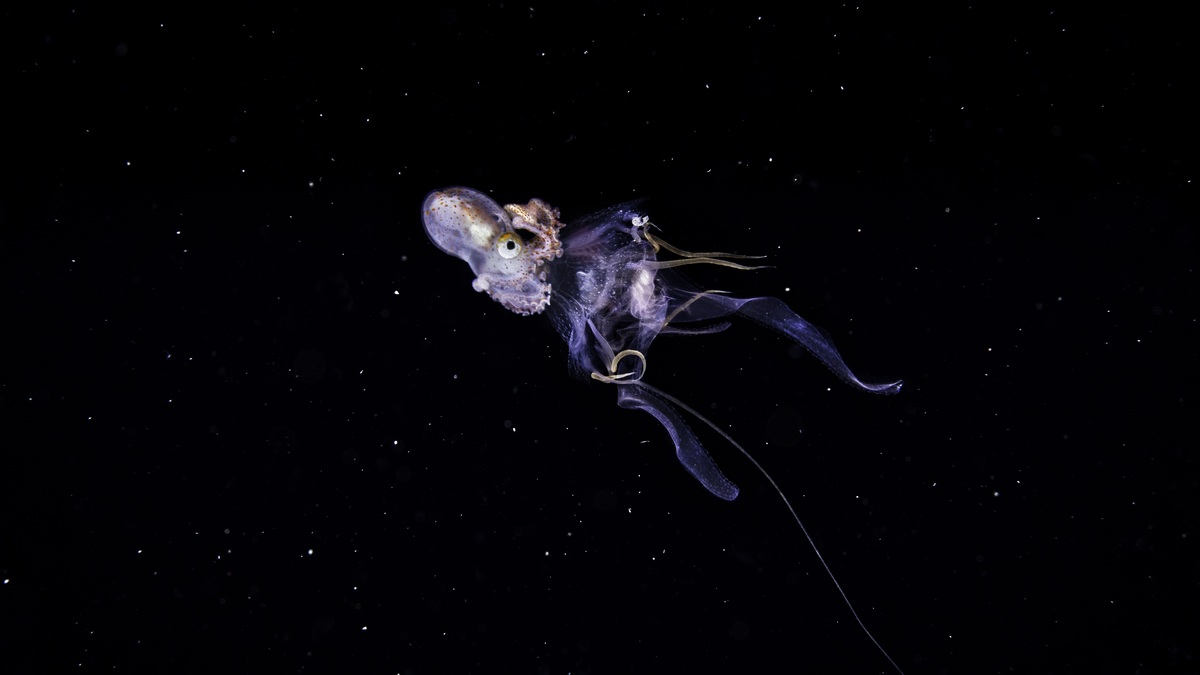
Deep-sea fishes, cephalopods, crustaceans and gelatinous animals hunt one another. Where encounters are infrequent, slow growth and low routine activity can conserve energy until an opportunistic meal appears, although active hunters also occur. A bioluminescent lure may draw prey close enough for capture, while an expandable stomach allows a predator to exploit an unusually large meal.
Vertical migration links deep and shallow water. Animals in the deep scattering layer often rise at night to feed and descend by day. They carry consumed surface carbon downward in their bodies and release it through respiration, waste or predation. This active transport supplements passive sinking.
Scavengers provide another mobile connection. After feeding at a carcass, amphipods and fishes carry its nutrients away through their tissue and waste; some later become prey elsewhere. Movement keeps a localized food pulse from remaining an isolated endpoint.
Terrain influences encounters. Ridges, seamounts, slopes and canyons redirect flow and offer hard surfaces. The relationships described in ocean floor topography help explain why suspension feeders cluster in one place while sediment feeders dominate another.
A web is more accurate than a chain
Detritivores, filter feeders, grazers, scavengers and predators often use more than one resource. An amphipod might eat a carcass and later become prey for a fish. A mussel supported partly by symbiotic bacteria may also filter particles. A web captures those intersecting routes better than a single ladder of consumers.
Scientists reconstruct the routes with stomach contents, stable isotopes, fatty acids, environmental DNA, cameras and experiments. Each method covers a different timescale. A stomach shows a recent meal, while tissue chemistry can integrate feeding over longer periods.
The main pattern is nevertheless clear. Sunlit production supplies a widespread but diluted rain, large falls create brief feasts and chemosynthesis supports concentrated communities where reduced chemicals emerge. Microbes process every pathway and mobile animals connect them across the largest habitat on Earth.
The balance among those inputs changes with depth and bottom relief because moving water redistributes both particles and animals. Researchers therefore compare multiple seasons and sites rather than assuming one camera deployment represents the whole deep sea. The resulting picture is dynamic: scarcity dominates broad areas, but particles, migration, seeps and falls repeatedly create opportunities for life across different timescales, locations and communities on the seabed.