Ocean floor sediment is made of mineral grains eroded from land, microscopic remains of marine organisms, minerals that form in seawater or within sediment, volcanic material and tiny amounts of extraterrestrial dust. The mixture changes dramatically with distance from shore, water depth, biological productivity, currents, climate and the age of the seafloor.
There is no single substance called ocean “soil.” Some seabed is exposed rock or gravel; other areas hold sand, mud, calcareous or siliceous ooze and clay several kilometers thick. Oceanographers commonly describe sediment by both grain size and origin and a sample can belong to several descriptive categories at once.
Sediment is loose material, not soil
Sediment consists of unconsolidated particles that settle or are deposited. Soil on land usually includes a structured mixture altered by roots, weather, organisms and water near the surface. Seafloor mud is sometimes casually called soil, but marine geologists use sediment because the term describes the material and its depositional history more accurately.
The seabed ranges from bare basalt at young mid-ocean ridges to thick deposits along continental margins. NOAA’s account of seafloor texture and sediment notes mud, clay, sand and rocky boulders, with sediment covering most of the ocean bottom. Texture depends on particle size and how firmly grains are packed.
Terrigenous or lithogenous material
Terrigenous sediment comes from continents, while the broader term lithogenous includes rock-derived material such as volcanic debris. Weathering breaks rocks into mineral grains. Rivers carry enormous loads to coasts; wind transports fine dust far offshore; glaciers release debris when ice melts; waves erode cliffs; and eruptions spread ash.
Coarse gravel and sand usually settle near their source unless strong currents or gravity flows move them. Silt and clay stay suspended longer and can travel across ocean basins. Quartz, feldspar, clay minerals and rock fragments are common, but composition reflects source geology and chemical alteration during transport.
Continental margins accumulate especially thick terrigenous deposits. Submarine canyons funnel material downslope and sediment-laden density flows called turbidity currents can carry sand into deep water. The USGS marine sediment catalog defines transport broadly across suspended particles and density flows. Attributing a graded layer to a particular earthquake, storm, slide, or flood requires several lines of evidence.
Biogenous sediment from marine life
Biogenous sediment is derived from organisms. Microscopic plankton build shells or tests from calcium carbonate or silica. After death, some remains sink, survive dissolution and accumulate on the bottom. Larger shell fragments, coral debris, fish teeth, bones and organic matter also contribute locally.
When microscopic biological remains make up at least 30 percent of a deep-ocean sediment, oceanographers call it ooze. NOAA educational material on diatom ooze and marine sediment distinguishes calcareous ooze from siliceous ooze. The remaining portion can include clay and other particles, so ooze is rarely pure shell material.
Biological production at the surface is only the first control. Most organic particles are consumed or decomposed before reaching the bottom. Shell chemistry, sinking rate, water depth, temperature and burial conditions determine what survives.
Calcareous ooze
Calcareous ooze contains abundant calcium carbonate remains. Important sources include foraminifera, coccolithophores and pteropods. Their tiny shells rain toward the seafloor after the organisms die, sometimes packaged in faster-sinking aggregates or fecal pellets.
Calcium carbonate dissolves more readily in colder, high-pressure deep water that contains more dissolved carbon dioxide. Below a regional boundary called the carbonate compensation depth, dissolution balances or exceeds the supply, so carbonate generally fails to accumulate as widespread ooze. The depth varies among ocean basins and through time.
Calcareous ooze is therefore common on many elevated regions and shallower deep-ocean floors but scarce in the deepest trenches. “Deep sea” alone does not predict composition; the seafloor’s position relative to local carbonate chemistry is crucial.
Siliceous ooze
Siliceous ooze contains remains made from biogenic silica, especially the glasslike tests of diatoms and radiolarians. Diatoms are photosynthetic and thrive in many nutrient-rich surface waters. Radiolarians are zooplankton that occur widely in the open ocean.
Siliceous remains accumulate where biological supply is high enough to exceed dissolution and dilution by clay. Siliceous ooze is associated with productive polar waters and equatorial or coastal upwelling regions. Distribution is patchy because productivity, preservation and sediment transport all vary.
Silica and carbonate respond differently to seawater chemistry. A site too deep for carbonate preservation may still collect siliceous material. Neither type of ooze means that the living plankton occupied the seafloor; most lived in sunlit or upper waters far above.
Hydrogenous and authigenic minerals
Hydrogenous sediment forms by precipitation from seawater. Authigenic is a related, often broader term for minerals formed in place on or within the seabed during early chemical reactions. A Woods Hole sediment classification treats authigenic minerals as precipitates or products of early reactions. The categories overlap among textbooks, so one rigid four-box scheme can create false precision.
Examples include manganese nodules, iron-manganese crusts, phosphorites, evaporite minerals and metal sulfides near hydrothermal systems. Minerals can also form in sediment pore water as organic matter decomposes or fluids move upward. Pyrite and carbonate concretions are familiar authigenic products.
Many authigenic deposits grow extremely slowly and may incorporate metals from seawater or sediment. Their economic interest is discussed in Argo’s overview of natural resources from the ocean. Their roles as habitat and the uncertainty surrounding disturbance remain part of any resource assessment.
Cosmogenous particles
Cosmogenous sediment arrives from space. Micrometeorites, cosmic dust and impact debris contribute a minute fraction of ordinary marine sediment. Tiny metallic or glassy spherules can sometimes be identified by shape and chemistry.
The category is scientifically useful even though it is small by volume. Extraterrestrial markers can help identify impact horizons or trace material flux to Earth. Volcanic spherules and industrial particles can resemble cosmic grains, so researchers confirm origin with mineralogical and chemical evidence.
Grain size changes seabed character
Geologists classify clastic particles broadly as gravel, sand, silt and clay by diameter. Grain size influences pore space, permeability, oxygen penetration, stability and which bottom-dwelling organisms can burrow or attach. Mud combines silt- and clay-sized material and may also contain abundant organic matter.
High-energy waves and currents winnow away fine particles, often leaving sand, gravel, or exposed rock. Quiet environments allow mud to settle. Storms can resuspend seabed sediment and bottom currents form ripples, dunes, contour deposits, or scoured surfaces.
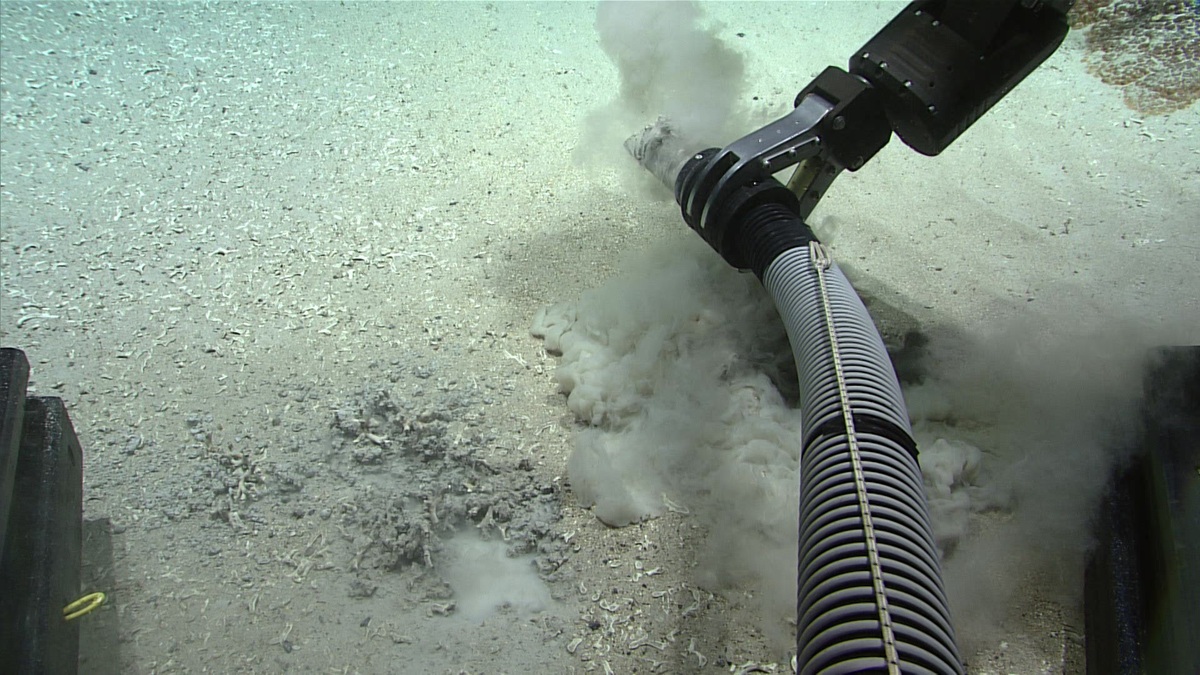
USGS seafloor mapping programs combine acoustic techniques with photographs, cores and samples. Sonar can suggest bottom hardness and texture over wide areas; direct samples are needed to identify actual grains and validate the interpretation.
Where sediment accumulates fastest
Deposition is usually rapid near river mouths and on continental margins because land supplies are large. Deltas and submarine fans can accumulate thick sequences. Deep, remote ocean basins receive much less material and fine clay may settle only very slowly.
Young crust close to a spreading ridge has had little time to collect sediment. Older seafloor generally carries a thicker cover, although currents, topography, dissolution and subduction complicate the pattern. Trenches can contain thick deposits but ultimately carry sediments into subduction zones.
Distance from land is an imperfect shortcut. Windblown dust crosses whole basins, icebergs release debris offshore and turbidity currents move continental sand into deep water. Productivity can also overwhelm land-derived input in particular regions.
Sediment is an ocean habitat
Marine sediment contains bacteria, archaea, protists, worms, crustaceans, mollusks and many other organisms. Some live on the surface; others burrow centimeters or meters below it. Their mixing, called bioturbation, blurs layers and changes oxygen and nutrient movement.
Grain size and chemistry act as abiotic controls on marine life. Sandy bottoms drain and shift differently from cohesive mud. Organic-rich sediment can consume oxygen as microbes decompose material, creating steep chemical gradients just below the water-sediment boundary.
Depth adds other constraints. Pressure rises, temperature usually falls and sunlight disappears through the ocean’s vertical zones. Yet the deep seabed is not barren; food arrives as sinking particles, carcasses, wood falls, or chemical energy around seeps and vents.
How sediment cores reveal the past
A core recovers a cylinder of layers beneath the seafloor. Researchers describe color, grain size, fossils, structures, density, magnetic properties and chemistry. Radiometric ages, fossil ranges, magnetic reversals and volcanic ash layers help build a chronology.
Former International Ocean Discovery Program expeditions drilled sediments and rocks beneath the ocean to study Earth’s history. Cores can record shifts in ice sheets, ocean temperature, circulation, biological productivity, erosion and volcanic activity. Each indicator is a proxy that requires calibration and context.
Layers are not always a neat annual stack. Burrowing mixes sediment, currents erase intervals, slides deposit older material out of sequence and drilling can disturb a core. Geological oceanographers compare sites and combine core results with seismic images. Argo’s explanation of geological oceanography describes how these tools fit together.
Why the mixture matters
Sediment composition records connections among continents, ocean life, seawater chemistry, climate and plate tectonics. Mineral grains reveal erosion and transport. Shells capture aspects of surface-water conditions. Authigenic minerals record reactions after burial, while rare cosmic particles add an extraterrestrial signal.
The mixture also controls practical decisions about cables, foundations, dredging, habitat protection, contaminants, carbon burial and resource assessment. A map labeled “mud” is a beginning: engineers and scientists still need strength, water content, layering, chemistry and biological information.
Ocean floor sediment is best understood as a changing archive and habitat rather than a uniform blanket. Its particles have traveled through very different pathways and their proportions explain why one patch of seabed feels like sand, another like sticky clay and another like soft biological ooze.