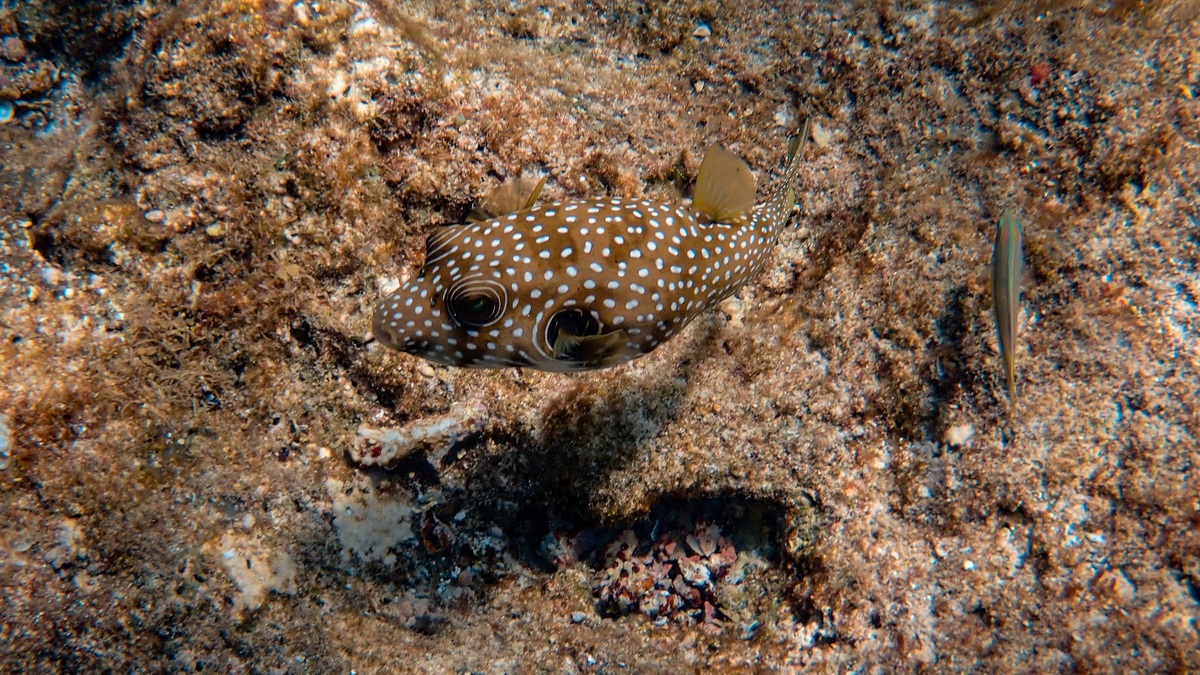
Hawaii’s marine food web begins with microscopic phytoplankton in the water and algae growing on the seafloor. Herbivorous fish and invertebrates consume this primary production. Predatory fish, seabirds, turtles and sharks connect the higher levels, while microbes and detritivores return nutrients from waste and dead organisms.
The web changes between shallow reefs and deeper mesophotic habitat. Open-ocean pathways add another energy source. A NOAA-supported isotope study in the Northwestern Hawaiian Islands found that benthic algae supported much of a healthy reef food web, including pathways leading to sharks. The result does not mean sharks graze algae; energy passes through prey.
A food web is a network, not a single chain. One fish may eat plankton as a juvenile and larger prey as an adult. A predator can feed in several habitats, linking energy sources that look separate on a diagram.
Sunlight powers primary producers
Phytoplankton use sunlight to convert carbon dioxide and water into organic matter. Currents carry these cells through nearshore and offshore waters. Their abundance depends on light, nutrients, temperature and grazing.
Benthic algae colonize hard reef surfaces, including exposed rock and dead coral. Crustose coralline algae form thin mineralized crusts, while turf algae create short mixed growth. Larger seaweeds add another producer group.
Corals contain symbiotic dinoflagellates that transfer photosynthetic products to their hosts. Coral animals also capture plankton. This combination of sunlight and feeding helps build reef structure in nutrient-poor tropical water.
Grazers move algal energy through the reef
Parrotfish scrape or excavate algal material from reef surfaces. Surgeonfish and other herbivores crop turf or browse larger algae according to species. Sea urchins graze accessible substrate.
Grazing supports fish growth while preventing some algae from monopolizing open reef space. The outcome depends partly on grazer abundance. Algal type and coral condition also determine the response. More grazing is not automatically better in every microhabitat.
A Maui study of algal production and herbivore consumption measured both sides of that balance in a fisheries management area. Production can exceed consumption at one site and not another, so island-wide claims require multiple surveys.
Plankton feeders connect reef and open water
Zooplankton include small animals and larval stages that drift with currents. They graze phytoplankton or consume other plankton. Reef fish intercept them as water flows past the structure.
Planktivorous fishes become prey for larger hunters. Jacks and groupers are common examples. Seabirds feed on schooling fish near the surface, carrying marine nutrients back to nesting islands through guano.
NOAA-funded researchers compared 22 Hawaiian reef-fish species in shallow and mesophotic coral ecosystems. Plankton feeders retained similar food sources across depths, while invertebrate feeders and omnivores changed sources.
Invertebrates create many middle pathways
Sponges filter particles and microbes from water. Mollusks occupy several feeding roles. Some graze algae; others filter plankton or hunt. Crabs and shrimp likewise differ by species, consuming living prey or material already dead.
These invertebrates feed many reef fish as well as octopuses. Larger predators consume both groups. Specialized species also eat coral tissue, with some butterflyfish and sea stars among them. Such feeding does not necessarily kill an entire colony.
Detritus links nearly every level. Feces and mucus settle into crevices. Tissue fragments reach the sediment as another detrital source. Worms and small crustaceans process that material before microbes complete much of its decomposition.
Predatory fish occupy several levels
Predator categories overlap. A small wrasse eating crustaceans sits above its prey, while the same fish can be eaten by a larger jack. Moray eels hunt in reef cavities. Uku and other snappers forage across wider areas.
Body size changes feeding relationships, while habitat sets the available prey. Time of day adds another division. Day-active hunters may use visual cues over the reef. Nocturnal species exploit prey that leave shelter after dark.
Fishing alters predator abundance selectively because people target particular sizes and species. Food-web response depends on whether other predators replace the missing feeding role and how prey behavior changes.
Sharks receive energy that began with algae
Researchers traced carbon and nitrogen isotope signatures through algae, invertebrates, fish and sharks in Papahānaumokuākea Marine National Monument. The chemical patterns linked top predators to seafloor primary production.
Stable isotopes reveal integrated diet pathways over time rather than one recent meal. Carbon signatures help distinguish basal sources, while nitrogen typically becomes enriched at higher trophic positions. Interpretation needs local baseline samples.
The study focused on relatively healthy Northwestern Hawaiian Islands reefs. Near populated main islands, runoff alters food-web structure and fishing pressure can do the same through another pathway. The evidence supports a mechanism, not a claim that every Hawaiian shark depends on algae in exactly the same proportion.
Green turtles can link habitats
Hawaiian green turtles often graze algae and seagrass where available, although diet changes with life stage and location. They move from feeding grounds to resting sites, then females travel to nesting beaches.
Turtles therefore transport consumed material through the ecosystem. Their waste supports microbes and detritivores. Eggs or hatchlings also become prey on land and at sea, linking marine production with island consumers.
Their legal protection does not place them outside the food web. Conservation changes abundance and behavior, which can affect grazing pressure at frequently used sites.
Deep reefs use a different mix of sources
Mesophotic reefs begin around 30 to 40 meters in Hawaii and can extend beyond 150 meters where light still supports photosynthetic communities. As light declines, benthic production contributes less in some settings and food arriving from above can become more prominent.
The 22-species isotope study found shallow food webs based on phytoplankton and macroalgae, while the studied mesophotic web was more strongly phytoplankton-based. Trophic position remained broadly similar even when the food source changed.
Depth therefore changes the route of energy without automatically changing a fish’s functional level. Argo’s guide to ocean depth zones provides wider context, although mesophotic reefs span a regional light-defined transition rather than one global depth boundary.
Physical conditions set the food web’s limits
Temperature and light influence where producers grow, while wave exposure changes the physical setting. Mixing and land runoff supply nutrients. Animal waste contributes locally, while internal recycling keeps material moving within the reef. These abiotic ocean factors constrain biological interactions.
Land-based nutrients can stimulate algal growth beyond natural levels. A peer-reviewed Maui investigation linked submarine groundwater discharge with nearshore water quality and reef biota, using chemical tracers and algal bioassays.
Heat stress can cause coral bleaching by disrupting coral-algal symbiosis. Lost living coral changes shelter and feeding surfaces even if turf algae increases. The new web may carry energy efficiently while supporting a different community.
Food webs explain contaminant transfer
Some persistent contaminants accumulate in organisms faster than they are eliminated. When predators eat many contaminated prey, concentrations can rise at higher trophic levels through biomagnification.
The process varies by chemical. Lipid-soluble compounds behave differently from substances that bind to proteins. Age affects tissue concentrations because exposure accumulates over time. Diet changes intake and migration can move an animal between contaminated areas. Trophic level alone therefore cannot predict a safe meal.
Argo’s report on heavy metals in ocean food chains explains this pathway. Monitoring edible tissue provides the evidence needed for consumption advice.
How scientists map the web
Stomach-content analysis identifies recently eaten material but can miss soft prey that digest quickly. Direct observation captures behavior in a limited place and time. DNA methods can identify fragments that lack visible features.
Stable isotopes integrate assimilated food over longer periods. Fatty acids and compound-specific isotope analysis refine source estimates. Researchers combine methods because each answers a different question.
Evidence supports multiple Hawaiian food webs. Animal movement connects them and currents carry material between habitats. Argo’s introduction to aquatic food chains supplies the basic producer-consumer framework, while the Hawaiian case shows why real ecosystems branch far beyond one line.
Monitoring follows change through time
NOAA’s National Coral Reef Monitoring Program surveys record benthic cover and key fish groups around the Hawaiian Archipelago. Repeated methods distinguish a lasting community shift from a brief local observation.
A food-web interpretation needs abundance as well as species identity. Ten grazing fish can exert a different effect from one, while algal productivity changes how much consumption the reef can support. Biomass and size structure refine simple counts.
Long-term records can connect later biological response with earlier bleaching or storm damage. Fishing records add human pressure to the comparison. Correlation alone does not prove one cause, so field measurements are strongest when combined with experiments or chemical tracers.