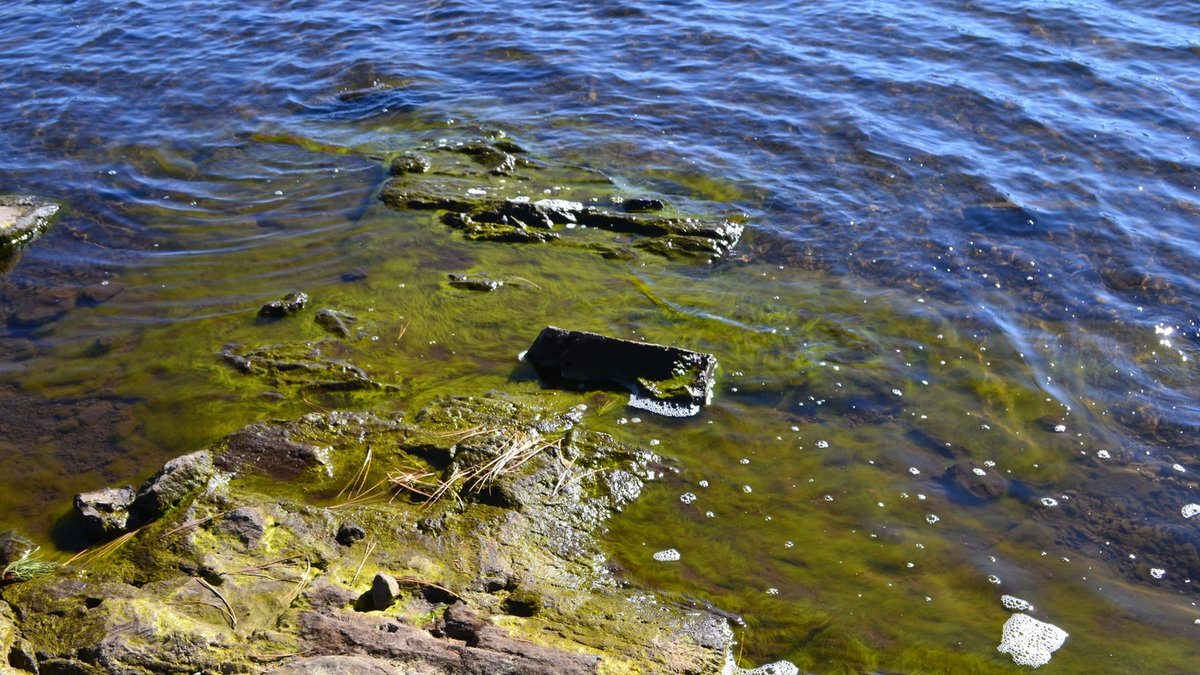
Yes, organisms that people call seaweed can grow in lakes. The everyday label usually refers to visible algae in salt water, but lakes also support freshwater macroalgae large enough to see without a microscope. Stringy green masses near shore are often filamentous algae such as Spirogyra or Cladophora. Other growths that look similar may be rooted aquatic plants or colonies of cyanobacteria.
The word seaweed therefore gives only a rough visual description. Correct identification is more useful because each group grows differently and poses different concerns. The Province of British Columbia’s overview of freshwater algae explains that algae range from microscopic single cells to large macroalgae. Some species form filaments or colonies that gather into mats visible from shore.
A modest amount of algae belongs in a healthy lake. Problems begin when growth becomes dense enough to smother habitat, obstruct recreation or contribute to large swings in dissolved oxygen. A surface mat can also resemble a potentially harmful cyanobacterial bloom, so appearance alone cannot settle whether the water is safe.
What lake seaweed actually is
Filamentous algae consist of cells joined in long threads. The threads may begin on rocks or sediment, then trap gas and rise as loose green clumps. Spirogyra, sometimes called water silk, has slippery strands. Cladophora forms branching filaments and can attach firmly to hard surfaces. Chara and Nitella are larger branched algae that can resemble underwater plants.
Freshwater macroalgae do not form one single taxonomic group. The label describes visible size and growth form rather than one branch of the tree of life. Many belong to green-algae lineages, including relatives of the algae from which land plants evolved. Calling a lake growth seaweed may be understandable in conversation, but naming its growth form or genus gives lake managers far more useful information.
Aquatic plants, also called macrophytes, are a separate group. Many have a true root system with stems and leaves, even when every visible part remains underwater. Cattails emerge above the surface, while water lilies carry floating leaves. Other species grow entirely below the water. The U.S. Environmental Protection Agency defines macrophytes as plants growing in or near water and recognizes emergent, submerged and floating forms.
Planktonic algae are tiny cells suspended in the water. A large population can tint an entire lake green or brown without producing stringy strands. Periphyton is the slippery community of algae and other microorganisms attached to underwater surfaces. People may casually call these growths lake weed or pond scum. Seaweed is another loose label, even though the terms can describe different organisms.
Freshwater algae support the lake food web
Algae capture light through photosynthesis and build organic matter that feeds aquatic food webs. Microscopic algae are eaten by zooplankton, which in turn support insects and fish. Larger algae provide surfaces where microorganisms and small invertebrates live. Their photosynthesis releases oxygen during daylight, while algae and other organisms consume oxygen through respiration. Oxygen levels can therefore rise during a sunny afternoon and fall overnight, especially in highly productive water.
Macrophytes add physical structure that algae alone cannot provide. Plant beds shelter young fish and offer substrate for aquatic invertebrates. They also soften wave energy near shore, while their roots can stabilize bottom sediment. EPA lake assessments use several macrophyte measurements as indicators. The depth of growth is recorded alongside its density and the types present because both absence and overabundance can reveal changes in water conditions.
Growth along the shallow margin is especially common because sunlight reaches the lakebed there. Water depth and clarity help determine which organisms occupy a site. The character of the sediment also plays a role. A clear lake may support rooted plants deeper than a turbid lake, while algae attached to rocks can thrive where a firm surface and enough light are available.
Why lake algae sometimes grow out of control
Nitrogen and phosphorus are essential nutrients, but excess inputs can fertilize rapid growth. Runoff may carry nutrients from fertilized land or eroding soil, while failing septic systems and animal waste can add more. The U.S. Geological Survey notes that plant and algae overgrowth often follows human nutrient inputs to lakes and ponds.
Warm water under calm, bright conditions can favor some blooms. Shallow water warms quickly and slow circulation allows buoyant organisms or detached mats to gather. Conditions vary by species, so a lake can have abundant filamentous green algae in one cove while open water remains clear. Natural aging also tends to make shallow ponds more productive as sediment and organic matter accumulate.
Dense growth creates problems through its mass as well as its identity. Mats can clog intakes and interfere with swimming or fishing. When a large amount dies, decomposing microbes consume dissolved oxygen. A sudden loss of oxygen can stress or kill fish. Penn State Extension’s guidance on filamentous algae warns that treating a whole pond at once may worsen this risk because so much material decays together.
How to tell algae from plants and cyanobacteria
Long strands that lift from the water as a tangled mass suggest filamentous algae. A specimen with recognizable plant organs such as leaves and stems is more likely an aquatic plant. Branched algae such as Chara can complicate the comparison because they resemble plants, but they lack the same true organs. A field guide or a local lake specialist can narrow the identification before any management begins.
Cyanobacteria are photosynthetic bacteria commonly known as blue-green algae. Some species can produce cyanotoxins, although the presence of a bloom does not prove that toxins are present. Cyanobacterial growth may look like spilled paint, pea soup, small clippings or surface scum. Filamentous green algae more often hold together as hairlike strands, yet visual clues can overlap.
The EPA says laboratory analysis is needed to confirm cyanobacteria and toxins. People should follow posted advisories and avoid suspicious water rather than trying to judge safety by color. The agency also advises keeping pets away from water where a harmful bloom may be present because animals can swallow contaminated water or lick material from their fur. Local health or environmental authorities can provide current guidance for a specific lake.
Responsible ways to manage nuisance growth
Management starts with identifying the organism and the reason it has become abundant. A useful assessment records where the growth occurs and how much area it covers. Seasonal changes should be recorded too. Water clarity and dissolved oxygen measurements can add context, while photographs from the same shoreline point help distinguish a recurring patch from a rapid expansion. Professionals may examine samples under a microscope or test the water when cyanobacteria are suspected. Removing a patch may clear a swimming area temporarily, but persistent nutrient inputs can support another crop. Long-term work often focuses on keeping soil and fertilizer out of the water. Maintaining septic systems and preserving vegetated shoreline buffers can also slow the runoff that feeds new growth.
Mechanical removal can be practical in a small area. Raked algae should be moved away from the water so its nutrients do not wash straight back into the lake as it decomposes. Large lakes and public waters require a broader plan because disturbance can spread fragments, damage habitat or conflict with local rules. Lake associations and natural-resource agencies can help identify appropriate methods.
Chemical products should never be chosen from appearance alone. An algaecide intended for one organism may be ineffective against an aquatic plant and killing too much biomass at once can reduce oxygen. Product labels and water-use restrictions differ by place. So do local permit requirements. A qualified lake manager can match any treatment to the confirmed species, water chemistry and size of the affected area.
The goal is usually a functional plant and algae community rather than bare water. Some growth feeds animals and protects shorelines. Intervention becomes most useful when a verified nuisance threatens recreation, habitat or water quality, with the underlying nutrient source addressed alongside short-term removal.
Growth commonly called seaweed can be identified more precisely with Argo’s guide to native lake plants, algae and invasive weeds.