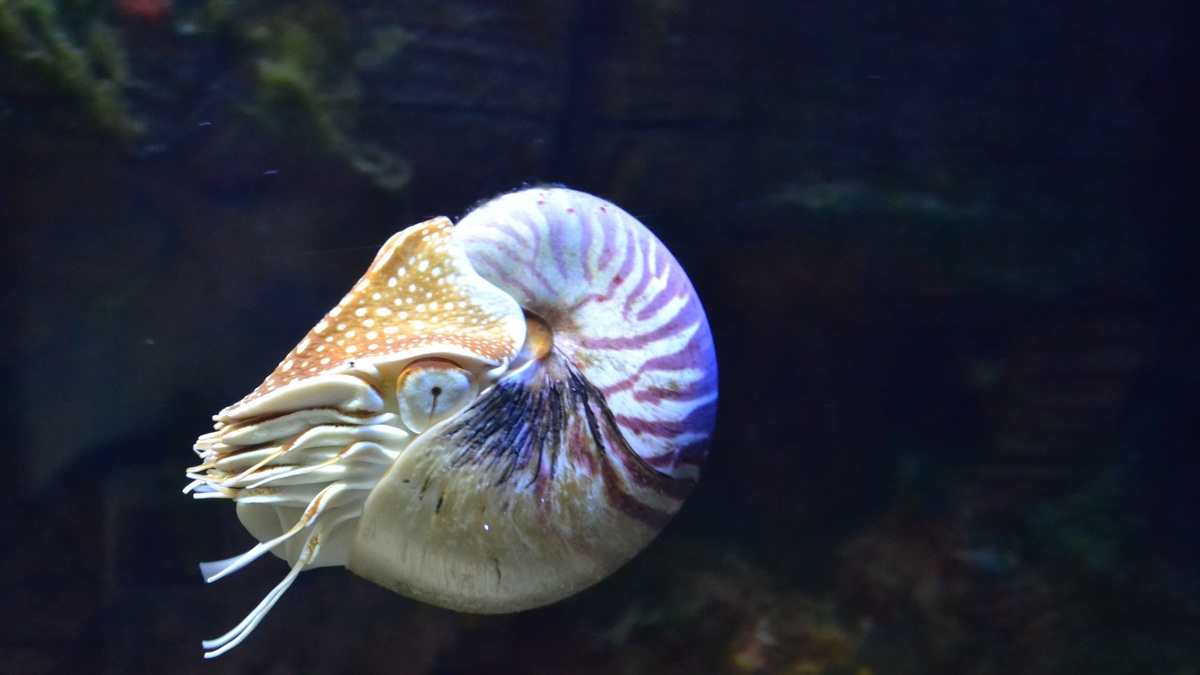
A nautilus is a marine cephalopod that carries a coiled external shell. It is related to octopuses, squid and cuttlefish, but its many slender tentacles lack suckers and its shell remains visible throughout life. The animal occupies only the newest outer chamber, while older chambers help control buoyancy.
Living nautiluses occur around steep tropical reefs in the Indo-Pacific. They often spend daylight hours in deeper, dim water and move shallower at night to feed. Temperature and pressure constrain these vertical journeys, so they do not simply drift anywhere a current leads.
The NOAA nautilus overview describes the chambers and the tube called a siphuncle that passes through them. The shell is both a protective structure and a precisely regulated buoyancy system.
The animal lives in the outer body chamber
As a nautilus grows, its mantle adds shell at the opening. The animal moves forward and seals off the space behind it with a wall called a septum. Repeating this process creates a series of chambers that traces growth from the tiny center outward.
The shell’s spiral follows a regular expansion, but it is misleading to call every nautilus shell a perfect golden spiral. Biological growth varies and the mathematical description depends on how landmarks are measured.
A muscular hood can cover the opening when the animal withdraws. The hood is not a hard trapdoor, yet it adds protection. The living body still remains vulnerable to predators capable of cracking or entering the shell.
The Smithsonian Ocean chambered nautilus profile places the shell within cephalopod evolution. Most living cephalopods reduced or lost an external shell, while nautiluses retained one.
The siphuncle adjusts liquid within old chambers
A cord of living tissue called the siphuncle runs through openings in the chamber walls. It removes fluid from newly sealed chambers through osmotic and active processes. Gas then occupies much of the vacated space.
The system does not work like a submarine tank that rapidly fills and empties. Chamber adjustment is relatively slow. Fine control of position also comes from swimming, body orientation and water movement.
Too much pressure can damage the shell at extreme depth. Nautiluses therefore occupy a bounded vertical habitat where cool temperatures suit their physiology without exceeding shell limits. Species and location affect the exact range.
A funnel provides jet propulsion
Water enters the mantle cavity and is expelled through a flexible funnel. Directing that jet moves the animal forward, backward or sideways. The nautilus is less streamlined than a squid and much of its movement consists of controlled hovering or modest bursts.
Dozens of retractile appendages around the mouth help locate and grasp food. Unlike octopus arms, they have adhesive ridges rather than suckers. A hard beak breaks pieces from crustaceans, carrion and other prey.
Nautiluses use chemical senses extensively. Their simple pinhole-type eyes form images without a lens, while organs near the mouth sample dissolved cues. The combination suits nocturnal foraging along reef slopes.
Its ancestry is old, but the living animal is modern
Nautiloid relatives were diverse in ancient oceans and shells in the fossil record extend back hundreds of millions of years. Living nautiluses are sometimes called living fossils because the general shell form appears ancient.
The label does not mean a modern species has remained unchanged since the Paleozoic. Lineages branch, go extinct and evolve new traits. Today’s Nautilidae represent a surviving branch rather than direct replicas of every fossil nautiloid.
The University of California Museum of Paleontology cephalopod guide shows the broader fossil history. It helps separate the long history of cephalopods from the much narrower history of living species.
Shell fossils also reveal buoyancy strategies in extinct forms. Straight, curved and coiled shells occupied ancient seas. The modern coil is one successful arrangement, not the only design the lineage ever produced.
Slow reproduction increases harvest risk
Nautiluses grow slowly and produce relatively few large eggs. Females lay eggs individually on hard surfaces and development can last about a year. Such a life history limits how quickly a depleted local population can rebound.
The polished shell has long been sold for jewelry and decoration. Baited traps can remove animals from isolated reef populations faster than they are replaced. Deep water does not protect a species when fishing gear reaches its daily habitat.
International trade in nautilus species is controlled under CITES Appendix II. The listing does not ban every trade, but it requires evidence that exports are legal and not detrimental to wild populations.
A shell on a beach may have traveled far
An empty chambered shell can float after the animal dies. Currents may carry it far beyond the living species’ range before it strands. A beach shell is therefore not reliable proof that nautiluses inhabit nearby reefs.
Living animals should not be inferred from shell shops either. Provenance, species identity and legality matter because commercial shells pass through international supply chains. Conservation depends on monitoring populations as well as trade.
A nautilus combines familiar cephalopod features with an external shell. Its funnel moves it, tentacles handle food and the siphuncle regulates old chambers. Understanding those parts replaces the vague image of a fossil survivor with the biology of a living deep-reef animal.
Reproduction differs from fast-growing squid
Male and female nautiluses are separate and males transfer sperm with modified appendages. Eggs are attached to hard substrate in crevices where direct observation is difficult. Much of what is known comes from aquariums, which may not reproduce every natural condition.
Hatchlings emerge with a small functional shell and several chambers. They do not pass through a free-swimming larval stage like many marine invertebrates. Young animals add shell and septa as they grow.
The long development of each egg and low reproductive output contrast with squid that can produce many offspring rapidly. Population turnover is therefore slow, a major concern where trapping removes breeding adults.
Scientists use baited remote cameras to estimate abundance without hauling every visitor to the surface. Mark-recapture studies and genetic samples reveal movement between reefs, which can be limited by deep channels or unsuitable temperatures.
Shell color provides camouflage
Brown bands are strongest on the upper shell, while the underside is pale. This countershading can reduce contrast when seen from above or below. The pattern differs from the rapid skin-color changes used by many octopuses and cuttlefish.
Nautiluses possess pigment cells but lack the elaborate chromatophore display system of their coleoid relatives. Their defensive options rely more on withdrawal, the hood and the shell. Slow swimming makes structural protection especially important.
The shell opening changes form as the animal matures and males may differ from females. Specialists use shell measurements with soft-body anatomy because an empty, worn shell can hide important identifying features.
Local populations can be naturally isolated
Nautiluses may not cross warm surface water or very deep channels between islands. A population on one reef can therefore have little genetic exchange with neighbors. Heavy harvest in a single area may not be replenished by animals arriving from far away.
This isolation makes local monitoring essential. A species can remain widespread on a map while particular populations collapse. Trade data also need geographic origin, not only a species name.
Protecting habitat and limiting unsustainable capture address different parts of the problem. Reef condition supports feeding and egg laying, while harvest controls keep slow-growing adults in the population. Together they give the chambered cephalopod time to complete its unusually long life cycle.
A reliable sighting record notes depth, temperature and whether bait influenced behavior. Those details let researchers compare nautilus populations without assuming every camera visit measures natural abundance in the same way. Combined with trade records, the surveys reveal where a slow-breeding local population needs the strongest protection.
Related reading: marine snow and pelagic and benthic zones.