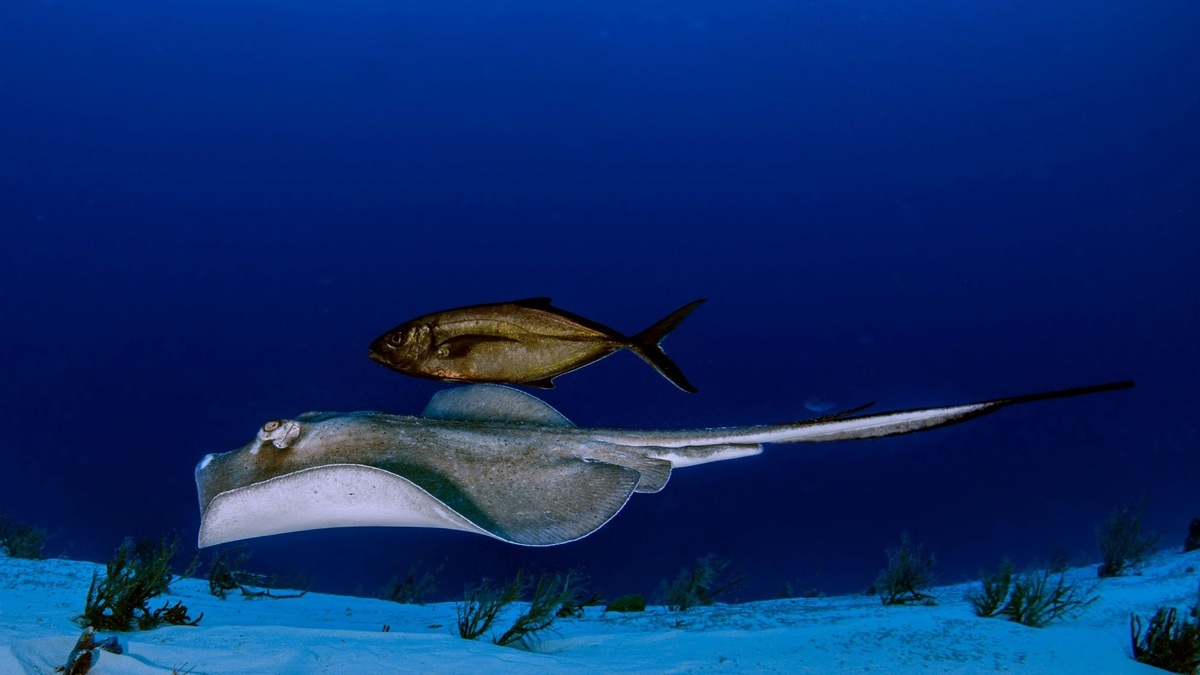
The pelagic zone is the open water column, from the surface to water just above the bottom. The benthic zone is the seabed and the sediment or rock immediately associated with it. A fish swimming a meter above mud is pelagic at that moment; a worm burrowing through the mud belongs to the benthic habitat.
The comparison describes position rather than depth. Pelagic water spans bright coastal seas and the deepest ocean trenches. Benthic habitat likewise ranges from wave-washed shorelines to abyssal plains. NOAA’s American Samoa overview separates pelagic and benthic ecosystems while showing how closely they interact.
Many organisms move between the two. A crab larva may drift as plankton before settling and a bottom-feeding fish can swim through open water. Ecologists classify the life stage and activity being studied instead of assigning every species one permanent label.
The pelagic realm is three-dimensional water
Pelagic organisms include drifting plankton and actively swimming nekton. Currents transport plankton, although many can control their depth or make short horizontal movements. Fish, squid, turtles and marine mammals move more strongly against the flow.
Temperature, salinity, oxygen and light create vertical layers without a physical floor between them. Fronts and eddies add horizontal boundaries. Pelagic habitat can change over hours as water masses move past a fixed sampling station.
NOAA explains that the pelagic zone covers waters beyond the continental shelf in one common usage, but pelagic also broadly means open water. Authors should state their definition when comparing habitats.
The distinction also changes how carbon is counted. Pelagic respiration returns carbon dioxide to the water column, while burial in benthic sediment can isolate carbon for much longer periods. Bottom currents may expose buried material again. Carbon budgets therefore measure sinking flux above the seabed and the fraction retained after animals and microbes process it.
Chemical gradients continue below the visible bottom. Oxygen may penetrate only millimeters into fine sediment before microbes switch to nitrate, metal oxides or sulfate. This vertical sequence is benthic even though pore water occupies spaces between grains. Sampling it requires intact cores rather than ordinary water bottles.
The benthic realm begins at a surface
Benthic environments include exposed bedrock, coral framework, sand, mud and the pore spaces within sediment. Attached organisms occupy the surface, while infauna burrow beneath it. Microbes extend into chemical layers that animals may never enter.
Bottom type strongly influences the community. A sponge needs firm attachment, a burrowing clam requires penetrable sediment and a deposit feeder relies on organic particles mixed into the seabed. Depth alone cannot predict which habitat exists.
Bathymetry adds slope and landform context. Argo’s account of ocean-floor topography describes shelves, canyons and abyssal plains that organize benthic environments across a basin.
Near-bottom boundary layers show how closely the realms meet. Friction slows water against the seabed and turbulence lifts sediment into suspension. Filter feeders exploit particles carried through this layer, while mobile fish follow prey concentrated above bottom relief. Instruments mounted a few centimeters and several meters above the floor can record sharply different conditions.
A whale fall demonstrates the transfer dramatically. Soft tissue first feeds pelagic and benthic scavengers, then enriched sediment supports dense small animals. Microbes later use lipids stored in bones and generate sulfide for chemosynthetic communities. One carcass can sustain a succession of bottom habitats for years while drawing its original carbon from surface food webs.
Food crosses the boundary in both directions
Photosynthesis in surface water produces most organic matter entering the deep ocean. Sinking particles feed benthic microbes and animals. Carcasses deliver rare concentrated meals, while fecal pellets can descend faster than individual cells.
Benthic animals return nutrients to the water through excretion and decomposition. Burrowing mixes oxygen into sediment and releases dissolved compounds. Currents resuspend particles, making bottom material available to pelagic filter feeders.
This exchange is called pelagic-benthic coupling. Its strength changes with depth, current and productivity. A shallow shelf may receive fresh seasonal blooms quickly, while abyssal sediment receives a much smaller, altered fraction months later.
Marine snow makes the downward route visible, but material also travels laterally. Bottom currents carry resuspended sediment along a slope and storms lift shelf particles high into the water column. A trap placed directly above one patch may therefore collect food produced far away.
Burial marks the fraction that escapes rapid recycling. Microbes continue to consume organic matter after it reaches the seabed and burrowing animals expose deeper particles to oxygen. Sediment cores show how much carbon remains after those losses, giving the benthic realm a long-term role that a water sample cannot measure.
Life histories connect distant habitats
Many bottom animals release eggs or larvae into open water. Pelagic dispersal allows colonization beyond the parent’s patch, but currents may carry larvae away from suitable substrate. Chemical cues and swimming behavior help some larvae choose where to settle.
Demersal fish live close to the bottom while remaining capable swimmers. They feed on benthic prey and may rise into the water column. The term distinguishes their association with the seabed from truly attached or burrowing organisms.
Vertical migrators transport carbon in the opposite direction from passive sinking. They feed near the surface and respire at depth, sometimes becoming prey near the bottom. Such movement prevents the ecological realms from functioning as isolated systems.
In the abyss, the water-bottom connection operates under chronic food scarcity. WHOI’s account of the abyssal zone shows the scale across which a small particle flux supports swimming animals and organisms in sediment. A rare carcass can briefly strengthen that connection over a limited area.
Scientists sample each realm differently
Pelagic surveys use nets, water bottles, acoustic instruments and optical profilers. A net integrates organisms across its tow path, while water samples preserve chemistry at selected depths. Sonar can track dense animal layers without identifying every species.
Benthic work uses grabs, cores, trawls, cameras and remotely operated vehicles. A core preserves vertical sediment structure. Imagery shows fragile animals in place, although it can miss organisms hidden below the surface.
Matching methods is crucial. Comparing a short bottom video with a kilometer-long pelagic tow would confuse sampling scale with ecological difference. Repeated observations capture seasonal settlement, migration and sediment disturbance.
Disturbance travels across the interface
Bottom trawling, dredging and seabed construction directly alter benthic terrain and suspend sediment into the water. Pollution arriving in water can bind to particles and accumulate on the bottom. Oxygen loss can compress pelagic habitat and kill immobile benthic animals where low-oxygen water touches the seabed.
Marine protected areas often need both perspectives. Protecting a reef surface without considering fishing in the water above can leave key predators exposed. Pelagic protection alone may fail if spawning or nursery habitat on the bottom is damaged.
Pelagic and benthic are complementary coordinates in the same ocean. One identifies life in water, the other life tied to the floor. Their exchanges determine where food travels, how populations disperse and how a disturbance in one realm reaches the other.
Stable-isotope measurements can trace the exchange when direct observation is impossible. Carbon and nitrogen signatures in bottom animals are compared with suspended particles, local algae and prey. The chemical pattern can show whether a community depends mainly on fresh surface production, resuspended sediment or chemosynthetic carbon. Fatty-acid markers provide another line of evidence because some primary producers leave distinctive compounds in consumers. Neither method identifies every feeding event, but agreement between chemical tracers and observations makes the inferred connection more convincing.
Related comparisons separate the neritic and oceanic zones horizontally and the littoral and sublittoral zones along the seafloor.