A sea sponge is a simple aquatic animal whose body pumps water through a network of pores and canals. Sponges belong to the phylum Porifera, a name meaning pore bearer. They have no brain, heart, lungs or true digestive tract, yet they feed, reproduce and respond to their surroundings.
NOAA’s introduction to the sea sponge notes that scientists have described thousands of living species. Most inhabit salt water, from sunlit reefs to the deep seafloor. A smaller group lives in freshwater lakes and rivers.
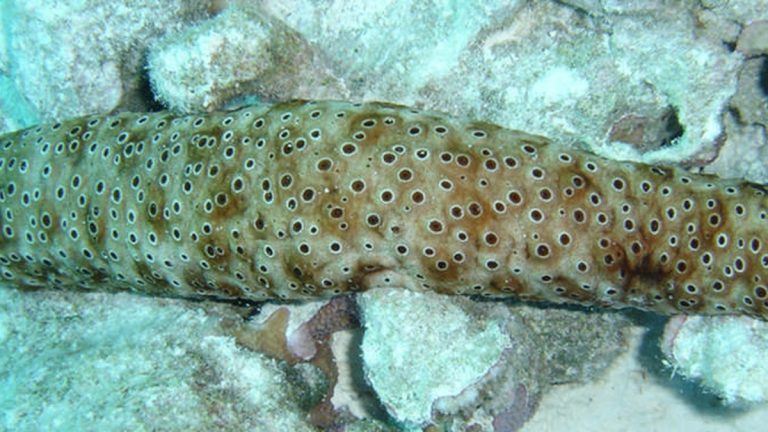
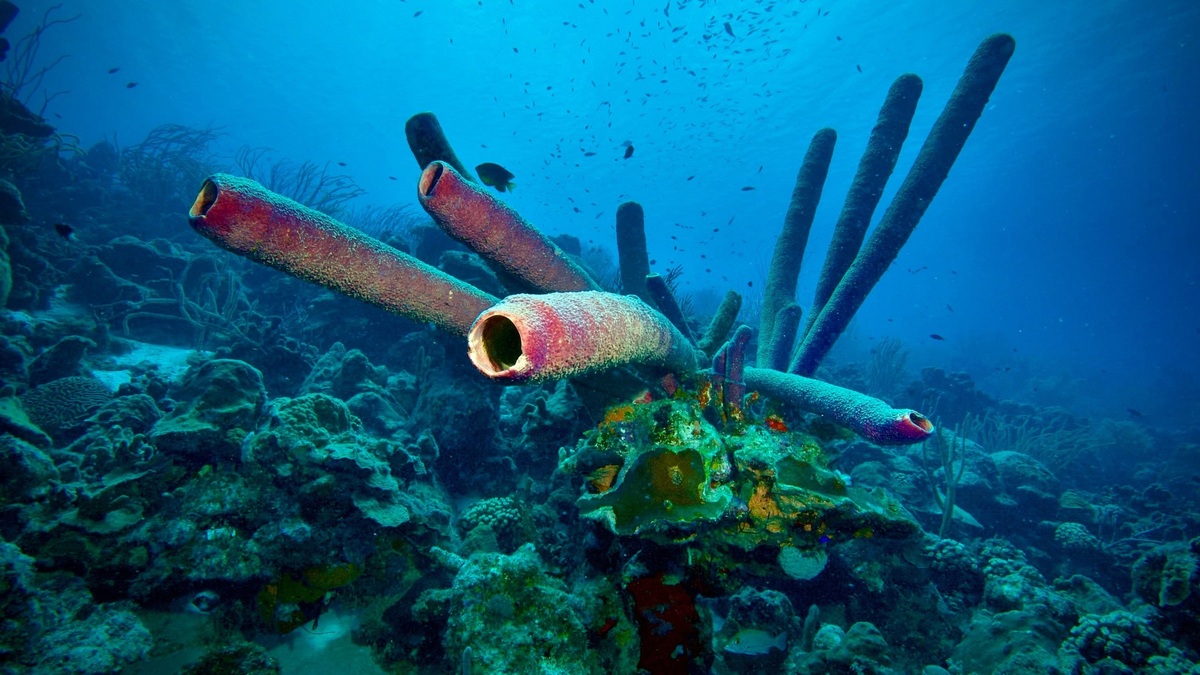
The familiar bath sponge represents only one soft-bodied form. Living sponges may resemble tubes, crusts, fans, cups or branching fingers. Mineral needles or flexible protein fibers support many bodies, producing textures that range from fragile glass to resilient rubber.
A sponge is an animal without organs
Sponges are multicellular animals, but their organization differs sharply from that of fish, corals or worms. They lack true tissues arranged into organs. Specialized cells carry out essential jobs and can reorganize when the body is damaged.
A layer of flattened cells covers much of the exterior. Tiny openings called ostia admit water, while larger openings called oscula release it. Inside, chambers lined with collar cells maintain the current.
Those collar cells, or choanocytes, beat whip-like flagella. Each cell’s collar traps bacteria and suspended organic particles from passing water. Other mobile cells distribute nutrients through the body and help build structural material.
The Smithsonian Ocean sponge guide explains how this cellular organization supports animals with remarkably varied shapes. A sponge’s form often reflects water flow, sediment and available surfaces in its habitat.
Filter feeding moves an enormous volume of water
Water enters through many small pores, moves through canals and feeding chambers, then exits through one or more oscula. Pressure created by thousands of flagella keeps the flow moving. The system delivers both food and dissolved oxygen.
Filtration is the sponge’s central activity. Bacteria, microscopic plankton and organic fragments become food. Dissolved compounds can also contribute to nutrition, especially in clear tropical water where visible particles may be scarce.
Efficient pumping depends on clean channels. A sponge can slow or stop water flow when disturbed. Some species produce mucus or shed surface cells to clear sediment that would otherwise clog their pores.
Filtration affects the surrounding ecosystem. By removing particles and releasing waste products, sponges transfer material between the water column and bottom communities. The process contributes to nutrient cycling on reefs and in deeper habitats.
Skeletons of glass, stone or flexible protein
Many sponges make microscopic support elements called spicules. Calcium carbonate or silica forms these pointed structures. Their shapes provide taxonomists with useful clues for identifying species that look similar from the outside.
Other species rely heavily on spongin, a flexible protein framework. Commercial bath sponges come from species whose cleaned skeletons retain a soft, absorbent network after living cells are removed. Synthetic products now account for most objects sold as household sponges.
Glass sponges build intricate silica skeletons and are especially associated with deep, cold water. NOAA describes glass sponge reefs that create three-dimensional habitat for other animals. Some living structures persist for centuries.
Sponges reproduce in several ways
Many species release sperm into the water, which another sponge draws into its canal system. Fertilization may occur internally. A swimming larva later leaves the parent, settles on a suitable surface and transforms into a stationary juvenile.
Sponges can also reproduce asexually. Buds detach or remain connected, while broken fragments may establish new individuals. Freshwater species often form resistant packages of cells called gemmules that survive unfavorable seasons.
Strong regenerative ability does not make every injury harmless. Recovery depends on species, wound size and environmental conditions. A fragment buried by sediment or moved into unsuitable flow may die even when its cells retain regenerative potential.
Many sponges host dense communities of bacteria and archaea. These microbes can process nitrogen, carbon or sulfur compounds and sometimes produce defensive chemicals. The NOAA reef tutorial places such nutrient exchanges within the broader productivity of coral ecosystems.
Where sea sponges live and why they matter
Most sponges attach permanently to rock, coral rubble, shells or other firm surfaces. Species also occupy soft sediment by anchoring with specialized structures. Their depth range extends from intertidal pools to hadal environments.
Habitat-forming sponges add vertical structure to otherwise flat seabeds. Small crustaceans, worms and juvenile fish use their surfaces or internal spaces. Predators include nudibranchs, sea stars, hawksbill turtles and certain fish adapted to chemical defenses or tough skeletons.
Some sponge populations are vulnerable to bottom-contact fishing, warming, disease and declining oxygen. Deep species can grow slowly, making recovery difficult after a reef is broken. Protection requires knowing where persistent sponge grounds occur.
A sponge continuously negotiates water flow
The apparent stillness can hide rapid cellular activity. Some sponges contract their canals in coordinated waves, expelling debris through oscula. These movements occur without muscles or a nervous system, relying on signaling among cells.
Sponges compete for limited hard surface with corals, algae and other attached animals. They may grow over neighbors, retreat from chemical defenses or occupy shaded crevices. Storm damage can open new space and redistribute fragments.
Not every colorful mass on a reef is a sponge. Tunicates can also filter water through openings, but they possess true tissues and a chordate body plan. Close inspection of pore patterns and skeletal material helps specialists distinguish them.
Skeletons and microbes preserve hidden information
Sponges also record environmental conditions in their skeletons. Growth layers and chemical ratios in long-lived species can preserve clues about past seawater. Interpreting those records requires species-specific knowledge and independent dating.
Relationships with microbes vary from sparse communities to bodies densely packed with symbionts. Microbes may transform nitrogen compounds, fix carbon or contribute defensive chemistry. The sponge supplies habitat and a continuous stream of seawater-derived substrates.
Reef restoration projects sometimes transplant sponge fragments, but success depends on attachment, flow and species ecology. Moving organisms can also spread disease or disturb donor populations, so restoration needs permits, health screening and monitoring rather than casual relocation.
Age is difficult to judge from size. Growth can slow when food is scarce and a large colony may contain areas of different vitality. Some deep species appear exceptionally old, yet estimates depend on growth models or dated skeletal features.
Canal systems respond to changing conditions
Pumping is active. Flagella create currents through branching canals whose geometry influences efficiency. A sponge can adjust openings or halt flow when sediment, toxins or physical disturbance threaten its feeding chambers.
Flow limits body shape. A thick sponge needs chambers that keep cells close enough to moving water for oxygen and food exchange. Narrow branches or folded surfaces increase functional area without a circulatory system.
Species process different particles. Many capture bacteria, while some deep-sea sponges supplement filtration by trapping tiny crustaceans. Carnivorous sponges often have reduced canal systems and hooked structures that hold prey.
Environmental pressures on sponge communities
Sponges release cells, dissolved compounds and nutrient-rich particles. On reefs, this movement can make dissolved organic matter available to animals that cannot consume it directly. Researchers call one version of this recycling the sponge loop.
Chemistry supplies defense. Many species produce compounds that deter predators or fouling organisms. Some molecules attract biomedical research, although discovery does not mean a wild sponge can be used safely as medicine.
Heat can disrupt microbial partnerships, while acidification may affect calcium-carbonate structures differently from silica forms. Local pollution and sediment compound these pressures. Coordinated cells and continuous flow nevertheless let sponges occupy nearly every marine environment.
Careful taxonomy supports protection. Identifying species correctly reveals which habitats contain slow-growing builders and which populations can recover more quickly after disturbance. A sponge’s quiet exterior conceals constant filtration, cellular coordination and microbial exchange, processes that make these organless animals active participants in marine ecosystems.
Related reading: marine snow and pelagic and benthic zones.