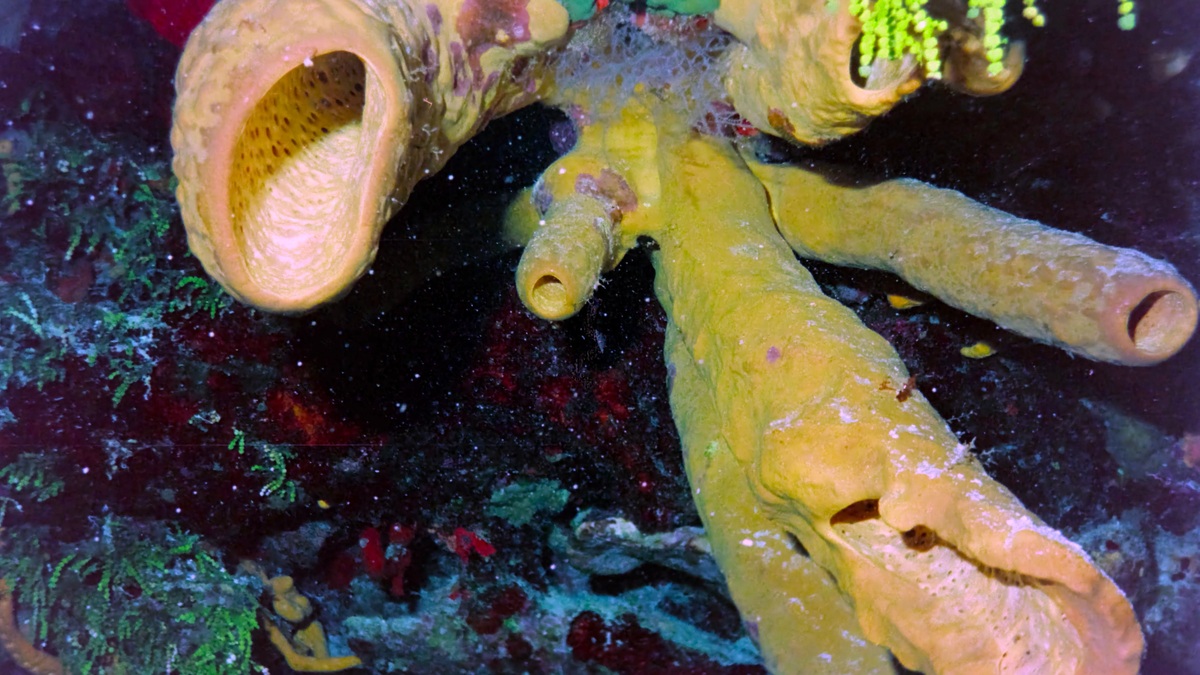
A glass sponge is a deep-water animal whose skeleton is built largely from silica, the mineral material in glass. Its supporting elements, called spicules, may fuse into a delicate lattice that resembles spun glass. The living tissue forms a thin layer over this framework and filters food from passing water.
Glass sponges belong to the class Hexactinellida. Their spicules commonly have a six-rayed basic form, which gives the group its scientific name. Some live as solitary cups or tubes, while a few species build massive reefs in cold, dark water.
The NOAA glass sponge overview recounts the discovery of living reefs off British Columbia in 1987. Similar structures were known from fossils, so finding modern examples revealed an ecosystem that had been missing from scientific view.
Silica spicules create a mineral scaffold
Silica dissolved in seawater is taken up and deposited as spicules. In many glass sponges, the elements fuse into a rigid network. The geometry distributes mechanical stress while leaving openings through which water can move.
The skeleton is biological glass, but it is not manufactured like a window. Enzymes and cellular processes control deposition at ocean temperatures. Researchers study these structures because their layered fibers combine strength with resistance to cracking.
Different species produce distinct forms, from branching fans to tubular baskets. Shape reflects inherited growth patterns along with local flow and substrate. A preserved skeleton shows the framework but not the soft living tissue that once covered it.
The Smithsonian Ocean sponge guide explains that sponges are animals despite lacking muscles, nerves and organs. Their bodies are organized around water flow rather than active pursuit of food.
A shared tissue network carries electrical signals
Many glass sponge cells connect within a continuous, multinucleate tissue called a syncytium. This organization differs from the more cellular bodies of most other sponges. Electrical signals can travel through the shared tissue and temporarily stop water pumping.
Halting the current may protect the filtering system when sediment or irritating particles arrive. The response is coordinated without neurons. It demonstrates that rapid electrical communication can evolve outside a conventional nervous system.
Water enters through small openings, passes through chambers where particles are captured and exits from larger vents. Bacteria and tiny organic particles contribute food. Pumping also supplies oxygen and carries waste away.
British Columbia holds living glass sponge reefs
Reef-building glass sponges produce intertwined skeletons that remain after individuals die. New sponges grow on the framework and sediment becomes trapped among the spicules. Over generations, the structure rises above the seabed.
The Canadian Pacific reefs occur on the continental shelf in cold, low-light water. Some complexes cover many square kilometers. Mapping has revealed additional reefs since the first modern discovery, including sites in the Strait of Georgia and Hecate Strait region.
Fisheries and Oceans Canada describes protected glass sponge reef areas where bottom-contact fishing is restricted. Protection focuses on the fragile structure as well as the living sponges.
The reefs create vertical relief on otherwise soft bottom. Rockfish, crustaceans and other animals use the complex habitat for shelter or feeding. The sponge community also filters large volumes of water, linking suspended particles with the seafloor.
Deep reefs are ancient-looking, not unchanged fossils
Glass sponge reefs were widespread during the Jurassic period. Their apparent disappearance from younger rocks encouraged the view that reef-building forms were extinct. The living Canadian reefs showed that suitable conditions still support this mode of growth.
Calling a modern reef a living fossil can obscure evolutionary change. Today’s species are not Jurassic individuals preserved alive. They belong to an old lineage whose members continued to evolve while retaining the capacity to build silica frameworks.
Fossil reefs help geologists interpret ancient seas, while living reefs reveal the ecological processes behind the rock record. Neither archive is complete. Soft tissue rarely fossilizes and remote modern habitats remain incompletely surveyed.
The skeleton is vulnerable to direct contact
Silica frameworks can withstand ordinary currents yet break under anchors, cables or heavy fishing gear. Once crushed, a reef may recover slowly because growth is limited by cold temperature, food supply and the need for stable substrate.
Sediment clouds can interfere with filtration even when gear does not strike a sponge. Managers therefore consider both direct damage and changes to water near the bottom. Camera surveys document condition without collecting large pieces.
The Government of Canada reef summary describes conservation measures for these globally unusual habitats. Boundaries and rules differ among protected areas, so mariners and fishers need current regional information.
Climate-driven changes in temperature, oxygen and seawater chemistry may also affect growth. Responses are difficult to forecast because species differ and long time series are scarce. Protecting intact reefs gives researchers a baseline against which future change can be measured.
A glass sponge is an animal built around flow
The animal’s unusual traits fit one coherent design. Silica spicules provide support, a canal system delivers water and the syncytium coordinates pumping. None requires a mouth, gut or brain like those of a mobile animal.
Glass sponges also show why deep-sea exploration changes basic biology. A reef type known mainly from fossils was found alive within modern fishing grounds. Subsequent mapping revealed both its ecological value and its exposure to human activity.
Viewed closely, the glass skeleton is not decorative waste. It records growth, supports living tissue and eventually provides habitat for a larger community. The reef depends on the accumulated work of many slow-growing animals across generations.
Reef mapping depends on sound and cameras
Multibeam sonar can reveal mounds rising from the seafloor, but acoustic shape alone cannot confirm living sponge cover. Towed cameras and remotely operated vehicles provide the visual evidence needed to distinguish an intact reef from dead framework or ordinary rocky relief.
Mapping teams record sediment, current features and associated animals alongside sponge density. These layers help explain why reefs occur in one corridor and not another. They also show where a protection boundary would leave fragile structures exposed.
Repeated images can detect broken skeletons, new growth or smothering sediment. Growth is too slow for dramatic annual changes at many sites, so consistent camera position and long monitoring intervals are important.
Environmental DNA may eventually help detect species from traces in water. It complements rather than replaces imagery because a DNA signal does not show reef size, condition or physical damage.
Glass fibers inspire materials research
Some sponge spicules contain concentric silica layers around an organic core. The layered design can redirect cracks and preserve strength under bending. Engineers examine it as a model for making durable fibers under gentler conditions.
Biomimicry requires caution. A useful structural principle does not mean a sponge skeleton can simply replace industrial glass. Biological material is produced slowly for a living body, while manufactured fibers must meet cost and scale requirements.
The scientific value adds to ecological value without replacing it. A reef should be protected as habitat even if no commercial technology results from studying its silica architecture.
Spicule chemistry can also record conditions during growth. Trace elements and isotopes may provide clues about seawater temperature or nutrient supply, although the biological controls on incorporation must be calibrated for each species.
Larvae must reach stable bottom
Glass sponges reproduce sexually by releasing sperm that other individuals capture from the water. Fertilization and early development occur within the body in many species, followed by a mobile larval stage. The larva eventually settles and begins the attached adult life.
Successful settlement requires suitable substrate and flow. Fine sediment can bury tiny recruits before they establish a skeleton. Existing reef framework may provide elevated surfaces, helping one generation create conditions used by the next.
Recruitment is difficult to measure because young sponges are small and deep sites are costly to revisit. Photogrammetry can compare the same reef surface over time, while samples reveal whether apparent new growth belongs to reef-building species.
Connectivity among reefs depends on larval duration and current pathways. A protected reef may still recover poorly after damage if few larvae arrive, which is why managers consider networks of habitat rather than isolated points.
Growth, settlement and mortality together determine reef persistence. The surviving framework can last after tissue dies, but only living sponge cover continues filtration and produces the next generation of skeleton. Monitoring both framework and living tissue shows whether a mapped reef is functioning, declining or recruiting.
Related reading: marine snow and pelagic and benthic zones.