Researchers using the NASA/ESA/CSA James Webb Space Telescope report in a Nature study that interstellar comet 3I/ATLAS carries a chemical signature unseen in Solar System comets. The finding suggests that this visitor formed in a cold, distant planetary system that may predate the Sun by billions of years.
The comet is only the third confirmed interstellar comet ever identified. Its path brought it through the Solar System after a long journey from elsewhere in the Milky Way. When the Sun warmed its surface, ancient ice turned into gas and created a glowing coma that Webb could examine in detail.
That brief observing window gave astronomers a rare look at material from another planetary system. 3I/ATLAS appears to preserve clues from a place and time far beyond the reach of any spacecraft. Martin Cordiner of NASA Goddard Space Flight Center, lead author of the study, called it “a unique opportunity to study an ancient object from the distant Galaxy, probably pre-dating our Sun and Solar System.”
Webb caught 3I/ATLAS after its solar swing
As 3I/ATLAS began moving away from the Sun in December 2025, astronomers pointed Webb toward the comet. The timing mattered. Solar heat had freshly activated the comet’s frozen surface, releasing gases that made its chemical makeup easier to read.
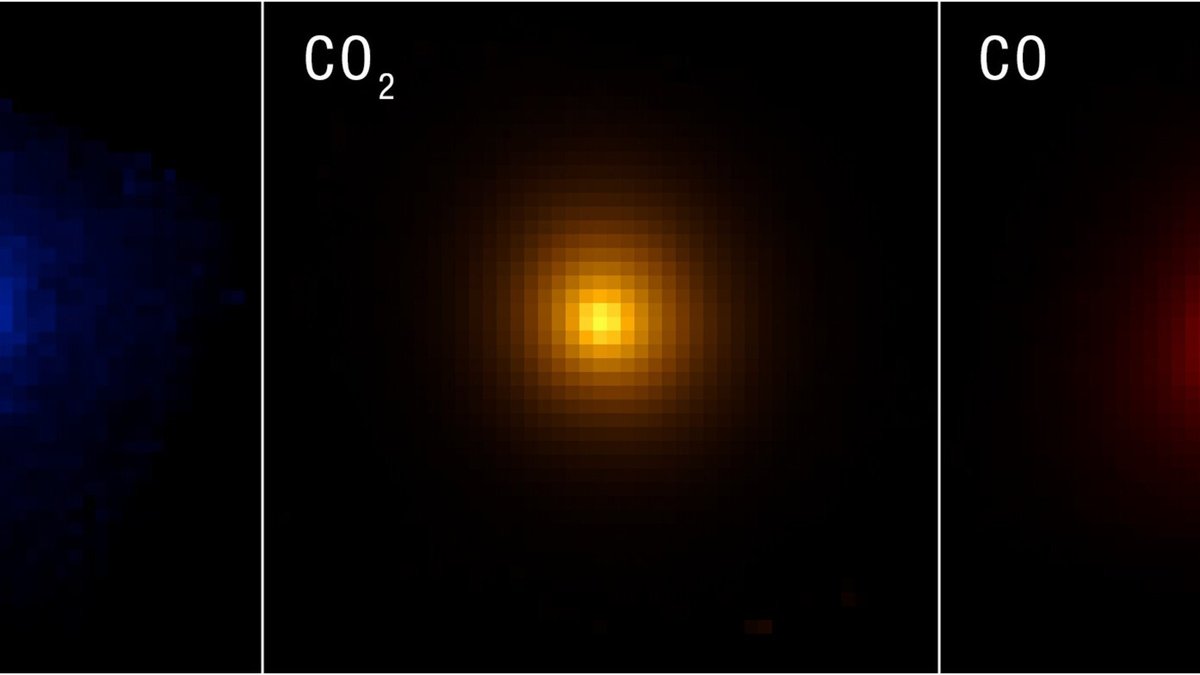
Webb used its Near-Infrared Spectrograph, known as NIRSpec, to split the comet’s light into a chemical fingerprint. Different molecules and isotopes absorb or emit light in distinct ways. That lets scientists identify what is present in the coma, even though the comet itself is small and distant.
The observing team received approval to interrupt Webb’s planned schedule. Interstellar comets are fleeting targets and 3I/ATLAS offered a chance to study matter that formed around another star. Once the comet moved too far from the Sun, its activity would fade and the richest signal would be harder to capture.
For planetary scientists, the coma acted like a released archive. The gases carried information about the comet’s original ice. Those ices likely formed long before 3I/ATLAS was thrown into interstellar space and began its lonely passage through the galaxy.
Heavy water points to a deep-frozen birthplace
One of Webb’s strongest clues came from deuterium, a heavy form of hydrogen. When deuterium bonds with oxygen in water, it creates a form often described as heavy water. The ratio of heavy hydrogen to ordinary hydrogen can reveal the temperature and radiation conditions where ice first formed.
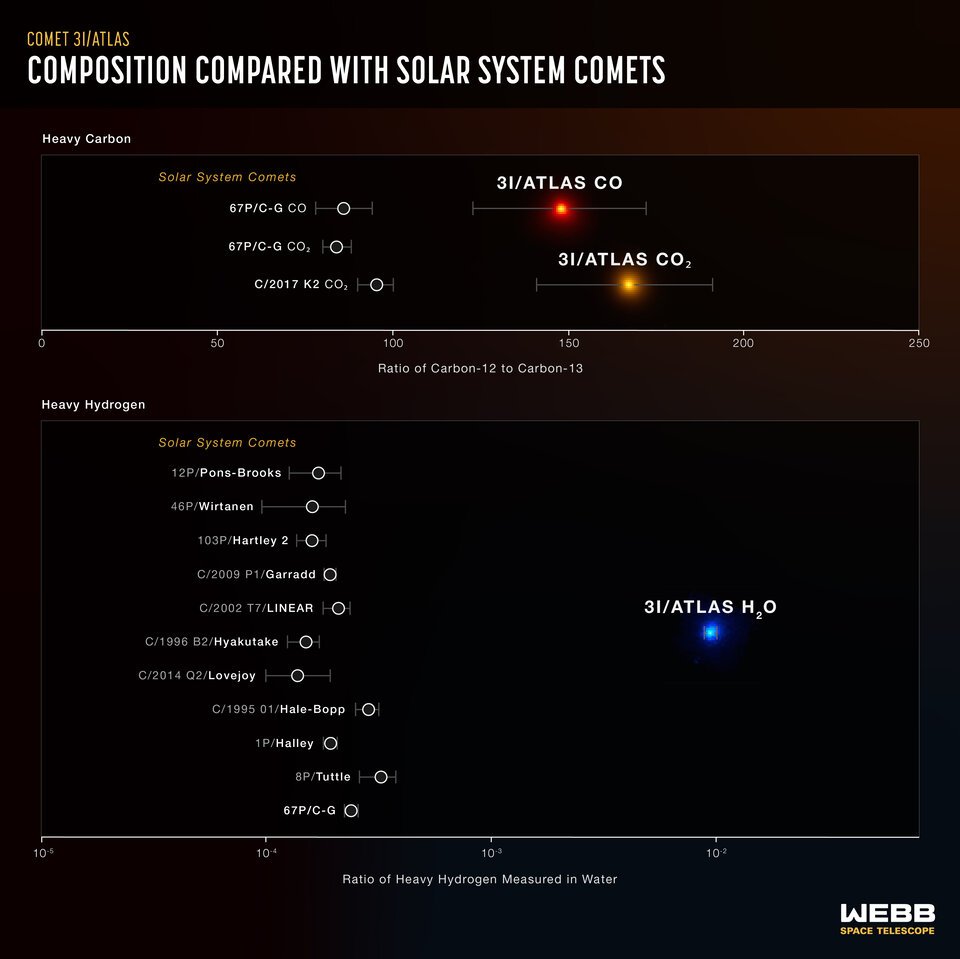
NIRSpec found exceptionally high levels of deuterium in 3I/ATLAS. According to the research team, the comet’s deuterium enrichment is about 30 times higher than values seen in Solar System comets. That extreme ratio points to a birthplace where chemistry unfolded in deep cold.
In such an environment, icy grains could preserve heavy-water signatures for immense spans of time. Long-term warmth would tend to rework those ices and alter the original balance. The Webb measurements suggest that the material in 3I/ATLAS spent its early history in a frozen state.
This matters because cometary ice is a record of planetary formation. In our Solar System, comets help scientists understand how water and organic ingredients moved around the young Sun. With 3I/ATLAS, researchers are reading a similar record from another system.
Cordiner described the value of that record in simple terms. “We get direct insight into that distant time and place,” he said. The phrase captures why a small comet can matter so much. It carries a sample of conditions that telescopes can usually infer only from afar.
Carbon clues suggest an older star system
Another signal came from carbon. Webb detected only traces of carbon-13 compared with the lighter isotope carbon-12. That balance adds a separate line of evidence for an ancient origin.
Across the galaxy, generations of stars slowly change the chemical mix of interstellar material. As stars form, age and die, they enrich space with heavier isotopes. Younger planetary systems can inherit more of those products from earlier stellar generations.
The Sun formed about 4.5 billion years ago, after the Milky Way had already gone through long cycles of stellar birth and death. A system with lower carbon-13 levels could have formed earlier, when the galaxy’s chemical recipe was different. That makes 3I/ATLAS especially valuable.
The carbon finding fits with the heavy-water result. Both point toward a cold, ancient environment that developed along a different chemical path from the region that produced the Solar System. The comet’s composition gives scientists a direct sample of that history.
A separate study using the European Southern Observatory’s Very Large Telescope, led by astronomer Cyrielle Opitom of the University of Edinburgh, examined carbon and nitrogen varieties in cyanide. Together with Webb’s measurements, these observations sharpen the picture of a comet formed far from home.
A relic from cosmic noon
The research team estimates that 3I/ATLAS could have formed as long as 10 to 12 billion years ago. That would place its origin during a period known as cosmic noon, when star formation across the Universe was near its peak.
During that era, young stars and planetary systems were forming at a furious pace. Dense clouds of gas and dust gave rise to new suns, disks and icy bodies. 3I/ATLAS may be a leftover from one of those early systems.
The comet’s young birthplace was likely cold and dense. Radiation may have been present, but the material appears to have avoided sustained heating. That combination could allow unusual isotope ratios to survive in the ice for billions of years.
Eventually, gravitational encounters may have thrown 3I/ATLAS out of its original system. Such ejections are expected during planetary formation, when growing planets can scatter smaller bodies into deep space. Once expelled, the comet would have drifted between stars until its path carried it through our Solar System.
Scientists have seen only a tiny number of interstellar visitors up close. Each one adds a new data point to a much larger question. How varied are planetary systems across the galaxy and how unusual is the chemistry that built our own?
What this comet could reveal about life’s ingredients
Comets interest astrobiologists because they can carry water, carbon compounds and other ingredients tied to prebiotic chemistry. 3I/ATLAS lets researchers compare those ingredients across star systems. Its unusual chemistry broadens the range of known comet compositions.
Stefanie Milam of NASA Goddard, a co-author of the study, linked the isotope findings to a larger search. “The bigger picture here is looking at the possibilities of prebiotic chemistry elsewhere in the galaxy,” she said.
That question reaches beyond one comet. Earth is the only place known to host life. Scientists want to know whether the chemical starting points for life are common across the galaxy or tied to a narrow set of conditions.
Interstellar objects provide a rare way to study that issue directly. They arrive as natural messengers from distant systems. Telescopes can read their gases, dust and isotopes without sending a spacecraft across light-years.
Milam said that “Analysis of these interstellar objects is a major step towards learning how common, or uncommon, the conditions for the evolution of life are in the Universe.” For 3I/ATLAS, Webb has turned a passing comet into a record of ancient ice chemistry, early star formation and the diversity of worlds that formed long before our Sun.