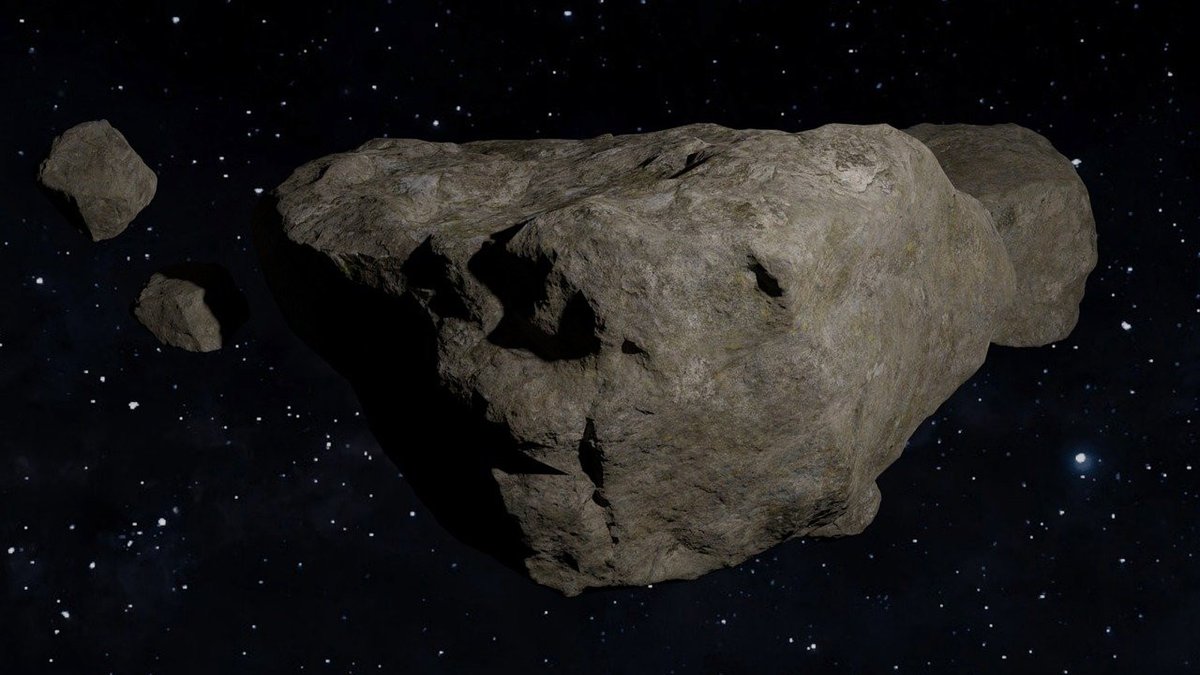
A study in Earth and Planetary Science Letters has found evidence that a rare meteorite from the Sahara Desert came from a shattered protoplanet that may have been as large as the Moon. The finding points to a vanished world that formed during the solar system’s infancy, then broke apart after a violent collision.
The meteorite, known as Northwest Africa 12774 or NWA 12774, belongs to a scarce class called angrites. These rocks are some of the oldest volcanic materials known from the solar system. Their chemistry has puzzled researchers for years because it differs sharply from the rocks that make up Earth, Mars and many familiar meteorites.
For Aaron Bell, an assistant research professor in the Department of Earth Science at the University of Colorado Boulder, the sample offered a rare chance to look inside a vanished planetary body. “It’s incredible to think there was once a world this large,” Bell said. “We only know it existed because a few fragments of it happened to land on Earth.”
A Sahara meteorite preserved the clue
The clue came from a small piece of ancient debris recovered in the Sahara Desert. NWA 12774 is an angrite meteorite, a type of volcanic meteorite that formed only a few million years after the solar system took shape about 4.56 billion years ago.
Angrites are exceptionally rare. Among more than 80,000 meteorites found on Earth, only 68 are classified in this group. That scarcity makes each sample valuable, especially when it preserves minerals that record conditions from the earliest stages of planet building.
Scientists have long viewed angrites as strange messengers from the young solar system. They contain very little silicon dioxide, also called silica, compared with Earth, Mars and many rocky worlds. Silica is a major ingredient in common crustal rocks, so its low abundance in angrites hinted at a parent body with unusual chemistry.
For years, that chemistry led many researchers to connect angrites with relatively small asteroids. The new analysis of NWA 12774 changes that picture. Its minerals appear to record pressures that require a much larger parent body than a typical small asteroid.
The sample therefore becomes more than a rare rock. It acts like a surviving page from a destroyed planet’s geological record, carrying mineral evidence from a world that disappeared before the modern solar system settled into its current form.
Crystals formed under crushing pressure
At the center of the discovery is clinopyroxene, a mineral found in Earth’s crust and mantle. Bell and his colleagues found clinopyroxene crystals in NWA 12774 with unusually high levels of aluminum.
That aluminum mattered because the mineral’s chemistry changes with pressure. The researchers used a geobarometer, a method that estimates pressure from mineral composition, to reconstruct the conditions in which the crystals formed. Their calculations showed a mean crystallization pressure of about 17.56 kilobars.
For comparison, pressure at the bottom of the Mariana Trench is about 1 kilobar. NWA 12774 therefore appears to preserve a signal from a setting far more compressed than the deepest ocean trench on Earth.
The team’s method focused on the relationship between the Ca-Tschermak’s component in clinopyroxene and the chemical makeup of the liquid from which the crystals grew. In simpler terms, the mineral recorded how tightly the surrounding material was squeezed as molten rock cooled and crystallized.
That pressure points to a parent body with a radius of at least about 1,000 kilometers. A small asteroid with a radius below 200 kilometers would struggle to generate such conditions. The mineral chemistry instead points toward a planetary embryo, one of the early building blocks that formed while the planets were still assembling.
The lost body may have rivaled the Moon
The minimum size estimate already places the angrite parent body in a remarkable category. A radius near 1,000 kilometers would make it far larger than most asteroids and large enough to behave geologically like a small world.
Other details in NWA 12774 make the story even more striking. The crystals preserved sharp edges and delicate chemical patterns. If those crystals had spent long periods deep inside a hot interior, those features would likely have softened or disappeared.
Their preservation suggests the crystals may have formed relatively close to the surface of the parent body. If high pressure existed at modest depth, the body itself would need to be even larger. Under that scenario, the angrite parent body may have exceeded 1,800 kilometers in radius.
That size would place it in the same broad range as the Moon. It could even approach the scale of Mars, whose radius is about 3,300 kilometers. The study therefore describes a body that may have been a major early world, then vanished through catastrophic disruption.
Planet formation in the early solar system was chaotic. Young worlds collided, merged, shattered and fed material into larger planets. NWA 12774 appears to preserve evidence from one of those lost bodies, giving researchers a physical fragment from an era that is usually reconstructed through models.
Angrites point to a separate planetary path
The chemistry of angrites makes the discovery especially important. These meteorites are volcanic, ancient and silica-poor. Together, those traits suggest that their parent body followed a distinctive route through early planetary evolution.
“The materials that formed the angrite parent body are fundamentally different from the ingredients of Earth and Mars,” Bell said. That difference matters because Earth and Mars are often used as reference points for rocky planet formation.
The angrite parent body appears to have formed from ingredients with a separate chemical identity. It also seems to have melted and produced volcanic rocks very early. That means it had enough heat for internal processing during the solar system’s first few million years.
Radioactive elements likely helped drive that early heat. Short-lived isotopes in the young solar system could warm small and medium-sized bodies from the inside. When rock melts, it can separate into layers and form new minerals that preserve pressure, temperature and chemical clues.
In NWA 12774, those clues point toward a planet-building pathway that left only scattered debris behind. The meteorite suggests that some early worlds grew large, developed unusual chemistry and then disappeared before they became familiar planets.
More vanished worlds may be waiting in drawers
The new finding also raises a practical possibility. Meteorite collections around the world may hold more fragments from vanished protoplanets. Some of those samples were collected decades ago, then classified and stored before modern tools could probe their mineral chemistry in detail.
Bell highlighted that point directly. “There are many meteorites sitting in drawers that haven’t been thoroughly studied,” he said. Those overlooked rocks could contain minerals with pressure records, chemical signatures, or textures that point to other lost worlds.
Future work may focus on more angrites and other rare meteorite classes. Researchers can use improved mineral analyses, pressure calculations and imaging methods to search for signs of large parent bodies. Each sample could help fill in the missing population of protoplanets predicted by planet-formation models.
The fate of the NWA 12774 parent body remains uncertain. A violent collision is one likely explanation. Its fragments may have scattered through the inner solar system, with some pieces later joining larger planets and others surviving as meteorites.
For now, NWA 12774 gives scientists a rare physical link to a vanished world. Its aluminum-rich crystals preserve pressure from deep planetary history and its chemistry hints at a lost branch of planet formation. A small rock from the Sahara has opened a window onto one of the solar system’s earliest missing worlds.