Astronaut sleep looked thin long before launch and stayed thin in orbit in a 2014 study that tracked crews on both space shuttle missions and the International Space Station. Researchers followed 64 astronauts across 80 shuttle missions and 21 astronauts across 13 ISS missions, then compared sleep in flight with sleep during preflight training and the first recovery week after landing. The pattern was blunt: crews were given more than eight hours for sleep in mission schedules, yet the amount they actually obtained was usually close to six hours.
The numbers came from a Lancet Neurology study that used actigraphy, a wrist-based way to estimate sleep and wake timing, along with daily logs of sleep-promoting drug use. Shuttle crew members averaged 5.96 hours of sleep in flight, 6.04 hours in the 11 days before launch and 6.29 hours during a two-week interval about three months before launch. ISS crew members averaged 6.09 hours in flight, 5.86 hours in the 11 days before launch and 6.41 hours about three months before launch. After returning to Earth, those averages rose to 6.74 hours for shuttle crews and 6.95 hours for ISS crews.
Sleep debt started before launch
The study matters partly because it did not treat sleep loss as an orbit-only problem. The researchers found that preflight training already carried short sleep, especially in the final 11 days before launch. Shuttle astronauts attempted about 7.35 hours of sleep in that period and obtained only 6.04 hours on average. ISS astronauts did even worse in the same countdown window, obtaining 5.86 hours.
Months before liftoff, the pattern was still visible. During the two-week interval scheduled about three months before launch, shuttle crews attempted 7.40 hours and obtained 6.29 hours, while ISS crews obtained 6.41 hours. Those figures show that the problem was tied to the broader pace of mission preparation, not only to weightlessness, noise, or the odd light-dark cycle once astronauts reached orbit.
Older research had already hinted that space crews struggle to protect sleep. A 2001 American Journal of Physiology study followed two shuttle flights and found disrupted sleep, performance strain and circadian problems under spaceflight lighting conditions. The 2014 paper pushed that picture further by showing how far the shortage extended into ordinary training weeks on the ground.
Nights in orbit stayed short
Flight schedules usually allocated enough time for sleep on paper. Shuttle crews attempted 7.35 hours a night in orbit, but they obtained only 5.96 hours on average. On ISS missions, the average obtained sleep was 6.09 hours. Both values were well below the post-mission recovery week, when shuttle astronauts reached 6.74 hours and ISS astronauts reached 6.95 hours.
Attempted sleep and actual sleep were therefore different measures with an important gap between them. The crew could be off duty and inside a sleep period without actually sleeping through most of that window. In space, that gap can come from heavy workload, awkward schedules, noise, stress, circadian misalignment and the simple difficulty of winding down after a demanding day.
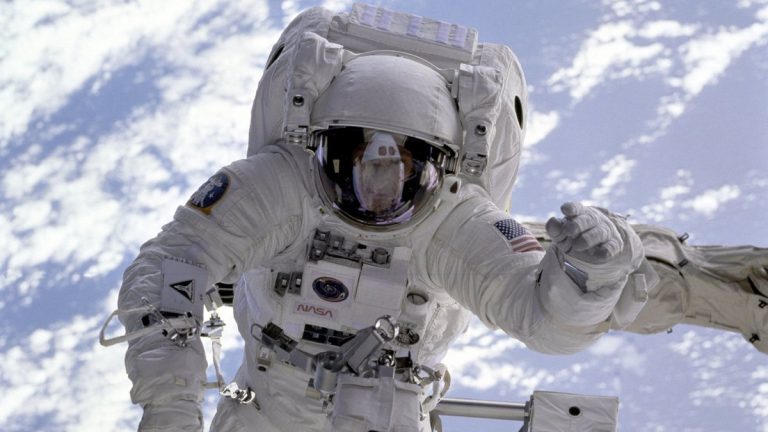
The assigned title angle highlights one operational consequence of those short nights: astronauts slept under six hours before 41 of 80 spacewalks. That detail fits the wider pattern reported in the paper, where short sleep repeatedly appeared before high-stakes work rather than only during quieter parts of a mission. When a crew member is scheduled for a demanding task outside the spacecraft, even a small drop in alertness can matter more than it would in a routine office day.
Sleep drugs were common in flight
The study also measured how often astronauts tried to compensate with medication. Among 78 shuttle-mission crew members who reported drug use, 61, or 78 percent, said they took a sleep-promoting drug on 500 of 963 nights, which came to 52 percent of those nights. Among 16 ISS crew members who reported drug use, 12, or 75 percent, used the same kind of medication during their missions.
Those figures stand out because the paper was not describing rare emergency use. Medication use was woven into normal mission life for many astronauts. The researchers did not present sleep drugs as proof of failure or misuse. They treated the pattern as evidence that crews and flight surgeons were working around a stubborn operational problem that mission design had not solved.
Hypnotic drugs can help someone fall asleep, but they do not erase every risk tied to short rest. Some medications can leave residual grogginess, especially if sleep is cut short again by schedule demands. Earlier work cited by the paper, including a 1999 study on pharmaceutical use by US astronauts, had already shown how common onboard medication was. The 2014 results added stronger, longer, objective sleep tracking to that concern.
Why short sleep worries flight teams
Chronic sleep loss is not only about feeling tired. It can slow reaction time, weaken sustained attention and make judgment less consistent across a long work period. A 2005 Journal of the Experimental Analysis of Behavior study on crewmember performance before, during and after spaceflight showed that space missions can stress the mental systems needed for precise work. The new sleep study did not test every mission error directly, but it sat on top of a larger body of evidence linking sleep restriction with performance decline.
The authors were careful with their wording, yet their warning was direct. In the abstract they wrote, “Because chronic sleep loss leads to performance decrements, our findings emphasise the need for development of effective countermeasures to promote sleep.” That sentence is one reason the paper still gets cited in discussions of mission safety, workload design, lighting and fatigue management for longer exploration missions.
The stakes rise further when missions grow longer and more autonomous. Ground simulations such as the 520-day Mars-500 mission study have already reported altered sleep duration and timing under prolonged confinement. A trip to Mars would add long communication delays, repeated critical operations and far fewer chances to lean on real-time support from Earth. In that setting, a sleep problem that begins in training and continues in flight becomes part of the mission architecture, not a minor comfort issue.
What the study can and cannot answer
The paper was an observational study, which means it described what happened without assigning crews to experimental sleep schedules. That design makes it strong for measuring real mission life and weaker for proving which single factor caused each short night. The study also used actigraphy rather than full laboratory polysomnography, so it estimated sleep from movement and logs instead of measuring every brain-wave stage.
Even with those limits, the dataset was unusually broad for human spaceflight research: 1063 in-flight days from shuttle missions, 3248 in-flight days from ISS missions and 4014 ground-based days. Few astronaut sleep papers have covered that many crew members over that many days while comparing several phases of mission life in a consistent way. The size of the dataset is a large part of why the results remain influential.
The study did not claim that every astronaut was impaired, that every drug use episode was unsafe, or that one countermeasure would solve the issue. It did show that short sleep was common before launch, common during flight and still visible across both short-duration and long-duration missions. For a field that depends on exact timing, steady concentration and physically demanding work, that is a serious operational finding. The message is simple: protecting crew sleep deserves the same engineering attention as many other mission systems.