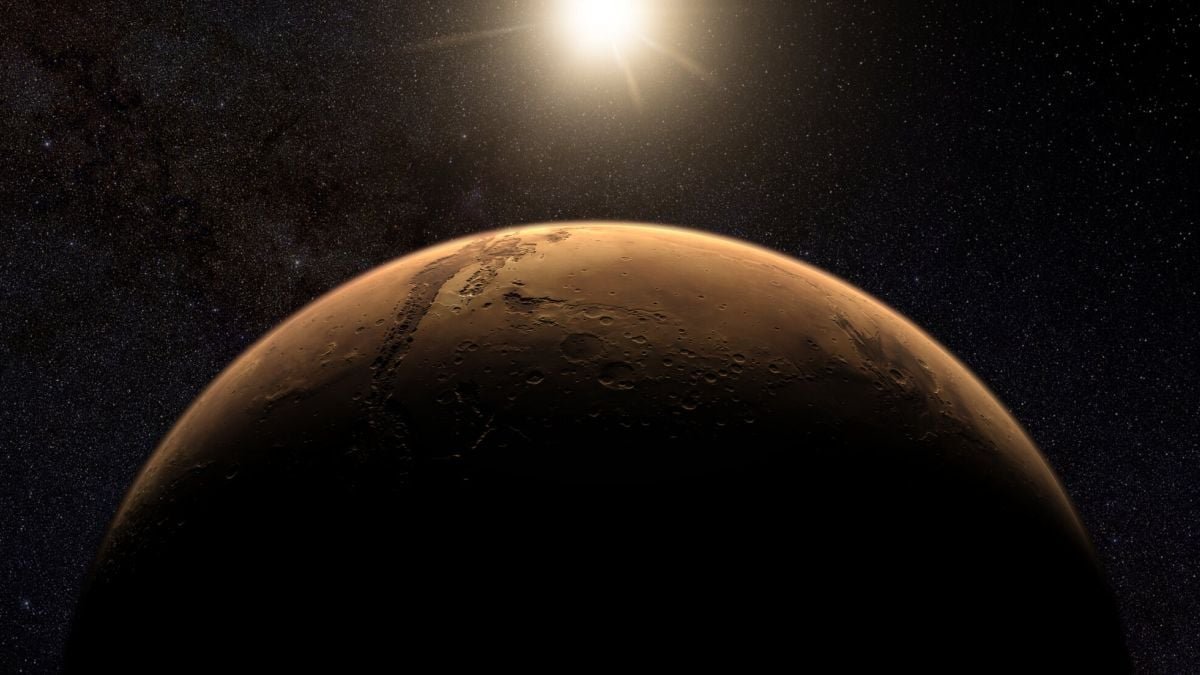
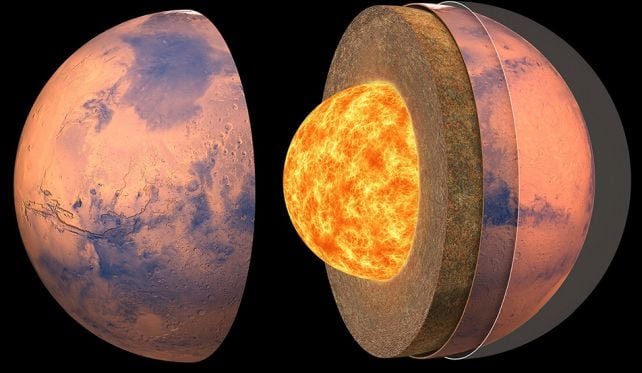
A study in Nature Astronomy reports a roughly 14-kilometer-thick layer deep in the Martian crust that may be the leftover base of a vast ancient magma system. Using seismic waves recorded by NASA’s InSight lander, the research team found evidence that Mars once stored, sorted and modified molten rock through a deep crustal plumbing network.
The discovery changes the way scientists can picture the Red Planet’s interior. Mars has long been treated as a world whose volcanic history was simpler than Earth’s. The new work suggests its crust may preserve the signature of long-lived magmatism, even though Mars lacks Earth-style plate tectonics.
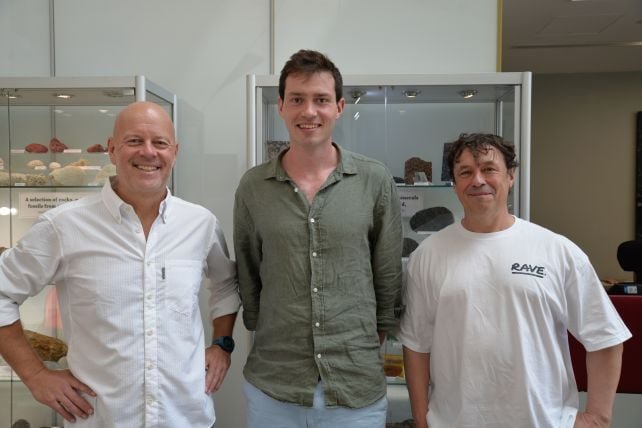
Led by Tobermory Mackay-Champion and colleagues, the team combined InSight seismic data with rock physics, thermodynamic modeling and statistical tests. Their goal was to explain a puzzling boundary far below the lander, where seismic waves seemed to move through unexpectedly dense and unusual rock.
Mars shows signs of deep magma plumbing
Mars still carries the scars of a fiery youth. Giant volcanoes tower over its surface, lava plains spread across broad regions and ancient crustal rocks preserve a record of the planet’s early heat. Yet the machinery that built that crust has remained hard to pin down.
The new study points to transcrustal magmatism, a process in which magma moves through and interacts with much of a planet’s crust. On Earth, such systems can store molten material at different depths. They also allow minerals to separate, melts to evolve and crustal rocks to become chemically diverse.
For Mars, that idea matters because the planet operates under a stagnant lid. Its outer shell does not cycle through plate tectonics in the same way Earth’s crust does. Even so, the InSight measurements suggest that Mars may have built complex crust through deep magmatic processing.
In simple terms, the planet may have had a hidden plumbing system. Mantle-derived magma could have risen into the crust, cooled in stages and left behind layers with different mineral makeups. Over time, those processes may have created a lower crust that looks far more organized than scientists expected.
NASA’s InSight data exposed a strange boundary
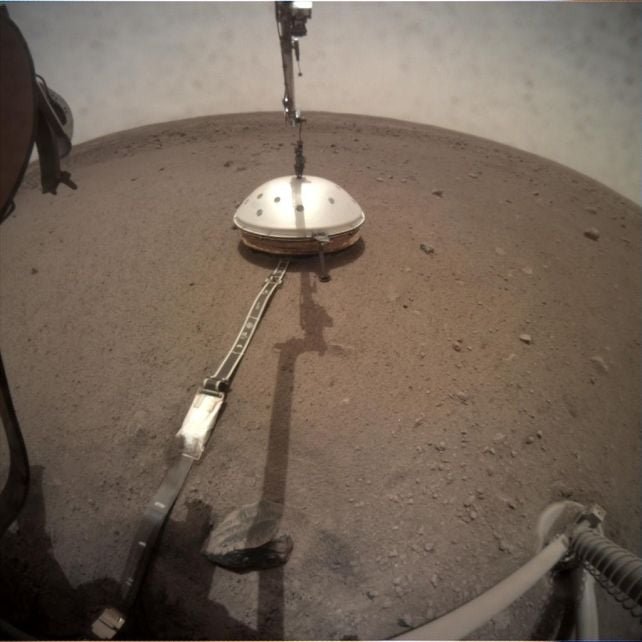
NASA’s InSight lander gave scientists their first detailed listen to the interior of Mars. After landing in Elysium Planitia, the mission recorded seismic vibrations from marsquakes and impacts. Those signals became a kind of planet-scale medical scan.
Seismic waves change speed as they pass through different materials. Dense rocks, fractured rocks, hot rocks and mineral-rich layers all leave clues in the way those waves travel. By measuring arrivals at InSight, researchers could infer the layered structure beneath the landing site.
Earlier analyses identified a boundary roughly 20 to 24 kilometers below the surface. Below it, seismic wave speeds were higher than expected for a simple Martian crust. The new study focused on what that boundary actually represents.
The team tested possible rock compositions against the seismic observations. The upper part of the lower crust matched mafic rock, which is relatively rich in magnesium and iron and has more silica than deeper ultramafic material. The deeper layer matched ultramafic rock, which is richer in iron and magnesium and poorer in silica.
That split gave the boundary a geological meaning. It may mark the place where two different crustal layers meet, both shaped by ancient magma that cooled and separated below the surface.
A 14-kilometer layer points to ancient magma sorting
The most striking result sits at the base of the crust. The study interprets the lowermost layer as a roughly 14-kilometer-thick zone of melt-depleted cumulate rock. In plain language, it may be the dense residue left after magma shed some of its melt.
This process is easy to picture. In a large magma reservoir, heavy crystals can sink while lighter melt rises. The leftover material becomes enriched in dense minerals. The melt above can become more silica-rich and chemically evolved.
According to Mackay-Champion, the scale of the inferred layer was a surprise. “Explaining a roughly 14-kilometer thick ultramafic zone at the base of the crust required a much larger magmatic system than we had initially expected.”
The team used thermodynamic modeling to test how such rocks could form under Martian conditions. Their results indicate that ordinary background heat would have struggled to produce the observed layer. Elevated heat flow appears to be needed, likely involving mantle upwelling and magmatic intrusion.
That conclusion gives the seismic boundary a deeper history. It suggests a period when heat and magma moved through the crust, creating a vertically linked system. The layer beneath InSight may be a frozen trace of that ancient activity.
Mars may have built complex crust without plate tectonics
Earth’s most familiar route to complex crust involves plate tectonics. Plates collide, sink, melt and recycle material through the mantle. That motion helps create chemically evolved rocks and broad volcanic systems.
Mars followed a different path. Its crust formed under a stagnant lid, with limited recycling at the surface. The Nature Astronomy study suggests that deep magma storage and differentiation can still produce complexity in that setting.
The key is time and heat. If magma remains stored within the crust long enough, minerals can separate and melts can change composition. New magma can enter the system and mix with older material. Surrounding crust can also be heated and partly melted.
The study’s interpretation places Mars closer to Earth in one important respect. Both planets may be capable of building chemically diverse crust through vertically connected magma systems. For Mars, the process appears to have happened inside a planetary shell that stayed largely intact.
That makes the Red Planet a valuable natural laboratory. It preserves ancient crustal architecture that Earth has often erased through tectonic recycling. Mars may therefore keep a clearer record of early rocky planet evolution.
The finding could widen the search for habitable worlds
The InSight lander measured only one site directly. It sat in Elysium Planitia for its entire mission, so the clearest seismic constraints come from the crust beneath that location. Even with that limitation, the broader geological setting makes the finding more intriguing.
Similar seismic boundaries have been reported far from the landing site. Mineral evidence across Mars also hints at evolved magmatism in multiple regions. Together, those clues suggest that the process identified below InSight could have reached beyond a single patch of crust.
“Taken together, these observations suggest that the crustal differentiation processes identified beneath InSight may have operated across broad regions of Mars,” Mackay-Champion said.
The possible link to habitability comes from what long-lived magmatic systems can do. They move heat. They help cycle volatile materials. They can create chemically varied environments where water, rock and heat interact. Those ingredients often sit at the center of discussions about habitable planets.
The study leaves open the biological question. It points to geological processes associated with habitable environments and shows that some of them may arise on planets with stagnant outer shells. “Habitability may be achievable in a wider range of planetary settings than we once assumed,” Mackay-Champion said.
For planetary scientists, the message is broad. A planet can lose its surface water, grow cold at the surface and still preserve evidence of a more dynamic interior past. Mars may have carried deep heat and complex magmatism long after its early formation.
Future missions could test how widespread these layers are. A network of seismometers would let scientists compare crustal structure across different provinces. More returned samples from ancient volcanic terrains could also reveal whether magmas evolved through deep, long-lived storage.
For now, NASA InSight has turned faint Martian rumbles into a new view of the Red Planet’s hidden architecture. Beneath the dry and dusty surface, Mars may hold the frozen memory of a vast magma system that once reshaped its crust from below.