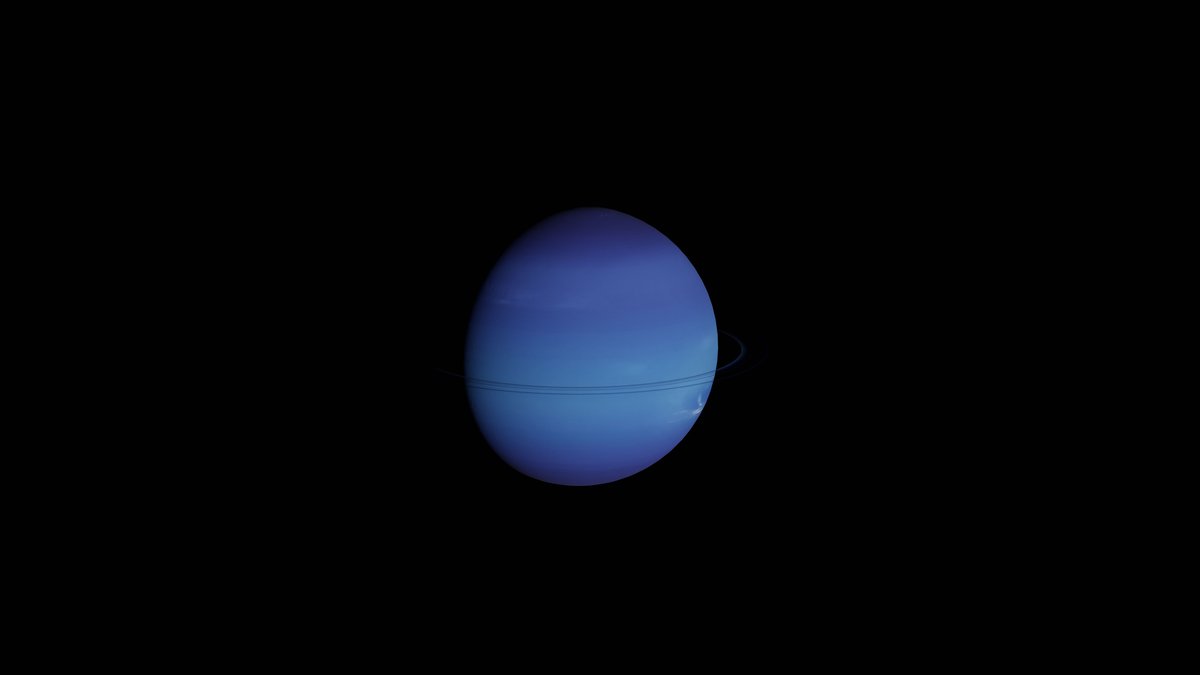
Researchers at the University of California, Los Angeles used computer models to test a hotter view of the solar system’s two outer planets. Their arXiv study, submitted to The Astrophysical Journal, proposes that Uranus and Neptune may contain enormous hydrogen-rich magma oceans below their familiar blue clouds.
The idea could reshape how scientists picture these distant worlds. Uranus and Neptune have long been grouped as ice giants because models often place a deep mantle of water, ammonia and methane beneath their hydrogen-helium atmospheres. The new work suggests that their measured size, density, gravity, heat flow and atmospheric chemistry can also fit a planet built around molten rock mixed with hydrogen under extreme pressure.
This is still a model result and the paper is a preprint. Even so, it tackles a real planetary mystery. Voyager 2 remains the only spacecraft to have visited Uranus and Neptune, with flybys in 1986 and 1989. Since then, scientists have had to infer most of what lies inside them from distant measurements and theoretical calculations.
A hotter interior for the solar system’s outer planets
Deep inside Uranus and Neptune, the new model places a supercritical magma ocean. In that extreme state, materials behave in ways that can blur the everyday boundary between liquid and gas. Temperatures and pressures are far beyond anything found at Earth’s surface.
The study describes possible “interiors comprising supercritical, hydrogen-rich magma oceans overlain by H2-rich envelopes,” according to its abstract. In plain language, that means a vast inner region of molten silicate material could sit beneath an outer envelope rich in hydrogen.
That picture gives the two planets a more active interior than their cold appearance suggests. Uranus and Neptune receive little sunlight at their great distances from the Sun. Their cloud tops look frigid, blue and remote. A planet’s surface appearance can hide a very different story far below.
The researchers argue that a magma-rich interior could reproduce several observed properties with a relatively simple set of fitting parameters for each planet. These include their radii, bulk densities, gravitational harmonics, moments of inertia, intrinsic luminosities and atmospheric compositions.
Why the old ice-rich model has struggled
The ice giant label has a technical meaning in planetary science. It refers to a planet enriched in volatile compounds that astronomers call ices, including water, ammonia and methane. Those materials can exist in dense fluid states inside giant planets.
Traditional interior models often give Uranus and Neptune three broad layers. A hydrogen-helium atmosphere sits on top. A large volatile-rich mantle lies below it. A rocky core occupies the deepest region. That framework has been useful, but several observations have kept the debate open.
One puzzle involves the planets’ magnetic fields. Uranus and Neptune both have magnetic fields that are tilted and offset in unusual ways compared with Earth’s more centered magnetic field. Interior structure matters because magnetic fields are generated by electrically conducting material moving deep inside a planet.
Another issue involves heat. Neptune radiates much more internal heat than it receives from the Sun. Uranus gives off surprisingly little internal heat by comparison. Any model of their interiors has to account for how heat moves through the planet and how much energy escapes to space.
The UCLA-led model explores whether a boundary layer between the outer envelope and deep magma ocean could influence that heat transport. A stable layer can slow the movement of heat from the deep interior, changing how a planet cools over billions of years.
The proposed layers inside Uranus and Neptune
At the top of the proposed structure is a hydrogen-helium atmosphere. This outer region carries heat upward and radiates energy into space. It is also the layer astronomers can study most directly through telescopes and spacecraft measurements.
Beneath that atmosphere, the model places a boundary region containing hydrogen, helium, magnesium, silicon monoxide and oxygen. This layer is important because it may be stable against convection. Convection is the churning motion that moves heat through fluids, much like hot soup circulating in a pot.
Below the boundary region lies the magma ocean. The study describes it as a deep mixture of silicate, iron and hydrogen. Silicates are rock-forming materials that dominate much of Earth’s mantle. Inside Uranus and Neptune, they would exist under crushing pressures and intense heat.
The word ocean may sound familiar, but this proposed ocean has little in common with seas on Earth. It would be a deep planetary layer made from molten or supercritical material. It would sit under conditions where chemical reactions and material properties can differ sharply from laboratory experience.
The model also gives scientists a way to connect the planets’ interiors to their atmospheres. If hydrogen interacts with molten rock at depth, that chemistry could help shape the gases seen higher up. That link is one reason the paper treats interior structure and atmospheric composition together.
What magma oceans could explain
A magma-ocean model could help scientists address several measurements at once. The most valuable models in planetary science usually explain more than one feature. Uranus and Neptune have known masses and radii, but many internal arrangements can produce the same outward size.
Gravity data offer another clue. A planet’s gravity field reflects how mass is distributed inside it. Voyager 2 measured key gravitational properties during its brief encounters and modern models continue to use those data. The UCLA-led study uses such constraints to test whether magma-rich interiors can match the planets’ observed structures.
Heat flow is also central. A stable boundary layer above a deep magma ocean could act as a thermal gate. It may allow some heat to escape while storing or slowing heat from deeper layers. That kind of structure could matter for explaining why Neptune shines with strong internal heat while Uranus appears unusually faint in its own heat output.
The model could also help explain atmospheric chemistry. Uranus and Neptune both have hydrogen-rich outer envelopes with methane contributing to their blue coloration. The paper argues that interactions between hydrogen and molten silicate material may set chemical conditions that later appear in observable atmospheres.
Because the study is based on modeling, it gives a possible solution rather than a final measurement. Better gravity data, magnetic field mapping, atmospheric sampling and heat-flow measurements would be needed to sort among competing interior models.
A nearby clue to distant sub-Neptunes
Across the galaxy, planets somewhat larger than Earth and smaller than Neptune are extremely common. Astronomers often call them sub-Neptune exoplanets. They range widely in mass and radius and many appear to have thick atmospheres.
Our solar system lacks a close match to those worlds. That makes Uranus and Neptune especially valuable. They are accessible compared with planets around other stars and they may preserve clues about how gas-rich rocky planets form and evolve.
The study links Uranus and Neptune to a broader class of gas dwarf planets. If their interiors contain hydrogen-rich magma oceans, they could serve as local examples for processes that may operate inside many sub-Neptunes. Those processes include hydrogen mixing with molten rock and changing the chemistry of the atmosphere above.
This connection matters because exoplanet observations often start with limited information. Astronomers may know a planet’s radius, mass, orbital period and some atmospheric signatures. Interior models then help translate those measurements into possible compositions.
A better understanding of Uranus and Neptune could sharpen those translations. If nearby planets with measured gravity fields and atmospheric chemistry can be modeled as magma-ocean worlds, similar physics may be relevant for distant planets that telescopes can only study as points of light.
Why a return mission matters
Voyager 2 transformed planetary science with its flybys of Uranus and Neptune. Those encounters also left scientists wanting more. Each flyby was brief and neither planet has ever been orbited by a spacecraft.
A dedicated orbiter could map gravity and magnetic fields in far greater detail. It could monitor weather and heat flow over time. A probe dropped into an atmosphere could directly measure gases and isotopes, which would help test competing ideas about formation and interior chemistry.
Several mission concepts have explored those goals, including a Uranus Orbiter and Probe and Neptune-focused mission studies. Such spacecraft would require long travel times and major investment. The scientific payoff could be broad, because the same mission would also study rings, moons, magnetospheres and atmospheric dynamics.
For now, computer models remain essential. They let scientists test how different ingredients and layers affect a planet’s size, density, heat and chemistry. The new UCLA-led work shows how a hotter interior could fit within the constraints already available.
The next step is evidence that can narrow the possibilities. Uranus and Neptune may look calm from afar, but their interiors could hold some of the solar system’s most important clues about planet formation. A future mission could tell scientists how much fire lies beneath those cold blue clouds.