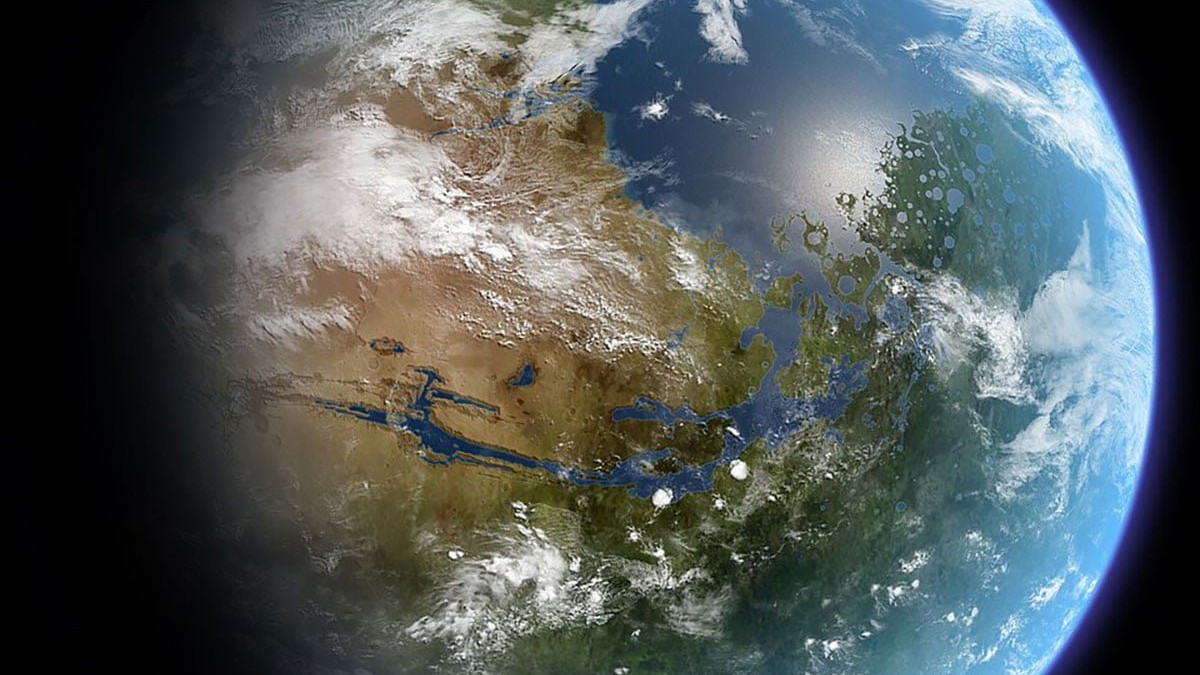
A study in APS Open Science tackles one of space exploration’s biggest questions with blunt arithmetic: making Mars broadly habitable would require planet-scale stores of gas, heat, water processing and industrial power. The analysis by Slava G. Turyshev of NASA’s Jet Propulsion Laboratory, California Institute of Technology, lays out why an Earthlike Mars sits far beyond present capability.
The paper treats Mars terraforming as an engineering problem with hard physical totals. Every proposed path has to supply pressure, warm the surface, make or import breathable gases and keep the new environment from collapsing back into the cold Martian state. Those requirements build quickly from impressive to staggering.
That makes the new work useful in a practical way. Instead of asking whether Mars could someday be altered, it asks how much mass and power each step would demand. The answer points toward smaller enclosed habitats as the realistic first chapter.
Mars has distant habitability milestones
The path to a gentler Mars begins with the planet as it is today. Mars is cold, dry at the surface and wrapped in an atmosphere so thin that astronauts would need full life support outside. Its average surface pressure is only a small fraction of Earth’s.
Turyshev’s analysis separates habitability into stages. One early milestone is reaching the triple point of water, about 6.1 millibars at 0 degrees Celsius. At that combination of pressure and temperature, water can exist as ice, liquid and vapor in equilibrium.
A later stage would allow pressurized agricultural zones under local covers. This approach is often called paraterraforming. It uses enclosed or semi-enclosed spaces to create livable pockets while the rest of Mars remains harsh.
Further along, Mars would need enough pressure to protect exposed humans from extreme low-pressure effects. The paper identifies 62.7 millibars as a key open-surface threshold because it corresponds to the pressure at which human blood no longer boils at body temperature.
The most ambitious target is an open, breathable atmosphere. That would require a large oxygen supply, a buffer gas such as nitrogen and much warmer surface conditions. Each milestone adds another planetary bill.
A thin atmosphere hides a giant mass problem
One number dominates the pressure problem. The study abstract states, “Mars requires 3.89 × 10^15 kg of atmosphere per millibar of global mean surface pressure.” That’s the cost of adding just one millibar across the entire planet.
Because Mars is a whole world, even modest pressure goals require immense inventories of gas. Human-relevant open-surface pressures move the requirement into the 10^17 to 10^18 kilogram range. That is asteroid or small-moon territory.
The reason is simple. Pressure comes from the weight of the atmosphere above the surface. Spread a gas over the full area of Mars and a small rise in pressure translates into a huge total mass.
The paper describes accessible native carbon dioxide as a limited resource for global transformation. A representative 20 millibar case could warm Mars by about 10 kelvin under present sunlight. That helps, yet it leaves the planet far from stable open-air habitability.
This is where optimism runs into inventory. Mars may contain useful stores of carbon dioxide and water ice. A breathable planet still needs enough gas to fill a sky and those totals dominate the calculation.
Warming Mars would demand vast climate engineering
Pressure alone cannot make Mars comfortable. The planet also needs a major temperature rise. Turyshev’s study estimates what it would take to push mean surface conditions toward the range where water melting becomes broadly relevant.
One option is to make the atmosphere better at trapping heat. Proposed agents include synthetic greenhouse gases, carbon dioxide mixtures with hydrogen and engineered particles that absorb sunlight or infrared radiation. Each mechanism has to be produced, delivered and maintained at vast scale.
Another idea uses mirrors in space. The paper finds that reaching meaningful warming through direct absorbed solar forcing could require reflector areas of roughly 10^13 to 10^14 square meters. That corresponds to tens of millions of square kilometers of reflective infrastructure.
Orbital reflectors also bring operational problems. They would have to be built or transported, positioned, controlled, repaired and protected over long periods. Mars dust, orbital dynamics and material aging would all matter.
The study’s strength is that it compares these ideas with shared physical yardsticks. It links temperature goals to forcing, atmospheric goals to mass and construction goals to throughput. That makes the scale visible.
Breathable air needs staggering oxygen and nitrogen
A human-friendly open atmosphere needs more than pressure. It needs the right composition. Turyshev’s paper estimates that a breathable endpoint with 21 kilopascals of oxygen and 50 kilopascals of nitrogen would require about 9.0 × 10^17 kilograms of oxygen and 1.9 × 10^18 kilograms of nitrogen.
Oxygen could in principle come from Martian water. Split water into hydrogen and oxygen, release the oxygen and keep doing that until the atmosphere reaches a breathable level. Mars appears to have enough accessible surface ice to make the idea physically meaningful.
The scale remains brutal. Producing that much oxygen would require processing vast quantities of water across the planet. The hydrogen would also need management, since it can escape easily into space.
Nitrogen is another challenge. On Earth, nitrogen dilutes oxygen and provides a buffer gas that helps make air breathable and safe. Mars has only small amounts in its present atmosphere, so a large nitrogen inventory may need to come from difficult sources or imports.
The atmospheric endpoint drives the conclusion. Biology or industry could change the route. The final breathable sky still has to contain the necessary mass of gases.
Energy becomes the hardest barrier
The oxygen calculation turns into an energy calculation. The paper estimates that water electrolysis for a breathable oxygen inventory would require reversible work of about 1.3 × 10^25 joules before losses and sink-management costs.
Spread over a millennium, that still implies power on the order of hundreds of terawatts. That is many times humanity’s current average global power use. Shorter schedules push the demand even higher.
Energy also appears throughout the rest of the system. Factories would need power to mine ice, process gases, build mirrors, synthesize greenhouse agents and maintain infrastructure. Industrial machines would have to run in a cold, dusty, low-pressure environment.
Then there is persistence. Mars can lose atmospheric gases to space and can lock gases into minerals or ice. Any long-term terraforming program would need to replace losses and counter chemical sinks.
For this reason, the paper frames terraforming as a throughput problem as much as a climate problem. A future civilization would need sustained planetary industry, high power generation and long-term control systems. The project would be measured across centuries.
Greenhouse habitats may come first
The most near-term route in the study points toward covered regions. The paper says, “Regional and covered-area habitability is the physically favored staged path.” That means enclosed habitats and greenhouse-like structures could deliver useful living space before a global atmosphere becomes possible.
Paraterraforming has several advantages. A structure can hold higher pressure inside while the Martian atmosphere remains thin outside. It can also trap heat locally and protect crops or equipment from the full outdoor environment.
On Mars, pressure differences can even help support certain greenhouse designs. A habitat at around 100 millibars would press outward against the low-pressure surroundings. With proper materials and engineering, that could help create large enclosed agricultural zones.
These local environments would still require energy, water, air handling, radiation protection and maintenance. Yet they avoid the need to fill an entire planet’s atmosphere at once. They also let engineers learn from smaller systems before attempting larger ones.
Turyshev’s analysis leaves Mars with its long-standing appeal. The red planet has water ice, sunlight, land area and scientific value. The new accounting gives that dream a sharper scale: the first habitable Mars may look like a network of engineered oases, while an Earthlike open world remains a far-future undertaking.