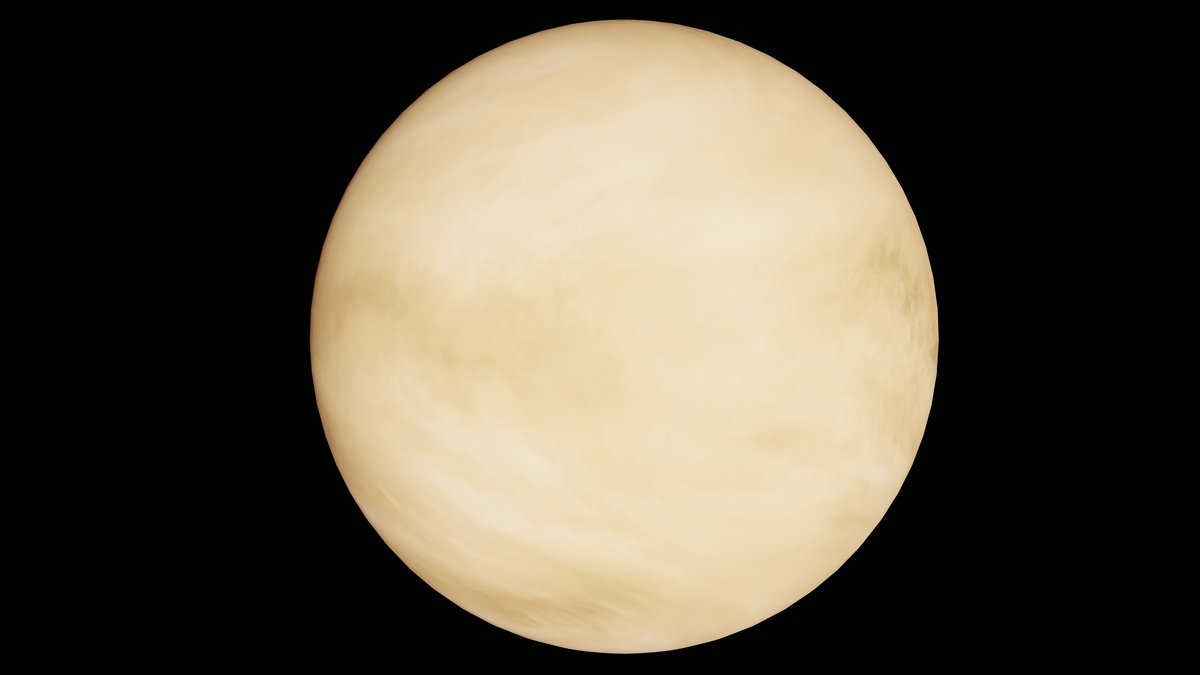
Researchers presenting a 2026 conference study have proposed a startling path for life in the inner Solar System. Their model suggests that impacts on Earth may have launched tiny pieces of life-bearing material into space, with some of that debris eventually reaching the clouds of Venus.
The work was presented at the 57th Lunar and Planetary Science Conference by a team with authors from Arizona State University, Johns Hopkins University Applied Physics Laboratory and Sandia National Laboratories. The result is an early-stage model, so it should be read as a possible pathway rather than proof that Venus is alive.
Even with that caution, the idea is powerful. Venus is often treated as Earth’s hostile twin because its surface is hot enough to melt lead. High above that surface, however, its clouds have long drawn attention from astrobiologists. If life ever turns up there, one possible origin story may begin on Earth.
A new route for life between worlds
Panspermia is the idea that life or life’s ingredients can move from one world to another. The paper describes it plainly: “Panspermia is the idea that life can originate on one planetary body and then be transferred to other bodies.”
That transfer would require a violent first step. A large asteroid or comet impact can blast rock and dust from a planet with enough force to escape into space. If that material contains hardy microbes or organic compounds, it could become a natural spacecraft.
Scientists have often discussed this possibility for Earth and Mars. Meteorites from Mars have been found on Earth, proving that rocks can travel between planets. The new study extends the question toward Venus, where the target for life would be the atmosphere rather than the surface.
The authors frame the idea with care. Material ejected from Earth would need to survive shock, heating, radiation and long exposure to space. Then it would need to enter Venus’ atmosphere in a way that leaves some fragments cool enough and small enough to linger in the cloud layer.
How impacts could launch microbes from Earth
Large impacts can turn a planetary surface into a spray of high-speed debris. Some fragments fall back down. Others enter orbit around the Sun. A small fraction can later cross another planet’s path.
For biological material, the journey is harsh. The first danger comes from the blast itself, which can crush and heat the material. After that comes interplanetary space, where radiation and extreme temperatures can damage cells and molecules.
The study builds on earlier work showing that these barriers can be survivable under some conditions. Rocks can shield material inside them. Organic compounds can persist through planetary ejection and spaceflight. The authors use that background to ask what happens when Earth-derived material reaches Venus.
Atmospheric entry adds another filter. Incoming rocks heat up as they slam into the air. Much of the material burns, melts, or vaporizes. In the team’s model, only a fraction remains cool enough to preserve possible cells or organic matter.
The key is fragmentation. If a bolide breaks apart in the right way, small particles can spread through the atmosphere. Those fragments would have a better chance of remaining suspended in the cloud region, where survival could last long enough to matter for astrobiology.
Why Venus’ clouds matter
The surface of Venus is one of the most punishing environments in the Solar System. Its thick atmosphere traps heat and the pressure at ground level is crushing. The clouds sit far above that furnace.
Those clouds are acidic and difficult for life as we know it. They also occupy a region with temperatures and pressures that have kept scientific interest alive for decades. Any discussion of modern Venus life usually turns to this high-altitude environment.
The conference abstract states the requirement clearly: “Once reaching Venus, microorganisms must be dispersed in or above the clouds if they are to retain the possibility of survival.” That single condition shapes the whole model.
To study the process, the team modeled how bolides behave as they enter Venus’ atmosphere. A bolide is a large meteor that produces an intense fireball. Its breakup can create smaller fragments that spread through the air.
The model focuses on whether some of those fragments could reach the right altitude and remain there. A short stay may still be meaningful. The team’s preferred estimate suggests that transferred life could be present in Venus’ clouds for at least a few days per century.
The Venus Life Equation
The researchers used the Venus Life Equation, a framework introduced in 2021 by Noam Izenberg and colleagues. It offers a structured way to think about the probability of living organisms on Venus today.
The equation is written as L = O x R x C. In this framework, L is the likelihood of extant life. O represents origination, R represents robustness and C represents continuity.
Origination asks whether life began on Venus or arrived there from somewhere else. Robustness asks whether a biosphere could survive changing conditions. Continuity asks whether habitable conditions lasted long enough to support life into the present.
For this study, the team focused on the arrival pathway. Earth could serve as a source if impacts launched microbe-bearing material into space. Mars could also be considered if life exists or once existed there.
The equation helps separate each uncertainty. That matters because every term carries large unknowns. A single optimistic assumption can change the final answer, so the authors treat the result as a way to explore possibilities rather than a settled measurement.
Billions of possible transfers
The numbers in the model are striking. Using earlier studies and their atmospheric-entry calculations, the researchers estimated how many Earth or Mars fragments could have reached the Venusian cloud environment over long spans of time.
The team used a pancake model to represent the breakup of an incoming object. In this approach, aerodynamic drag spreads fragments outward after an airburst. The cloud of debris becomes flattened, like a pancake of material moving through the atmosphere.
The researchers then considered several factors. They estimated the mass of incoming material, the portion that avoids destructive heating, the portion dispersed into small enough pieces and the fraction of cells that might adapt after arrival.
The preferred estimate points to about 100 cells dispersed through Venus’ clouds each Earth year. Over the past billion years, the model suggests roughly 20 billion cells may have been transferred from Earth. Larger ranges in the study allow for even higher totals under favorable assumptions.
Those figures sound dramatic, yet the final biological meaning remains uncertain. A delivered cell would still face acid droplets, limited nutrients and unfamiliar chemistry. Reaching the clouds is only one step in a much longer survival test.
What future Venus missions could test
Future Venus exploration could sharpen this question. Missions that measure cloud chemistry, particle structure and possible organic signatures would help scientists judge whether the atmosphere can support any Earth-like biology.
If a mission finds strong evidence for life in the clouds, origin will become one of the hardest questions. The organisms could have a Venusian history. They could also reflect transfer from another world. The new model gives researchers one way to evaluate the Earth-to-Venus route.
Sampling would be especially valuable. Cloud particles could reveal whether complex organics exist, how they are distributed and whether they show patterns associated with biology. Any claim about life would require careful checks against nonbiological chemistry.
The study also highlights a planetary-protection challenge. If natural impacts have moved material between worlds for billions of years, the inner Solar System may have a shared biological history in some scenarios. That possibility makes clean spacecraft handling and cautious interpretation even more important.
For now, the result leaves Venus with a provocative new question. Earth may have spent billions of years quietly throwing tiny biological messages toward its neighbor. Whether any of them found a place to persist remains one of the most intriguing problems in planetary science.